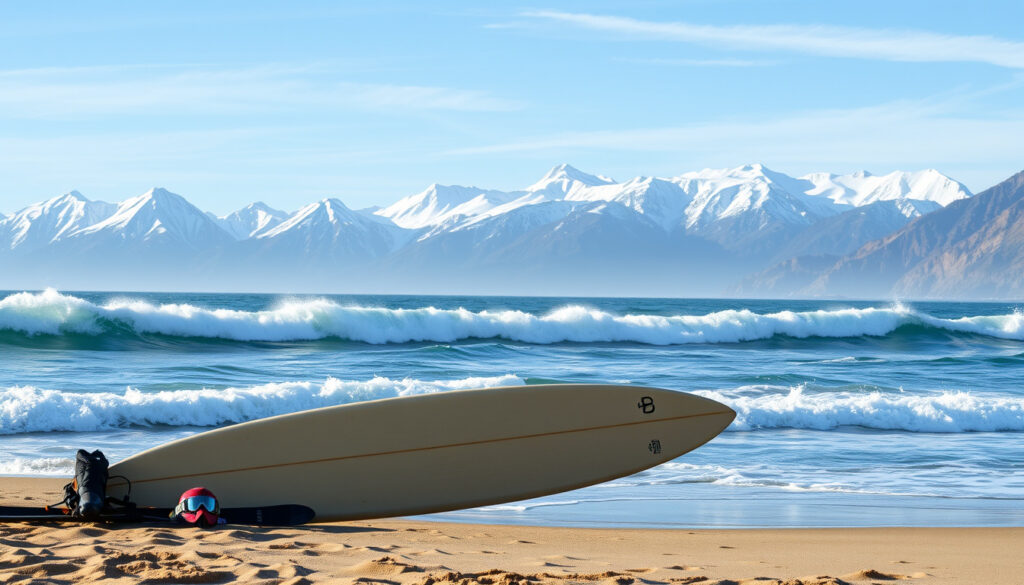
Canterbury Winter Snow Surfing: Surf and Ski Same Day Guide
There aren’t many places on the map where you can ski before lunch and paddle into the surf after it, with no flight in between — Canterbury, New Zealand, is one of them. Mount Hutt sits about 90 km southwest of Christchurch, while New Brighton Beach is a 15-minute drive from the city centre.
Distance to nearest ski field: 90 km (Mount Hutt, ~1.5 h drive) ·
Winter water temperature: 10°C (50°F) ·
Typical winter wave height: 1–3 m (3–10 ft) ·
Surfable beaches: 20+ ·
Surf season peak: May–September
Quick snapshot
- Mount Hutt is the closest ski field to Christchurch (MetService (national weather service))
- New Brighton is the closest surf beach to the city (WeWave (Canterbury surf guide))
- Winter water temperatures at Canterbury breaks average about 10°C (Surf Seeker (NZ surf break guide))
- Exact drive times to the ski fields change with road conditions, traffic and chain requirements; snow can settle as low as 200 metres in some systems (NZTA Journey Planner (official road alerts))
- June–August is the core winter window when snow depths and Southern Ocean swells both peak (RNZ (public broadcaster))
- June 2025: RNZ (public broadcaster) reported a Canterbury snow warning for areas south of the Rangitata River, with 15–25 cm forecast above 500 metres
- Winter advisories repeatedly put snow on Porters Pass, Lewis Pass and Burkes Pass (RNZ (public broadcaster))
- Carry chains, warm clothes, food, water and enough fuel or battery range for detours — Civil Defence’s winter checklist (Chris Lynch Media (Canterbury news outlet))
- Watch NZTA journey alerts before you leave; Canterbury’s alpine highways include State Highway 73, 7, 8 and 80 (Chris Lynch Media (Canterbury news outlet))
Five figures, one pattern: winter in Canterbury is a cold-water, cold-air proposition, and the numbers stay manageable when you prepare for both sides of the mountain.
| Metric | Winter value |
|---|---|
| Closest ski field | Mount Hutt (90 km / 1.5 h) |
| Closest surf beach | New Brighton (10 km / 15 min) |
| Winter water temperature | 10°C (50°F) |
| Typical winter wave height | 1–3 m (3–10 ft) |
| Winter air temperature range | 0–10°C (32–50°F) |
Where is the closest snow to Christchurch?
The nearest serious ski field to Christchurch is Mount Hutt, about 90 km southwest of the city — close enough that a pre-dawn start still leaves time for an afternoon surf. Most drivers allow 1.5 hours from the city centre, and the route climbs through foothills before the road starts to work. When severe winter outbreaks hit, RNZ (public broadcaster) names the same passes — Porters, Lewis and Arthur’s Pass — as the places where snow settles first.
- Porter Heights, Craigieburn Valley and Temple Basin are the other club fields within about two hours of Christchurch.
- All sit behind the alpine routes that NZTA treats as high-risk in winter, including State Highway 73, 7, 8 and 80 (NZTA (national transport agency)).
Canterbury snow sits behind passes, not at the city limits. Snow and flooding have at times hit southern highways at the same time (Chris Lynch Media (Canterbury news outlet)), turning a simple ski drive into a full day of route changes.
The pattern: the snow is genuinely close, but it is guarded by passes where a fine morning can become a chain-fitted crawl by lunch.
What is the 12 second rule in surfing?
The 12-second rule is a timing habit surfers use to read an unfamiliar break. You count the gap between wave sets; when the gap sits around 12 seconds, you treat it as a short, workable window for paddling out.
- Count the seconds from the last wave of one set to the first wave of the next.
- Use the number to judge how much time you have before the next set arrives.
- In longer-period swell — the kind Southern Ocean winter systems send to Canterbury — each wave carries more energy and lulls stretch further.
In Canterbury winter, long-period Southern Ocean swells are the norm, so the 12-second count is a safety check, not a trivia fact. Bigger gaps between sets mean bigger waves when they arrive.
The takeaway: the rule is a habit, not a law. In 10°C water, misreading a paddle-out window costs more than a clean-up set.
Do surfers surf in winter?
Yes — and in Canterbury, winter is often the season locals wait for. WeWave (Canterbury surf guide) describes the region as generally best from autumn through winter into early spring, when Southern Ocean southerly swells arrive more often.
That consistency comes with a cold-water price. Surf Seeker (NZ surf break guide) calls at least a 4×3 steamer the baseline for Canterbury, and winter locals usually go thicker: 5/4mm or 6/5mm suits, plus booties, gloves and a hood.
- 5/4mm or 6/5mm wetsuit for winter dawn sessions.
- Boots, gloves and a hood — the difference between a two-hour session and a fifteen-minute one.
- Spare thermal layer for the drive home.
At 10°C water temperature, a leaky suit doesn’t just ruin a session — it ends one. The gear list, not the swell, is what separates winter surfers from summer visitors.
The answer is yes, but with a qualification: winter surf in Canterbury is not a mild version of summer. It is a different sport with a longer gear list and a deep respect for the forecast.
Where is the best surf spot in Christchurch?
Ask three local surfers and you’ll get three answers, but the shortlist is stable.
- New Brighton: the closest and most consistent beach break, with a wide peak and easy access.
- Taylors Mistake: a point break with left and right rides that handles winter swell well (Surf Seeker (NZ surf break guide)).
- Sumner and Scarborough: sheltered corners that suit smaller days and newer surfers.
What are some hidden gems in Christchurch?
- Lyttelton Harbour breaks: sheltered corners that can hold a big southerly swell.
- Waimakariri rivermouth: shifting sandbar peaks that are usually quieter than the city beaches.
Neither is the kind of spot you’ll find on a postcard, and both reward surfers who read the tide before they paddle out.
The implication for visitors: New Brighton is the reliable default, and Taylors Mistake is worth the extra drive when the swell has size. The hidden spots stay hidden because they need local knowledge to read.
Where is the best surfing in New Zealand?
New Zealand’s surf map keeps returning to the same short list: Raglan for long left-handers, Taranaki for reefs, Gisborne for east-coast power and Canterbury for winter consistency.
- Raglan: world-class left-hand point breaks on the North Island’s west coast.
- Taranaki: exposed reefs that hold size well.
- Gisborne: powerful beach and point breaks on the East Cape.
- Canterbury: consistent Southern Ocean swells, cold water and uncrowded lineups.
Within Canterbury, WeWave (Canterbury surf guide) notes that north-facing beaches such as Leithfield and Amberley get the full benefit of winter south-west swells, with longer rides and fewer crowds than the city breaks.
What this means: if consistency and elbow room matter more than warm water, Canterbury belongs in the national conversation. It just asks for a thicker wetsuit than Raglan does.
What is the closest beach to Christchurch?
New Brighton Beach, 10 km east of the city centre, is both the closest beach to Christchurch and the city’s default surf beach.
- New Brighton: about 10 km and 15 minutes by car, with a long sandy beach and the city’s most famous pier.
- Sumner: roughly 12 km away, tucked behind the cliffs and more sheltered when the swell is big.
- Southshore: about 14 km away, at the southern end of the spit, with a quieter local feel.
The trade-off: the closest beach is also the busiest. On a clean winter day with snow on the Port Hills, the New Brighton car park fills early — get there before the lunch crowd.
How to Plan a Same-Day Surf and Ski Run
The same-day combo is more logistics than athleticism. The sequence that works for most people: ski first while the alpine passes are at their best, then let the afternoon breeze groom the surf while you drive back to the coast.
- Check the forecast the night before — the MetService Canterbury High Country pages track freezing levels (MetService (national weather service)), and a surf report tells you whether the coast is 1 m or 3 m. If either number looks marginal, swap the order or move the date.
- Pack both kits in one go: ski or snowboard gear, plus a 5/4mm or 6/5mm wetsuit, boots, gloves and a hood. Forgetting the wetsuit is the only failure mode that costs you the whole afternoon.
- Load the emergency kit before you leave the city. Civil Defence advice for Canterbury snow routes includes snow chains, warm clothes, food, water and enough fuel or battery range for a detour (Chris Lynch Media (Canterbury news outlet)).
- Drive early and watch NZTA’s winter risk list, which includes State Highway 73, 7, 8 and 80 (NZTA (national transport agency)).
- Set an exit time on the mountain; leave by mid-afternoon so the drive back lands you at New Brighton or Taylors Mistake with enough light for a session.
- Run the 12-second count before you paddle out. In cold water, a clean paddle-out matters more than finding the perfect peak.
The biggest enemy of a same-day run is daylight, not cold. Canterbury winter days are short, so a late start on the mountain can push the surf session into dusk — and the passes get colder and more unpredictable as the light goes.
The plan works when the passes cooperate and the gear is packed the night before. That is the difference between a story and a rescue call.
Timeline signal
Winter in Canterbury runs on a reliable clock: swells build from May, snow deepens through July and August, and road alerts follow every cold front.
- May–September: Canterbury’s surf season, with the most consistent swells in winter.
- June–August: the core window when ski fields and the surf coast are both in prime condition.
- July 2026: NZTA warned of 10-plus centimetres of snow around Burkes Pass to Lake Tekapo, with Porters Pass, Lewis Pass and Arthur’s Pass also at risk.
The signal: when a cold front crosses the South Island, the mountain passes and the surf coast respond at the same time. That is exactly when the same-day plan becomes worth it — and exactly when the roads can close.
What’s Clear vs. What’s Unclear
Confirmed facts
- Mount Hutt is the closest ski field to Christchurch.
- New Brighton is the closest surf beach.
- Winter water temperatures average about 10°C, so cold-water gear is required.
- Alpine routes in Canterbury regularly receive snow warnings in winter.
What’s unclear
- Exact drive times vary with traffic, weather and chain requirements.
- Daily wave heights depend on the swell and wind angle.
- The 12-second rule is a guideline, not a measurement.
- Snow levels range from roughly 200 metres to 400–500 metres depending on the system (Otago Daily Times (South Island newspaper)).
- Which beach is cleanest depends on the swell direction and tide.
The pattern: the confirmed list is enough to commit to winter trips, and the unclear list is exactly what the official alerts are designed to manage. Use one to decide whether to go, and the other to decide when.
What Local Agencies Tell Winter Travelers
The most useful advice about a Canterbury winter day comes from the agencies that manage the roads and mountains.
“Snow and ice advisories in Canterbury call for drivers to reduce speed, increase following distance, and avoid sudden braking or turning.”
“Arthur’s Pass National Park can receive over 5–10 metres of snow in the high alpine areas during winter and spring.”
“Canterbury High Country forecasts explicitly track freezing levels, which are critical for winter road and snow planning.”
The thread through all four: Canterbury winter is manageable when the alerts are treated as part of the itinerary. The agencies are effectively writing the snow-and-surf checklist for you.
Put together, Canterbury offers a rare practical version of the snow-and-surf dream: a morning in alpine snow and an afternoon in cold Pacific swell, with no flight in between. The risk is not the cold or the drive — it’s ignoring the warning system. For anyone planning a Canterbury winter day, the choice is clear: pack for both sides of the mountain, check MetService and NZTA before dawn, and turn around when the passes say so — or spend the afternoon reading weather alerts instead of riding waves.
Frequently asked questions
Can you really surf and ski in the same day in Christchurch?
Yes, with an early start. Mount Hutt is about 90 km from the city and New Brighton Beach is around 15 minutes from the centre, so the practical order runs mountain first, surf second. The passes have to cooperate, so check road alerts before you commit.
What wetsuit thickness is recommended for winter surfing in Canterbury?
A 4×3 steamer is the commonly cited minimum for Canterbury, and most winter locals use 5/4mm or 6/5mm suits with boots, gloves and a hood. At 10°C water, the extra neoprene is the difference between a short session and a proper one.
Are there surf lessons available in Christchurch during winter?
Lessons run through winter at New Brighton and Sumner, usually on smaller days when teaching conditions are safer. Ask the surf schools about winter availability and wetsuit hire, because the schedule depends on swell and student demand.
What is the best time of year for a snow-and-surf combination?
June through August is the core winter window. Canterbury’s surf season peaks from May through September, which lines up neatly with the ski season, so a same-day run is most reliable in mid-winter.
How do road conditions affect access to ski fields from Christchurch?
Snow can settle as low as 200 metres in some Canterbury systems, and passes like Porters, Lewis and Burkes regularly go under winter warnings. Carry chains, warm clothes and an emergency kit, and be ready for delays or detours.
What are the best surf breaks for beginners in winter?
Sumner and Scarborough are the usual first pick because they are more sheltered, and New Brighton works on smaller days. Pick a day under 1 m of swell and check the wind direction before paddling out.
Is it safe to surf alone in winter in Canterbury?
Cold water changes the risk calculation. At 10°C, a solo surfer has no margin for error if the leash snaps or the paddle-out takes too long. Surf with someone else, keep the right wetsuit on, and stay within sight of the beach.
The short version: everything in these answers points back to the same formula — check the forecast, pack for cold water and snow, and respect the passes.
Related reading
More related posts
 Carpal Tunnel Syndrome Symptoms – Early Signs and When to See a Doctor
 Auckland Airport Valet Parking: Rates, Booking & Guide (2025)
 Vitamin D3 and K2: Benefits, Dosage, and Safety
 Used Cars for Sale in Christchurch, Dorset: 6k+ Listings
 Movies Coming Out in 2025: Full Schedule & Most Anticipated
 Free Xero Accounting Course: Get Certified Without Spending a Penny
 Best Automatic Cat Feeder NZ: Reviews, Prices & Buying Guide
 When does spring start in NZ? Both dates explained