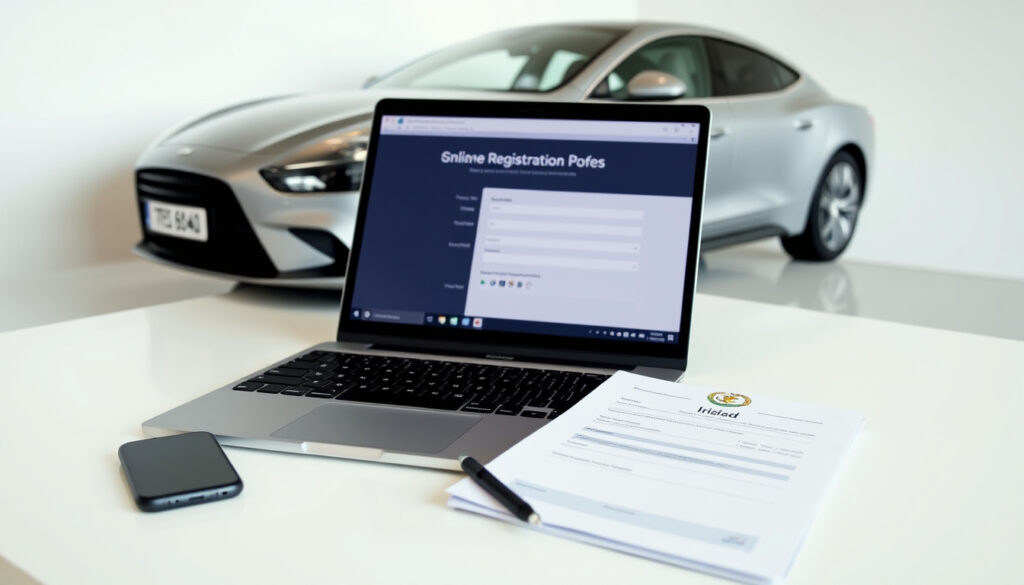
Change of Ownership Car in Ireland: How to Transfer Online
Selling or buying a car in Ireland used to mean a trip to the post office, a lot of form-filling, and a nervous wait for confirmation. Since September 2024, the Department of Transport’s new online service has turned that into a digital process that takes minutes. Here’s exactly how it works, what documents you need, and what to do in trickier situations like dealing with a pre-1993 vehicle or a deceased owner.
Online transfer fee: Free · Processing time: Instant · Required document: Vehicle Registration Certificate (VRC) · Service availability: 24/7
Quick snapshot
- Online transfer available at vehicleservices.gov.ie (official government portal)
- Service launched September 2024, free and instant (Department of Transport press release)
- Buyer needs a verified MyGovID account (MotorCheck consumer guide)
- Both parties must consent; seller receives a 30-minute Transfer PIN (MotorCheck consumer guide)
- Exact paper-transfer fee varies by local authority (ODO guide to change of ownership)
- Process for pre-1993 vehicles may differ across counties (ODO guide to change of ownership)
- Deceased owner cases depend on specific inheritance circumstances (Citizens Information guide)
- September 2024: official online CVO service goes live (gov.ie press release)
- Before 2024: only paper/postal transfer available (its4women guide to car ownership change)
- New VRC posted to buyer’s address after online transfer (MotorCheck consumer guide)
- Paper process for pre-1993 still requires local Motor Tax Office visit (ODO guide to change of ownership)
Here is a summary of the key details at a glance.
| Attribute | Value |
|---|---|
| Official online service | vehicleservices.gov.ie (official government portal) |
| Launch date | September 2024 (Department of Transport press release) |
| Fee | Free (Department of Transport press release) |
| Processing time | Instant (online) (MotorCheck consumer guide) |
| Required document | Vehicle Registration Certificate (VRC) (ODO guide to change of ownership) |
| Buyer verification | MyGovID account (MotorCheck consumer guide) |
| Transfer PIN validity | 30 minutes (MotorCheck consumer guide) |
| Paper route (pre-1993) | Form RF200 to local Motor Tax Office (ODO guide to change of ownership) |
How to change car ownership online in Ireland?
The most common scenario — a private seller transferring a vehicle to a private buyer — can now be done from a phone or laptop. The service is built around the Vehicle Registration Certificate (VRC, often called the logbook) and digital consent from both sides.
Step-by-step guide to online transfer
- Step 1: Seller visits vehicleservices.gov.ie/cvo/ and enters the vehicle registration number and VRC number (found on the logbook).
- Step 2: The system sends a Transfer PIN by email to the address on the National Vehicle and Driver File. This PIN is valid for 30 minutes (MotorCheck consumer guide).
- Step 3: The buyer logs in with a verified MyGovID account and enters the PIN. They can then review vehicle details — make, model, colour, motor tax status, NCT status, number of previous owners, and import history (Department of Transport press release).
- Step 4: Both parties confirm consent. The transfer is recorded instantly on the National Driver and Vehicle File.
- Step 5: A new VRC is posted to the buyer’s address (MotorCheck consumer guide).
Because the Transfer PIN expires in half an hour, both parties need to coordinate the exchange in real time. Sellers should have their email open, and buyers should have MyGovID ready before starting.
Required information and documents
- Vehicle Registration Certificate (VRC) — must be in the seller’s name (ODO guide to change of ownership)
- Seller’s email address (the one on file with the NVDF)
- Buyer’s verified MyGovID account
- Buyer’s full name, address including Eircode, and PPS number (ODO guide to change of ownership)
What happens after the transfer is completed
- The seller is immediately removed as registered owner; the buyer appears on the NVDF as the new owner (Department of Transport press release).
- Motor tax and insurance records update automatically? Not quite. The buyer must still tax the vehicle separately if needed and notify their insurer of the change in ownership (its4women guide to car ownership change).
The implication: This new system eliminates the old postal wait, but requires digital coordination between buyer and seller.
Can you transfer ownership online?
Yes — but only for private-to-private transfers of vehicles first registered after 1993. The digital service does not cover trade sales, pre-1993 vehicles, or transfers involving deceased owners. Here’s how eligibility breaks down.
Eligibility criteria for online transfer
- Both parties must be private individuals (not motor dealers or garages) (Department of Transport press release).
- The vehicle must have a post-1993 registration (the modern VRC format).
- Both parties need internet access and the buyer must have a verified MyGovID account (MotorCheck consumer guide).
Differences between online and paper transfer
The two routes differ sharply in speed, cost, and convenience.
| Feature | Online (post‑1993) | Paper (pre‑1993 or special cases) |
|---|---|---|
| How to do it | vehicleservices.gov.ie/cvo/ | Form RF200 to local Motor Tax Office (ODO guide to change of ownership) |
| Time to complete | Minutes (real time) | Up to 2 weeks |
| Fee | Free | Nominal administration fee (varies) |
| Documents needed | VRC, MyGovID, email | Signed VRC or RF200, proof of identity |
| Buyer verification | MyGovID + Transfer PIN | Signature on paper |
Online is fast and free, but it demands digital literacy and real-time coordination. Paper is slower and incurs a small fee, but it works for older vehicles and edge cases where online isn’t available.
Pros and cons of using the online service
Upsides
- Free and instant
- 24/7 availability
- Buyer can check vehicle history before completing
- No need to post logbook or visit an office
Downsides
- Requires MyGovID (not everyone has it)
- Transfer PIN expires quickly (30 minutes)
- Not available for pre‑1993 vehicles or trade sales
- Buyer needs reliable internet
Why this matters: For the majority of private car buyers and sellers in Ireland, the online option removes the biggest friction point of vehicle transfer — the wait. But those with older cars or who lack digital verification are still forced into the older, slower paper route.
What’s unclear about eligibility
- What to do if the seller’s email on the NVDF is outdated – no standard fix published (MotorCheck consumer guide)
- Whether the online service works for vehicles with outstanding finance – not addressed by official sources
The pattern: digital eligibility is binary – quick online for modern private sales, paper only for everything else.
What documents do I need to transfer ownership?
The exact paperwork depends on whether you’re using the online service or the paper process, and whether the vehicle is pre-1993. Below is a breakdown for each scenario.
Vehicle Registration Certificate (VRC)
The VRC is the central document for any change of ownership. It contains the vehicle details and the registered owner’s name. For online transfers, the seller enters the VRC number. For paper transfers, both parties sign Section E on the back of the VRC (ODO guide to change of ownership). If the VRC is lost, a replacement must be ordered from the Department of Transport before any transfer can proceed.
Proof of identity for both parties
- Seller: email address on the NVDF record (online) or signature on paper.
- Buyer: verified MyGovID account (online) or photo ID and signature (paper).
- PPS number: usually required on paper forms, and the online system asks for it from the buyer (ODO guide to change of ownership).
Additional documents for deceased owners
- Death certificate of the registered owner.
- Proof of entitlement (e.g., Grant of Probate, Letters of Administration, or a signed declaration from the next of kin).
- Form RF200 is typically used because the online service cannot process a transfer from a deceased person (Citizens Information guide).
- Contact the local Motor Tax Office or the Department of Transport in Shannon for specific guidance (ODO guide to change of ownership).
The consequence: without the right documents, the transfer stalls – the VRC is the single most important item to keep safe.
How much is the fee for transfer of ownership?
Cost is one of the big differences between the old and new processes. The headline figure is zero for online, but paper transfers may come with a small charge.
Online transfer fee
Free. The online service at vehicleservices.gov.ie carries no fee. The Department of Transport designed it as a zero-cost e‑government service (Department of Transport press release).
Fee for paper transfer (if applicable)
Paper transfers — using Form RF200 or the VRC‑signing route — may incur a nominal administration fee set by the local authority. The exact amount varies; some councils charge a small handling fee, others do not (ODO guide to change of ownership). It’s best to contact your local Motor Tax Office before submitting.
Late registration penalties
If the change of ownership is not registered within 30 days of the sale, a late penalty may apply. The fee structure is set by the Department of Transport and can be checked on motortax.ie (its4women guide to car ownership change). The penalty amount is typically small but adds unnecessary cost to a free process.
The pattern: Online is free and immediate; paper is cheap but not free, and delays cost money. The real price of paper is the waiting time and the trip to the office.
How to change car ownership for a deceased owner
This is the most sensitive scenario, and the process differs significantly from a standard transfer. The online service cannot be used because the registered owner cannot provide consent. Everything moves to paper.
Required documentation for deceased owner transfer
- Death certificate (original or certified copy).
- Proof of legal entitlement: Grant of Probate, Letters of Administration, or an inheritance deed (Citizens Information guide).
- Form RF200 — the standard change-of-ownership form for paper applications (ODO guide to change of ownership).
- The VRC, if available; if lost, a replacement must be ordered separately.
Inheritance and next-of-kin process
The executor of the will or the next of kin must complete the transfer. If the estate includes multiple vehicles, separate forms are needed for each. Some local Motor Tax Offices allow a simplified declaration if the estate is small, but this varies (ODO guide to change of ownership).
Contacting the Department of Transport
For specific guidance on a deceased owner case, the Department of Transport in Shannon is the central point of contact. Alternatively, the local Motor Tax Office can advise on required forms and any exemptions (Citizens Information guide). Expect the process to take several weeks due to paper handling.
If the deceased owner had a joint owner (e.g., a spouse), the transfer may be simpler — the surviving owner can apply directly to have their name added as sole owner. Legal advice is recommended for complex estates.
The implication: For families, the digital shortcut doesn’t apply here. Budget extra time and be prepared for a paper trail that includes legal documents. Calling Shannon early can save weeks of back‑and‑forth.
Clarity: confirmed facts and open questions
Confirmed facts
- Online transfer is available for private post-1993 vehicles (Department of Transport press release).
- No fee for online transfer (Department of Transport press release).
- Both parties must sign the VRC or complete digital consent (ODO guide to change of ownership).
- Online service operates 24/7 (MotorCheck consumer guide).
- The buyer receives a new VRC by post (MotorCheck consumer guide).
- Transfer PIN expires in 30 minutes (MotorCheck consumer guide).
What’s unclear
- Exact paper‑transfer fees by local authority — not published centrally (ODO guide to change of ownership).
- Process for pre-1993 vehicles may differ from county to county (ODO guide to change of ownership).
- Deceased owner transfers depend on specific inheritance circumstances (Citizens Information guide).
- What happens if the seller refuses to release the VRC? — no standard procedure (ODO guide to change of ownership).
- How to handle a seller whose email on the NVDF is not accessible – no official workaround published.
- Whether the online service accepts non-Irish driving licences for MyGovID – not clarified by the Department of Transport.
This split between confirmed and unclear highlights where the new system still leaves room for interpretation, especially in edge cases.
What the experts say
“This e-government service allows private vehicle owners to transfer vehicle registration to another private owner, entirely online.”
— Department of Transport press release on the September 2024 launch (gov.ie)
“You can change the name on a Vehicle Registration Certificate (VRC), also known as a car registration certificate or logbook, by registering a change of ownership.”
— Citizens Information, Ireland’s official public service information website (Citizens Information guide)
Frequently asked questions
Can I transfer ownership if I lost my VRC?
Yes, but you must apply for a replacement VRC first. Order a duplicate from the Department of Transport in Shannon before starting the transfer. The online service requires the VRC number.
How do I update car tax after ownership change?
The online transfer does not automatically update motor tax. The new owner must tax the vehicle separately via motortax.ie or at a Motor Tax Office. Tax is not transferred with ownership.
Is the online service available for trade vehicles?
No. The online change-of-ownership service is only for private‑to‑private transfers. For sales to or from a motor dealer, use Form RF105 (ODO guide to change of ownership).
What happens if the buyer doesn’t register the change?
The seller remains the registered owner and may be liable for parking fines, tolls, and other penalties. It’s in the seller’s interest to complete the transfer immediately. The online service ensures this happens in real time.
Do I need to notify the insurance company?
Yes. Both the seller and buyer should inform their insurers of the change. The buyer must have valid insurance before driving the vehicle. Some insurers require proof of ownership transfer.
How long does the paper transfer take?
Paper submissions via local Motor Tax Office typically take 1–2 weeks for processing, plus postal time. Online is instant.
Can I use a solicitor for the transfer?
You can, but it’s not required for private sales. The online process is designed for individuals. For deceased‑owner cases or complex estates, legal advice is recommended.
Can I change car ownership for a vehicle registered before 1993?
Yes, but only by paper. Use Form RF200 and submit it to your local Motor Tax Office. The online service only works for vehicles with a modern VRC (post-1993).
Related reading
- Used Cars for Sale in Christchurch — New Zealand market insights
- Charging Station Near Me in Ireland — EV infrastructure updates
For private buyers and sellers in Ireland, the choice is clear: use the online service for instant, free transfer if your vehicle qualifies. For those with pre‑1993 cars or dealing with a deceased owner, the paper route remains the only option — plan for at least two weeks of processing time and a visit to your local Motor Tax Office. In either case, the golden rule is to complete the transfer within 30 days to avoid penalties.
More related posts
 Capital of New Zealand: Why It’s Wellington, Not Auckland
 Swimming Pool Near Me: Find Pools in Dublin & Cork
 Taco Bell New Lynn: Menu, Opening, Location & Prices
 United Airlines Manage Booking: How to Check In & Change Flights
 Mortgage Rate Predictions NZ 2026-2027: Expert Forecasts
 A3 Size in cm: Dimensions, Comparisons, and Common Questions
 Mag and Turbo Christchurch: Tyres, Mags & Services
 How to Transfer Money Between Banks: Ireland Guide