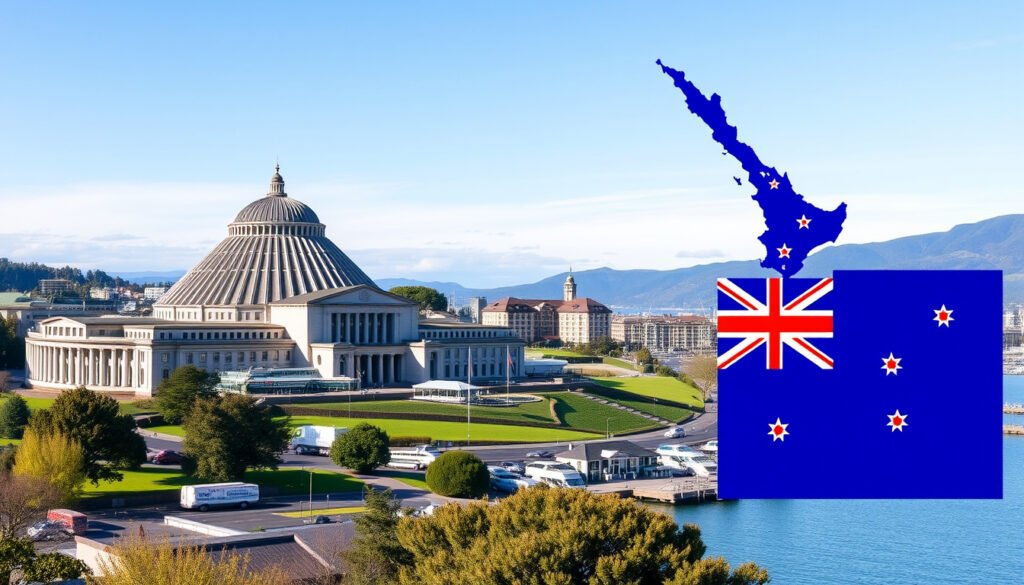
Capital of New Zealand: Why It’s Wellington, Not Auckland
Many travelers mistakenly think Auckland is New Zealand’s capital, but the correct answer is Wellington — a smaller, windier city with a bigger political role than its size suggests. The story of how New Zealand chose its capital is a tale of colonial politics, geography, and gold, and it still shapes the country’s identity today.
Current capital: Wellington ·
Capital since: 1865 ·
First capital: Old Russell (Okiato) ·
Population of Wellington: ~215,000 (2023)
Quick snapshot
- Wellington is the current capital of New Zealand (Wikipedia (encyclopedia))
- Auckland was the capital from 1841 to 1865 (Te Ara Encyclopedia of New Zealand (official historical reference))
- Old Russell (Okiato) was the first capital in 1840–1841 (Wikipedia (encyclopedia))
- Exact reasons why Wellington was chosen over other candidate cities like Picton or Nelson
- Whether political pressure from Auckland’s business elite influenced the decision to move
- Whether the gold rush directly caused the capital move
- The exact role of the Australian governors’ commission in the decision
- Whether lobbying from South Island MPs alone tipped the balance
- 26 July 1865: the first parliamentary session in Wellington marks the official capital move (New Zealand Parliament (official government records))
- Wellington remains the capital by constitutional convention; no serious proposals to move the capital again have emerged
The table below summarizes key facts about New Zealand’s capitals.
| Attribute | Value |
|---|---|
| Capital name | Wellington |
| Established as capital | 1865 |
| Population (city proper) | ~215,000 |
| Area | 444 km² |
| Previous capitals | Auckland (1841–1865), Old Russell (1840–1841) |
Is Auckland or Wellington the capital?
Wellington is the capital of New Zealand, not Auckland. The distinction often confuses visitors because Auckland is the largest city — home to over 1.6 million people — while Wellington’s city proper population is about 215,000 (Britannica (encyclopedia)). The capital is the seat of the national government, and that’s been Wellington since 1865.
Where is Wellington located?
Wellington sits at the southern tip of the North Island, on the shores of a deep-water harbor. Its location is notably more central than Auckland’s, which lies far north. This centrality was a key reason for the capital move.
Why is Wellington the capital?
In 1865, a commission of Australian governors recommended Wellington as the new capital. According to Te Ara Encyclopedia of New Zealand (official historical reference), the commissioners concluded that Wellington offered the greatest advantages for administering the government of the colony.
Four items, one pattern: the choice of capital was driven by accessibility for all regions. The table below shows how the two main contenders compare.
| Feature | Auckland | Wellington |
|---|---|---|
| Capital status | Former capital (1841–1865) | Current capital (since 1865) |
| Population (city proper, 2023) | Over 1.6 million | ~215,000 |
| Location | Northern North Island | Southern tip of North Island |
| Harbor | Waitematā Harbour | Wellington Harbour (deep-water) |
| Parliament seat | Formerly, now no | Yes |
Auckland’s size and economic power never translated into keeping the capital. For South Island MPs, the long sea voyage to Auckland was a deal-breaker. Wellington’s central location made it the practical compromise.
The implication: Geography, not population, determined the seat of power.
Why is Auckland no longer the capital?
Auckland served as New Zealand’s capital from 1841 to 1865. The move to Wellington was driven by a combination of political and geographical pressures that made Auckland less suitable as the colony expanded.
What was the first capital of New Zealand?
The first capital was Old Russell (Okiato) in the Bay of Islands, from 1840 to 1841. It was chosen by Governor William Hobson as a temporary administrative base. When Hobson moved his residence to Auckland in 1841, the capital followed (Te Ara Encyclopedia of New Zealand (official historical reference)).
Why did the capital move from Auckland?
The discovery of gold in the South Island during the 1860s shifted the colony’s economic and political weight southward (Waitangi Treaty Grounds (historical site & museum)). South Island MPs complained that traveling to Auckland was a long, costly sea voyage. A commission appointed by the governors of the Australian colonies evaluated several sites and recommended Wellington for its central location and good harbor (NZ History (government history site)).
Bottom line: Auckland’s capital status ended because its northern position made it inconvenient for the growing South Island population. Gold rush expansion and the need for a central seat of government tipped the balance toward Wellington.
Does New Zealand have two capitals?
No, New Zealand has only one official capital: Wellington. While some countries like South Africa have multiple capitals, New Zealand concentrates all national government functions in Wellington.
What is the difference between a capital and a largest city?
A capital is the city where the country’s government is seated — parliament, prime minister, and ministries. The largest city is simply the most populous urban area. Many countries separate these two roles (e.g., Ottawa vs. Toronto in Canada, Canberra vs. Sydney in Australia). New Zealand follows the same pattern.
Has New Zealand ever had multiple capitals?
No. The capital has moved three times — from Old Russell to Auckland, then to Wellington — but at any given time there was only one seat of government. The 1865 move was a transfer of the central government, not a split (Britannica (encyclopedia)).
The pattern: New Zealand has always centralized its government in a single city, avoiding the multi-capital models seen elsewhere.
What was the first capital of New Zealand?
The first capital was Old Russell, also known as Okiato, located in the Bay of Islands. It served from 1840 to 1841.
Where was Old Russell located?
Old Russell is a small settlement on the shores of the Bay of Islands, in the far north of the North Island. Today it’s a historic site with few permanent residents.
Why was the capital moved from Russell to Auckland?
Governor William Hobson decided to relocate the capital to Auckland because it offered a better harbor and more room for expansion. He established his residence there in 1841, making Auckland the second capital (Te Ara Encyclopedia of New Zealand (official historical reference)).
The implication: Even early on, practical factors like harbor quality and room to grow drove capital moves.
Why is Wellington the capital of New Zealand?
Wellington was chosen as the permanent capital in 1865 after a parliamentary commission evaluated several candidate cities, including Wellington, Whanganui, Picton, Havelock, Port Underwood, and Nelson (Waitangi Treaty Grounds (historical site & museum)).
What geographical advantages does Wellington have?
Wellington’s deep-water harbor offered safe anchorage for ships, and its central location within the colony made it easier for representatives from both islands to reach. The city’s position at the southern tip of the North Island also meant that South Island MPs faced a shorter sea journey than they would to Auckland.
How did political decisions influence the capital choice?
The commission’s recommendation was accepted by the government, and the fifth session of the 3rd New Zealand Parliament opened in Wellington on 26 July 1865, a date commonly used to mark the capital’s move (New Zealand Parliament (official government records)).
The decision to place the capital in Wellington was a deliberate effort to balance power between the North and South Islands. By choosing a central location, the colony avoided concentrating political influence in the already dominant Auckland region.
The catch: What began as a colonial compromise has endured for over 150 years, shaping New Zealand’s political geography.
What is the population of New Zealand’s capital?
Wellington city proper has a population of about 215,000 as of 2023, while the wider metropolitan area — including the Hutt Valley and Porirua — has over 400,000 people (Wellington City Council (local government authority)).
How does Wellington’s population compare to Auckland’s?
Auckland is far larger, with a population of over 1.6 million. The capital’s smaller size is a reflection of its administrative role rather than economic dominance. Most of New Zealand’s largest companies and financial institutions are based in Auckland, but the government remains in Wellington.
What is the metropolitan area population?
The Wellington urban area, which includes the city and surrounding suburbs, had an estimated population of 418,000 in 2023. This makes it the third-largest metropolitan area in New Zealand, after Auckland and Christchurch.
The pattern: Wellington’s population is modest compared to Auckland, underscoring its role as a political hub rather than an economic one.
Timeline: New Zealand’s capital moves
- 1840 – Old Russell (Okiato) becomes the first capital
- 1841 – Capital moves to Auckland
- 1865 – Capital moves to Wellington
- 1865–present – Wellington remains the capital
Each move was driven by the colony’s changing needs: first from a temporary settlement to a growing port city, then from a northern center to a more central location.
What’s clear and what’s not about the capital history
Confirmed facts
- Wellington is the current capital since 1865 (Wikipedia (encyclopedia))
- Auckland was capital from 1841 to 1865 (Te Ara Encyclopedia of New Zealand (official historical reference))
- Old Russell was first capital in 1840–1841 (Wikipedia (encyclopedia))
- The capital move was officially in 1865 (New Zealand Parliament (official government records))
- Wellington’s central location and harbor were key factors (Te Ara Encyclopedia of New Zealand (official historical reference))
What’s unclear
- Exact reasons why Wellington was chosen over other specific candidates like Picton or Nelson
- Whether political lobbying from Auckland’s business interests delayed the move
- Whether the gold rush directly caused the capital move
- The exact role of the Australian governors’ commission in the decision
- Whether lobbying from South Island MPs alone tipped the balance
Quotes from the record
“The commissioners chose Wellington because it was viewed as more central and because of its good harbor.”
— Te Ara Encyclopedia of New Zealand (official historical reference)
“The fifth session of the 3rd New Zealand Parliament opened in Wellington on 26 July 1865, marking the official transfer of the capital.”
— New Zealand Parliament (official government records)
What this means for New Zealand
The capital’s location in Wellington is a practical compromise that has held for over 150 years. It keeps the South Island connected to the political process, even as Auckland’s economic gravity pulls the country’s weight northward. For New Zealanders, the choice is clear: Wellington remains the seat of government, and the historical reasons for that choice — geography, accessibility, and the balance of regional power — still matter today.
en.wikipedia.org, worldatlas.com, ebsco.com, facebook.com, instagram.com, facebook.com
Frequently asked questions
What is the capital of New Zealand?
Wellington is the capital of New Zealand.
How long has Wellington been the capital?
Since 1865, over 150 years.
Why isn’t Auckland the capital?
Auckland was the capital from 1841 to 1865, but it was replaced by Wellington due to its more central location and better access for South Island MPs.
Does New Zealand have a second capital?
No, New Zealand has only one official capital: Wellington.
What is the population of Wellington?
Wellington city proper has about 215,000 people; the metropolitan area has over 400,000.
Is Christchurch the capital of New Zealand?
No, Christchurch is the largest city on the South Island but not the capital.
What is the capital of the South Island?
New Zealand does not have a separate capital for the South Island; the national capital is Wellington.
Related reading
- Air NZ Arrivals Wellington – Travel guide to arriving in the capital
- Flights Wellington to Nelson – Connecting the capital to the South Island
More related posts
 Best Vacuum Cleaner NZ: Top Picks, Reviews & Buying Guide
 Is Donald Trump Dead? Fact Check and Timeline
 12 Inches in CM: Exact 30.48 cm Conversion Guide
 Yachts for Sale NZ: Find Used, Cheap & Luxury Yachts
 Auckland FC Next Game: Date, Time, Venue & Tickets
 Jackpot City Mobile Login App: Download for Android & iOS
 Best Winter Jackets for Men in Ireland: 2025 Buying Guide
 Ear Wax Removal Cost NZ: 2024 Prices & Clinic Guide