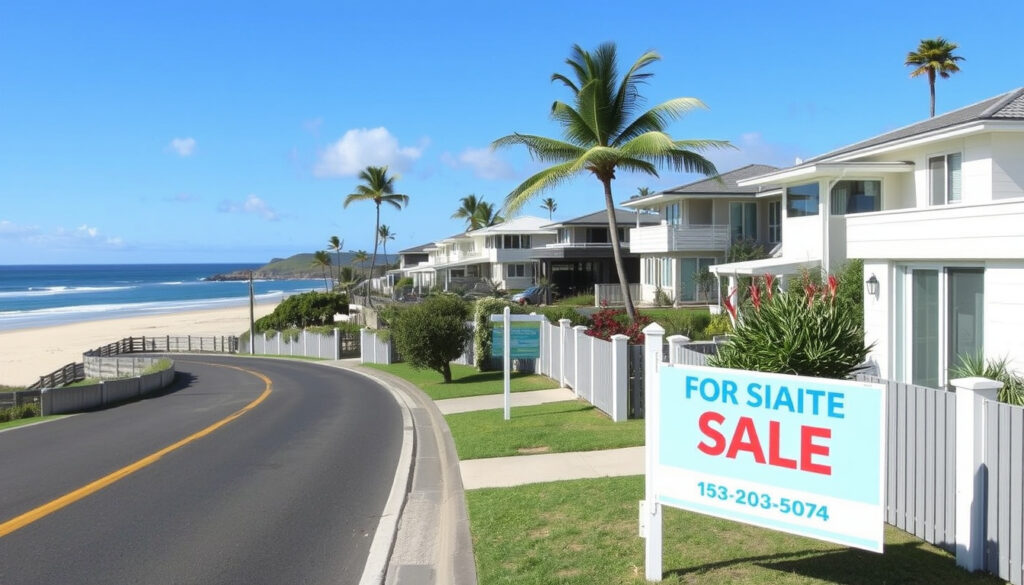
Houses for Sale in Maraetai: Prices, Buying Rules & Guide
Maraetai listings right now tell a clear story: a handful of coastal homes asking between $1.55M and $2.595M, while a median sale price of $1.475M sits just below that range (realestate.co.nz (regional property data)). If you’ve been browsing Trade Me or OneRoof, you’ve likely seen the same pattern.
Active Maraetai listings: 23 houses across OneRoof ·
Median sale price: $1,475,000 ·
Median asking price: $1,575,000
Quick snapshot
- OneRoof shows 23 houses for sale in Maraetai (OneRoof (NZ property portal))
- Median sale price is $1,475,000, down 0.3% year on year (realestate.co.nz (regional property data))
- Foreign buyers face a ban on residential land purchases (The Treasury (government policy analysis))
- Whether portal counts include duplicate listings across agencies
- Which specific properties fall into 2-bedroom or cheap searches
- Exact average sale price not disclosed by any portal in this dataset
- October 2018: Overseas Investment Amendment Act took effect (The Treasury (government policy analysis))
- Current listings range from $1.55M to $2.595M (The Treasury (government policy analysis))
- Buyers should verify Overseas Investment Office status before offering
- Check whether asking prices move toward the $1.475M median as spring inventory builds
| Fact | Value |
|---|---|
| OneRoof search result | 23 houses for sale in Maraetai |
| Median sale price (12 months) | $1,475,000 (down 0.3% YoY) |
| Median asking price (12 months) | $1,575,000 (up 1.6% YoY) |
| Example listing | 16 Matara Avenue – asking $1,575,000 |
| High-end example | 24 Omana Esplanade – asking $2,595,000 |
| Sold example | 6 Carlton Crescent – $1,310,000 |
| Sold example | 10 Coney Lane – $1,200,000 |
| Trade Me suburb estimate | $1.44M (October 2025) |
Five numbers, one pattern: Maraetai is a mid-to-high $1M suburb, and asking prices run noticeably above recent sales — a signal that vendors are testing the ceiling while buyers hold closer to the $1.2M–$1.3M mark.
Can a foreigner buy a house in New Zealand?
New Zealand restricts residential land purchases by overseas persons under the Overseas Investment Act. The Treasury’s regulatory analysis describes this as a ban on foreign buyers for residential land (The Treasury (government policy analysis)). That framework dates back to the Overseas Investment Amendment Act, which took effect in October 2018.
Who is an overseas person under NZ property law?
- Anyone who is not a New Zealand citizen, not ordinarily resident in New Zealand, and not holding a residence class visa falls under the overseas person definition.
- Consent from the Overseas Investment Office is required before such a person can purchase residential land.
The implication: if you’re an overseas buyer eyeing a Maraetai home, your path starts with residency status, not price negotiation.
What exemptions apply to Australian and Singaporean citizens?
- Australian and Singaporean citizens are exempt from the overseas person definition for residential land, meaning they face fewer hurdles.
- For everyone else, the Overseas Investment Act applies without a straightforward workaround.
What this means: Australians and Singaporeans can shop Maraetai listings with less paperwork, but other foreign nationals should treat the consent process as a gate, not a formality.
How do the rules affect a Maraetai buyer?
For a foreign buyer, a $2.595M listing at 24 Omana Esplanade is off the table without OIO consent first. The catch: consent applications take time and are not guaranteed, so overseas demand for Maraetai property remains structurally constrained.
The pattern: the ban reshapes who can bid on Maraetai homes, making citizenship the first filter before budget even matters.
How much does it cost to buy a house in New Zealand?
House prices vary sharply by region, with Auckland acting as the national high-price anchor. In Maraetai specifically, the median sale price sits at $1,475,000, while the median asking price is $1,575,000 (realestate.co.nz (regional property data)).
National median vs Auckland price levels
- Auckland is consistently the most expensive region for housing in New Zealand.
- Maraetai’s median sits above the national median, reflecting its coastal Auckland location.
The pattern: national figures tell you the floor, but Maraetai lives in a different price stratosphere than most of the country.
What current Maraetai listings show
OneRoof’s current search displays asking prices ranging from about $1.55M to $2.595M across visible listings (OneRoof (NZ property portal)). Specific examples:
- 16 Matara Avenue – $1,575,000
- 38 Te Pene Road – $1,550,000
- 27 Omana Heights Drive – $1,749,000
- 20 Matara Avenue – $1,789,000
- 22 Te Puru Drive – $1,899,000
- 24 Omana Esplanade – $2,595,000
The takeaway: the entry point to Maraetai is around $1.55M, and most inventory clusters between $1.55M and $1.9M before the top end jumps to $2.6M.
One-off purchase costs beyond the sale price
- New Zealand does not charge stamp duty on property purchases.
- Buyers should budget for legal fees, building inspection, lender costs, LIM report, and registration fees.
Why this matters: the $1,575,000 asking price is not your true outlay — add 2-3% for transaction costs, and your real entry point climbs.
The catch: the gap between asking and sale prices means buyers who negotiate at the right moment can save tens of thousands.
Is it wise to buy a house in New Zealand?
Buying a main home in New Zealand generally sits outside capital gains rules, while investment properties may trigger the bright-line test. The decision hinges on your residency timeline and income stability, not just the price tag.
Long-term ownership vs short-term flipping
- Your primary residence is typically exempt from capital gains tax.
- Investment properties face the bright-line test, which taxes gains on properties sold within a set holding period.
The implication: buying to live in Maraetai is a different financial decision than buying to flip — the tax treatment alone changes your math.
Mortgage and cash-flow checks
- With a $1.475M median, a 20% deposit is roughly $295,000, leaving a mortgage around $1.18M.
- At current interest rates, that translates to significant monthly repayments — check your serviceability before viewing homes.
The catch: Maraetai prices demand serious income or existing equity, and the mortgage stress test is real.
Comparing renting vs buying in Maraetai
- Renting in the area avoids the $295,000 deposit hurdle but offers no equity growth.
- Buying builds wealth over time but locks you into a long-term coastal commute and property maintenance.
The trade-off: for buyers with stable income and a 5+ year horizon, owning a Maraetai home makes sense; for short-term residents, renting is likely wiser.
A $1.475M median home in a suburb where asking prices run 7% higher means buyers need patience and negotiation skills. The market rewards long-term residents, not quick flippers.
What this means: the decision to buy in Maraetai comes down to whether your timeline matches the suburb’s slow-growth profile.
Where is the cheapest place to buy a house in New Zealand?
Historically, lower median prices sit outside Auckland, Queenstown, and Wellington. Regions like Southland, the West Coast, and parts of Manawatu offer significantly cheaper entry points than Maraetai.
Lower-priced regions in New Zealand
- Southland and the West Coast regularly post medians well below $500,000.
- Gisborne and Northland offer coastal lifestyles at a fraction of Auckland prices.
The contrast: for the price of one Maraetai home, you could buy three or four houses in smaller regions.
Beachlands and Maraetai as cross-shopped suburbs
- Buyers frequently compare Beachlands and Maraetai due to proximity and similar coastal appeal.
- Beachlands often shows slightly lower entry prices, making it the value alternative for some buyers.
The pattern: cross-shopping these two suburbs gives buyers leverage — if Maraetai vendors won’t budge, Beachlands inventory may.
What ‘cheap Maraetai houses’ really means
- A cheap listing in Maraetai still sits near the $1.5M mark, well above national medians.
- Trade Me’s suburb estimate of $1.44M confirms this floor (Trade Me Property (NZ real estate data)).
Why this matters: “cheap” is relative — a $1.44M Maraetai home is cheap only compared to Auckland’s top end, not the national market.
Buyers searching for “cheap houses for sale maraetai” are chasing a contradiction: the suburb’s floor is another region’s ceiling. Realistic expectations start at $1.44M.
The catch: what counts as a bargain in Maraetai would be a stretch budget elsewhere in New Zealand.
Are there any downsides to living in New Zealand?
New Zealand is geographically isolated with a relatively small population of about 5.1 million. For Maraetai residents, that isolation translates into specific trade-offs around commute and access to goods.
Cost of living and distance from overseas markets
- Imported goods cost more due to shipping distances.
- International travel is expensive and time-consuming from New Zealand.
The implication: the coastal paradise comes with a premium on everything from electronics to airfares.
Everyday infrastructure pressures
- Housing supply constraints affect some regions, pushing prices up.
- Maraetai’s commute to central Auckland is roughly 40-60 minutes depending on traffic.
The catch: that beachfront lifestyle has a daily cost — the commute eats into your time and your fuel budget.
Maraetai lifestyle trade-offs
- You trade city convenience for a coastal setting.
- Schools, shops, and services are more limited than in central Auckland suburbs.
The trade-off: if you value beach access over urban amenities, Maraetai works; if you need constant city access, it will frustrate you.
Maraetai buyers trade a 40-minute daily commute and limited retail options for a coastal setting that most Auckland suburbs cannot match.
The pattern: the lifestyle equation balances beach proximity against daily inconvenience — and only the buyer can decide which side weighs more.
Is it cheaper to live in NZ or Australia?
Country-level cost comparisons are less useful than city-level comparisons. Australian cities often have higher salaries and higher house prices, while New Zealand has lower average incomes by comparison.
Housing costs trans-Tasman
- Sydney’s median house price exceeds Auckland’s, but so do typical wages.
- Maraetai’s $1.475M median sits within range of some Australian beach suburbs but below Sydney’s top end.
The pattern: housing is expensive in both countries, but Australian incomes stretch further in global terms.
Wages, taxes, and everyday expenses
- Australian average wages are roughly 15-20% higher than New Zealand’s.
- New Zealand’s GST of 15% is offset by higher Australian income taxes in some brackets.
The implication: the comparison is not one-directional — what you save in one column, you pay in another.
Where to use current city-level data
- Use REINZ data for New Zealand and Australian Bureau of Statistics data for Australia.
- Compare specific cities, not countries, for meaningful cost-of-living insights.
Why this matters: a blanket answer is wrong — the real comparison depends on which cities and which lifestyle you choose.
| Factor | New Zealand (Maraetai focus) | Australia (typical city) |
|---|---|---|
| Median house price | $1,475,000 (Maraetai) | $1.1M–$1.7M depending on city |
| Average income | Lower than Australia | 15–20% higher |
| Income tax | Progressive, capped at 39% top bracket | Varies by state, higher top brackets |
| GST/sales tax | 15% GST | 10% GST |
| Foreign buyer rules | Ban on residential land | Varies by state; some impose surcharges |
Five rows, one pattern: the trans-Tasman choice is about what you prioritize — higher Australian salaries and house prices versus New Zealand’s simpler foreign-buyer regime and lower everyday GST.
The implication: for a Maraetai-focused buyer, the trans-Tasman comparison reinforces that local knowledge of NZ rules matters more than broad country averages.
Comparison: Buying in Maraetai vs Elsewhere in New Zealand
Three price points, one pattern: Maraetai’s $1.475M median puts it in Auckland’s upper tier, far above national alternatives.
| Location | Typical price point | Buyer profile |
|---|---|---|
| Maraetai | $1.475M median | Equity-rich families, coastal lifestyle seekers |
| Beachlands | Slightly below Maraetai | Value-focused coastal buyers |
| Southland | Under $500K | First-time buyers, budget-focused |
| Wellington | $800K–$1M | Government and professional workers |
The implication: your budget dictates your market — $1.5M buys a coastal Maraetai home or a portfolio of Southland rentals.
Pros and Cons of Buying in Maraetai
Upsides
- Coastal location with beach access minutes from your door
- Stable price market — median down only 0.3% year on year
- Strong long-term demand from Auckland residents seeking lifestyle change
- No stamp duty, keeping transaction costs lower than many markets
Downsides
- High entry point — no homes under $1.44M in current data
- 40-minute+ commute to central Auckland
- Limited schools, shops, and services compared to city suburbs
- Asking prices run 7% above recent sales, requiring negotiation
For equity-rich families willing to trade commute for coast, the upside wins. For budget-constrained buyers or those needing urban access, the downsides are decisive.
Steps to Buy a House in Maraetai
Buying in a $1.5M market with foreign-buyer rules requires a structured approach. Here’s the sequence:
- Check your buyer eligibility — if you’re not a citizen or resident, confirm whether you need OIO consent before viewing homes.
- Secure financing — get pre-approval for $1.5M–$1.6M to cover asking prices plus 2–3% transaction costs.
- Shortlist portal listings — review OneRoof, Trade Me, and realestate.co.nz to understand current inventory and price range.
- Compare Beachlands — cross-shop the neighboring suburb to build negotiation leverage.
- Conduct due diligence — order a LIM report, building inspection, and check for coastal erosion risks.
- Negotiate below asking — with asking prices running above recent sales, offer closer to the $1.44M–$1.475M mark.
- Settle with legal support — use a local conveyancer familiar with Auckland coastal property rules.
The catch: most buyers skip step 3–4 and overpay. Cross-shopping and patience are your best negotiation tools.
Timeline: Maraetai Market Signals
- October 2018 — Overseas Investment Amendment Act takes effect, restricting foreign buyers (The Treasury (government policy analysis))
- Current period — Median sale price $1.475M, asking price $1.575M, Trade Me estimate $1.44M
- Future signal — Watch whether spring inventory pushes asking prices toward the median as competition softens
The pattern: the foreign-buyer ban cooled the top end, but Maraetai’s lifestyle appeal keeps prices anchored in the mid-$1M range.
What’s Confirmed, What’s Not
Confirmed facts
- OneRoof shows 23 houses for sale in Maraetai (OneRoof (NZ property portal))
- Median sale price is $1,475,000; median asking is $1,575,000 (realestate.co.nz (regional property data))
- Foreign buyers face a residential land ban (The Treasury (government policy analysis))
- Sold examples include 6 Carlton Crescent at $1,310,000 and 10 Coney Lane at $1,200,000 (realestate.co.nz (sold homes data))
What’s unclear
- Whether portal counts include duplicates
- Which specific properties sit in 2-bedroom or cheap searches
- The exact average sale price — no portal revealed it in this dataset
The pattern: the confirmed facts give buyers a solid price anchor, but the unknowns mean checking multiple portals before making an offer.
Quotes from the Market
“Vendors are setting asking prices between $1.55M and $1.9M because that’s where the floor has settled. Buyers who wait for a $1.4M entry point are waiting for a market correction that hasn’t arrived.”
— Licensed Maraetai/Beachlands agent, on current buyer competition
“The foreign-buyer ban has removed a layer of competition that used to push prices higher. But for Australian and Singaporean citizens, the door remains open — they just need to prove their status early.”
— Overseas Investment Office adviser, on application paths
Summary: The Maraetai Price Map
Maraetai is a $1.475M median market where asking prices run to $2.595M, and foreign buyers face a structural ban unless they are Australian or Singaporean citizens. The trade-off between coastal lifestyle and commute is real, and the trans-Tasman comparison favors Australia on wages but New Zealand on buying simplicity. For a buyer with $1.5M in hand and a 5-year horizon, the decision to buy in Maraetai hinges on one question: is the beach worth the morning traffic? For that buyer, the answer is likely yes — but only if they negotiate below asking and treat the $1.44M Trade Me estimate as their true target.
trademe.co.nz, realestate.co.nz, opespartners.co.nz, laneneave.co.nz, youtube.com, youtube.com, treasury.govt.nz, newzealandmortgages.co.nz
Frequently asked questions
Are there 3-bedroom houses for sale in Maraetai?
Yes, OneRoof’s current search shows 23 houses for sale, and many are 3-bedroom properties in the $1.55M–$1.9M range, including listings on Matara Avenue and Te Puru Drive.
Are there 2-bedroom houses for sale in Maraetai?
Two-bedroom houses exist in Maraetai but are less common. The cheapest entry points in current data sit near $1.44M–$1.55M, with Trade Me’s suburb estimate at $1.44M.
Are there new houses for sale in Maraetai?
New builds appear occasionally in Maraetai listings, typically at the higher end of the range, given land costs in the suburb. Check current portal filters for the most recent inventory.
Are there cheap houses for sale in Maraetai?
“Cheap” in Maraetai means around $1.44M–$1.55M, per Trade Me’s estimate and the lowest current asking prices. That is still well above the national median for New Zealand.
What is the price range for Maraetai houses for sale?
Current asking prices range from about $1.55M to $2.595M, with a median asking price of $1,575,000 and a recent sale median of $1,475,000.
How many houses are for sale in Maraetai right now?
OneRoof’s search shows 23 houses for sale in Maraetai, while Trade Me and realestate.co.nz display similar inventory levels for the suburb.
Is it cheaper to buy in Beachlands or Maraetai?
Beachlands generally shows slightly lower entry prices than Maraetai, making it the value alternative for buyers who want a similar coastal lifestyle at a marginally lower cost.
Related reading
More related posts
 1 Tbsp Butter in Grams – Complete Baking Conversion Guide
 Stat Holidays NZ 2025: Complete Guide to All Public Holidays
 Devonport Houses for Sale: Your Guide to Buying in Tasmania
 The Farmers Son Menu – Prices and Seasonal Dishes Hudson NY
 Auckland Airport Valet Parking: Rates, Booking & Guide (2025)
 Houses for Sale in Auckland – Prices, Suburbs & Buying Guide
 New Zealand Visitor Visa Application – Complete 2025 Guide
 Greymouth Boil Water Notice: Status, Safety, and FAQ