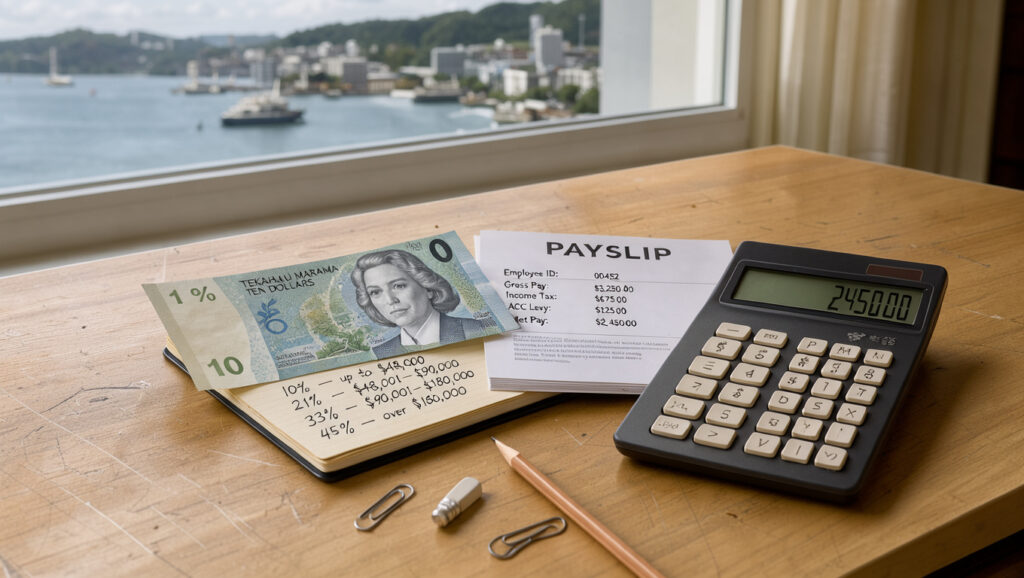
How Much Is Tax in NZ? Brackets and Take-Home Pay Explained
Most people first ask about tax when a salary offer arrives, and the payslip rarely looks like the number in the letter. This piece walks through New Zealand’s income tax bands and what a $70,000 and a $100,000 salary keep after tax, with the arithmetic shown so you can check every figure.
Lowest income tax rate: 10.5% on income from $1 to $15,600 · Top income tax rate: 39% on income above $180,000 · Income tax on $70,000: approx. $13,220 before ACC levy · Income tax on $100,000: $22,877.50 before ACC levy · Tax-free threshold: None; tax applies from the first $1 of income
Quick snapshot
- Five bands start on at 10.5%, 17.5%, 30%, 33% and 39% (Canstar (financial comparison site))
- New Zealand has no tax-free threshold, so the first $1 of income is taxed (TrustedCalcs (tax calculator publisher))
- According to BetterMoney NZ (guide publisher), the bottom four thresholds changed on , a date the evidence here does not confirm (BetterMoney NZ (guide publisher))
- The ACC earners’ levy changes by year, at 1.67% up to $152,790 for 2025–26 (BetterMoney NZ (guide publisher)) (BetterMoney NZ (guide publisher))
- Bands changed on , raising the earning limits for each rate (Canstar (financial comparison site)) (Xero (accounting software))
- According to Xero (accounting software), the levy is 1.75% for the year from (Xero (accounting software))
- Check the bands and levy for your own tax year against Inland Revenue’s published tables, because both have changed from one tax year to the next.
- Test the figures with a salary calculator on the same pay, such as Xero (accounting software), then compare the net result.
The implication: the bands and the levy are the two figures to check first, because they move the net number in every tax year.
Inland Revenue (tax authority) lists 39% as the top rate, which applies only to income above $180,000, a detail that changes how a salary reads on paper.
Ten headline figures, one pattern: the 10.5% and 17.5% bands carry the lower half of every salary, and the ACC levy sits on top of income tax as a separate charge.
| Item | Value |
|---|---|
| Lowest income tax rate | 10.5% on income from $1 to $15,600 |
| Top income tax rate | 39% on income above $180,000 |
| Income tax on $70,000 | Approx. $13,220 before ACC levy |
| Income tax on $100,000 | $22,877.50 before ACC levy |
| Tax-free threshold | None; tax applies from the first $1 of income |
| ACC earners’ levy, 2025–26 | 1.67% up to $152,790 |
| ACC earners’ levy, 2026–27 | $1.75 per $100 up to $156,641 |
| Non-declaration tax rate | 45% when no IR330 declaration is given |
| Effective rate on $70,000 | Roughly 19% |
| Effective rate on $100,000 | 22.9% |
How much tax will I owe on a $70,000 income in New Zealand?
A $70,000 salary touches three bands, and TrustedCalcs (tax calculator publisher) puts the total income tax at about $13,220, an effective rate of roughly 19%.
Three bands, one pattern: the lower two are taxed in full, and only the slice above $53,500 meets the 30% rate.
| Band | Income taxed | Rate | Tax |
|---|---|---|---|
| $0 to $15,600 | $15,600 | 10.5% | $1,638.00 |
| $15,601 to $53,500 | $37,900 | 17.5% | $6,632.50 |
| $53,501 to $70,000 | $16,500 | 30% | $4,950.00 |
| Total | $70,000 | — | $13,220.50 |
CalculatorLib (calculator publisher) reaches the same $13,220.50 in its 2024/25 table and lands on net pay of $55,659.50 after its levy (CalculatorLib (calculator publisher)).
- Multiply each slice by its rate: $15,600 × 10.5% = $1,638.00; $37,900 × 17.5% = $6,632.50; $16,500 × 30% = $4,950.00.
- Add the three amounts to reach $13,220.50 in income tax.
- Subtract the ACC earners’ levy. CalculatorLib uses 1.60% for 2024/25 on earnings up to $142,283, which is $1,120 on $70,000 (CalculatorLib (calculator publisher)).
- Arrive at take-home pay: $70,000 − $13,220.50 − $1,120 = $55,659.50.
If an employee does not give their employer an IR330 declaration, tax is deducted at a 45% non-declaration rate, far above the bands in the table (Inland Revenue (tax authority)). Filing the declaration keeps deductions on the bands.
If I earn $70,000 per year in New Zealand, how much is my hourly wage?
- $70,000 divided by 2,080 hours (40 hours a week over 52 weeks) is about $33.65 an hour before tax.
- The hourly figure assumes a 40-hour week and 52 paid weeks, so a shorter or longer week changes it.
The implication: a $70,000 offer is a gross figure, and the take-home amount is the one that pays for rent and groceries.
How much will I make after taxes if I earn $100,000 a year in New Zealand?
Calculate.co.nz (tax guide publisher) lists the current brackets from 1 April 2025 and total tax of $22,877.50 on $100,000, an effective rate of 22.9% (Calculate.co.nz (tax guide publisher)).
How much is tax paid?
- First $15,600 at 10.5%: $1,638.00
- $15,601 to $53,500 at 17.5%: $6,632.50
- $53,501 to $78,100 at 30%: $7,380.00
- $78,101 to $100,000 at 33%: $7,227.00
Those four slices total $22,877.50 before the levy. CalculatorLib’s 2024/25 table gives the same total, a $1,600 levy and net pay of $75,522.50 (CalculatorLib (calculator publisher)).
According to Eastmure (guide publisher), older bands produce $23,920 on the same salary, which is $1,042.50 more than the current schedule (Eastmure (guide publisher)).
What this means: each extra dollar above $78,100 loses 33% to income tax, so a raise in that range keeps about two-thirds of its value before the levy.
Is a salary of 70,000 NZD good in New Zealand?
Whether $70,000 is good depends on living costs, and the research behind this piece includes no verified cost-of-living dataset. What it does support is the take-home figure, and that is the number a household budget actually spends.
What is a livable salary in NZ?
- No verified living-cost figure was in the research, so this article does not name a livable salary.
- Stats NZ, New Zealand’s official statistics agency, is the place to check local costs against take-home pay.
Is $60,000 a good salary in New Zealand?
- On the same bands, $60,000 pays $10,220.50 in income tax: $1,638.00, then $6,632.50, then $1,950.00 at 30% on the slice above $53,500.
- After a 1.60% levy of $960, take-home pay is about $48,819.50.
What is $30 an hour annually in NZ?
- $30 an hour across 40 hours and 52 weeks is $62,400 gross before tax.
- On the same bands, that gross pays about $10,940.50 in income tax, leaving roughly $51,459.50 before the levy.
A salary offer is a gross figure, and the gap to take-home is what a household has to fit its budget around. Judge the offer on the net number before comparing it with anyone else’s pay.
The catch: on $70,000 the gap between salary and take-home runs to about $14,340 once tax and the 1.60% levy are counted, and that gap is the number to plan around.
Is NZ a highly taxed country?
This research does not settle the comparison. It holds no dated OECD or Treasury figure, so this section sticks to how New Zealand’s own bands are built.
The system is marginal: each rate applies only to the income inside its own band.
Who pays 33% tax in NZ?
- Earners with taxable income from $78,101 to $180,000 pay 33% on that slice. According to Kiwisimple (NZ tax calculator), the 39% top bracket starts above $180,000 (Kiwisimple (NZ tax calculator)).
- Someone earning $100,000 pays 33% only on the $21,900 above $78,100, not on the full salary.
The trade-off: a 33% headline suggests one rate for the whole salary, but the lower bands still apply to the first $78,100, so the higher rate touches only the top slice.
What are the tax brackets in New Zealand?
Five bands, one pattern: each rate applies only to the income inside its own band, and Canstar (financial comparison site) lists the bands in effect from the start of April 2025.
| Band | Income range | Rate |
|---|---|---|
| 1 | $0 to $15,600 | 10.5% |
| 2 | $15,601 to $53,500 | 17.5% |
| 3 | $53,501 to $78,100 | 30% |
| 4 | $78,101 to $180,000 | 33% |
| 5 | Above $180,000 | 39% |
What this means: a salary that stays inside the 17.5% band pays a lower average rate than one that crosses into 30% or 33%, so the bands matter more than the 39% headline.
Confirmed facts
- Current bands are those in effect from 1 April 2025, as set out by Inland Revenue (tax authority)
- According to Xero (accounting software), the ACC earners’ levy is modelled separately from income tax (Xero (accounting software))
What’s unclear
- Older thresholds: according to Eastmure (guide publisher), 2024–25 bands used 14,000 and 48,000 as band edges, which differ from the 1 April 2025 schedule (Eastmure (guide publisher))
- The 31 July 2024 change date: BetterMoney NZ (guide publisher) gives it, but the evidence here does not confirm it (BetterMoney NZ (guide publisher))
- Whether a capital gains tax applies: the sources gathered for this piece do not confirm a rule either way.
- How New Zealand compares with other countries: no dated OECD or Treasury figure was in the research.
“New Zealand has progressive or gradual tax rates. The rates increase as your income increases.”
Inland Revenue (tax authority)
“New Zealand has no tax-free threshold — every dollar is taxed from the first.”
TrustedCalcs (tax calculator publisher)
Check the bands and levy each April, because both move the net figure. For a salaried worker on $70,000, the choice is clear: budget from the roughly $55,660 that arrives, or keep planning around a headline that overstates what lands by about $14,340.
Related reading
The pattern: the two links above are the closest related pieces on this site, so the bands themselves are best checked against Inland Revenue’s own tables.
ird.govt.nz, moneyhub.co.nz, fahaq.com, ird.govt.nz, calculory.com
Frequently asked questions
Do I pay tax from the first dollar I earn in New Zealand?
Yes. New Zealand has no tax-free threshold, so the first band starts at $1 and runs to $15,600.
What is the ACC earners’ levy, and is it separate from income tax?
Yes. The levy is a separate charge with its own rate and cap, and it is deducted on top of income tax, which is why the net figures above subtract it separately.
Is the PAYE rate the same as my tax bracket?
Not exactly. According to Calculate.co.nz (tax guide publisher), PAYE is withheld from wages, while the bands set how much total tax the year comes to. Keep the two ideas apart when you read a payslip.
Does New Zealand have a capital gains tax?
The sources gathered for this piece do not confirm a capital gains rule, so check Inland Revenue’s published guidance before relying on any answer.
Where can I check my tax rate on the IRD website?
Inland Revenue’s tax rates page for individuals lists the current bands. Confirm any figure in this article against the tax year you are paid in.
What does the 45% rate apply to?
It applies when an employee does not give their employer an IR330 declaration. The employer then deducts tax at 45% from pay instead of the normal bands.
More related posts
 Best Burger Places Near Me in Dublin: Top Picks & Cheap Eats
 Can You Get Pregnant from Precum? Risks & Odds Explained
 NZ Herald Death Notices Last 7 Days: Search Recent Obituaries
 Clothes Drying Rack NZ: Best Heavy Duty Retailer Picks
 New Zealand Housing Market Crisis: Causes, Impact, and Forecast
 Main Street Cafe Invercargill: Menu, Hours, Reviews Guide
 Image to Text Converter: Free Online OCR Tools in 2025
 Gifts for Men NZ: How to Pick a Present He’ll Love