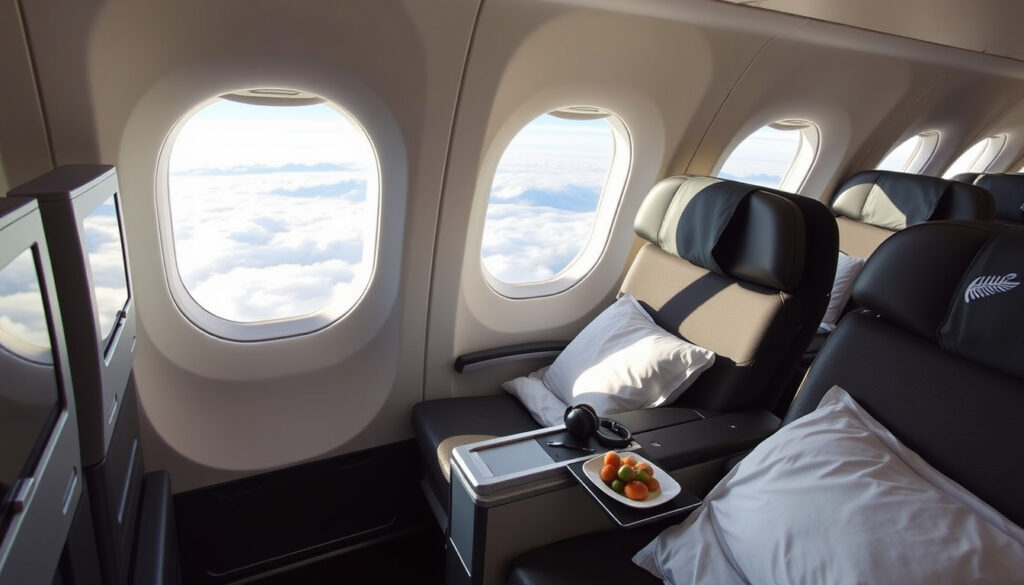
Business Class Air NZ: Reviews, Prices & Inclusions
If you’ve ever priced out a flight to New Zealand, you know the moment comes when you start wondering whether business class is actually worth the jump. The fare difference can be jaw-dropping — but so can a 14-hour flight spent trying to sleep in a recliner. Air New Zealand’s Business Premier sits at that crossroads, and the gap between what the airline promises and what past passengers actually experience is smaller than you might expect.
Seat Configuration: 1-2-1 ·
Bed Type: Lie-flat with memory foam mattress ·
Baggage Allowance: 3 bags at 23kg each ·
Lounge Access: Complimentary ·
Check-in: Priority
Quick snapshot
- Business Premier delivers fully lie-flat beds with 1-2-1 aisle access on 787-9 (Air New Zealand Official)
- Passengers get 3 checked bags at 23kg each, priority boarding, and lounge entry (Air New Zealand Official)
- 787-9 V3 cabin has 34 Business Premier seats across rows 2-7 and 10-12 (Air New Zealand Official)
- Precise international pricing varies by route and season without a public rate sheet
- Seat 11A concerns appear in general seat-advice contexts rather than Air NZ-specific reviews
- 777 variants show conflicting seat counts across third-party seat map sources
- Business Premier Luxe with private suites launched on 787-9 at rows 1 and 9 (Air New Zealand Official)
- 787-9 Premium Economy review recorded August 2025 on Queenstown-Auckland-Melbourne route (YouTube Review)
- New Business Premier interiors on 787-9 feature updated cabin layout per recent video review (Air New Zealand Official)
- Seat maps for each aircraft available directly through Air New Zealand website
- Price tracking tools like KAYAK surface seasonal deals for Business Premier
- 787-9 V3 Premium Economy review suggests continued fleet refinements on Dreamliner routes
The table below compares the three cabin classes across key travel parameters.
| Detail | Business Premier | Premium Economy | Economy |
|---|---|---|---|
| Seat type | Fully lie-flat bed | Adjustable headrest, extra legroom | Standard recline |
| 787-9 seat pitch | 79-80″ | 41″ (104cm) | 31-32″ |
| Checked bags | 3 × 23kg | 2 × 23kg | 1 × 23kg |
| Carry-on | 2 bags up to 14kg total | 2 bags up to 7kg each | 1 bag |
| Lounge access | Complimentary | Not included | Not included |
| 787-9 seat count | 34 (rows 2-7, 10-12) | 52 (rows 23-30) | Varies by config |
| 787-9 Business Premier Luxe | Rows 1 and 9 (4 seats each) | N/A | N/A |
What is included in business class air nz?
Air New Zealand’s Business Premier goes beyond a wider seat. The cabin is built around uninterrupted sleep on long routes — every seat converts into a fully lie-flat bed with a memory foam mattress topper, two full-size pillows, and a duvet (Air New Zealand Official). The service layer starts at the airport: priority check-in, dedicated baggage drop, and priority boarding mean you clear the terminal faster and board before the main cabin.
- Complimentary access to Air New Zealand lounges before departure and on qualifying connections
- Three pieces of checked luggage at 23kg each — that’s 69kg total in the hold (Air New Zealand Official)
- Priority baggage handling on arrival so your bags hit the carousel first
- Fine dining with multi-course menus and a curated wine selection
- Memory foam mattress, two full-size pillows, and duvet for the lie-flat experience
Priority check-in and boarding
Business Premier passengers bypass the main check-in queue entirely. Dedicated desks and staff handle everything from document verification to seat assignment in minutes. Priority boarding groups mean you’re aboard before carry-on bins fill up, and your luggage gets tagged with priority tags that follow it through the entire journey — from check-in drop to carousel delivery on arrival.
Lounge access
Air New Zealand operates lounges across its domestic and international network. Business Premier guests enter complimentary, along with a guest traveling on the same booking. The lounge provides a quieter pre-flight environment — better than terminal noise — with food, drinks, showers, and workstations. Connections of two hours or more become considerably more comfortable.
Baggage privileges
Three checked bags at 23kg each gives you 69kg of luggage allowance in the hold. Carry-on privileges allow two bags with a combined weight up to 14kg (Air New Zealand Official). For travelers packing bulky equipment — photography gear, sporting equipment, or work tools — this headroom matters more than the seat itself.
Business Premier’s baggage allowance alone — 69kg checked plus 14kg carry-on — represents roughly 2.3× what a Premium Economy passenger can bring. Passengers checking sports gear, samples, or family luggage will find the additional allowance makes the fare difference worthwhile.
Is business class worth it on air in New Zealand?
The answer hinges entirely on route length and sleep needs. On a 14-hour transpacific leg from Los Angeles to Auckland, a lie-flat bed transforms arrival from exhausted to functional. On a 5-hour trans-Tasman hop, Premium Economy’s extra legroom and recline deliver most of the comfort at a fraction of the cost (Going.com Guide).
Business Premier’s primary advantages — lounge access and lie-flat beds — compound in value as flight duration increases. Premium Economy seats recline 50% more than Economy and cost substantially less, making them the practical winner for short international hops (Going.com Guide).
Traveler reviews
Passenger accounts consistently praise Business Premier’s seat width and lie-flat configuration on the 787-9 Dreamliner. The memory foam mattress receives specific mention for improving sleep quality. Premium Economy reviews highlight the 41″ seat pitch as a meaningful upgrade over Economy, with the ZIM recline-forward seat providing better rest than standard recliners. A 2017 review noted that both cabins delivered “comfortable, spacious enough” experiences on an Auckland-Brisbane run (Allen on Travel). Recent 2025 Premium Economy coverage of the Queenstown-Melbourne corridor reinforces that the Dreamliner’s PE cabin remains competitive.
Key perks
- Lie-flat beds convert seats into 79.5″ sleep surfaces on 787-9 (Upgraded Points)
- 22″ seat width gives more shoulder room than Premium Economy’s 19-20″ (Upgraded Points)
- Complimentary lounge access with guest privileges
- Three bags at 23kg each vs Premium Economy’s two
- Priority boarding, check-in, and baggage delivery
Cost considerations
Business Premier fares run several thousand dollars above Premium Economy on equivalent routes. The premium varies significantly by season, booking timing, and route — with summer peak fares to New Zealand reaching their highest levels. Tools like KAYAK and Google Flights help track fare patterns. For travelers with Airpoints status, upgrade availability and earning rates shift the math in favor of business class more frequently.
What’s the difference between Premium Economy and business class?
Three measurable gaps separate the two cabins: bed type, baggage volume, and lounge access. Premium Economy delivers a significantly improved seat over Economy but stops short of lie-flat territory, while Business Premier commits fully to sleep as the primary amenity (Air New Zealand Official).
Here is how the two cabins compare across the main specification points.
| Feature | Business Premier | Premium Economy |
|---|---|---|
| 787-9 seat pitch | 79-80″ | 41″ (104cm) |
| 777-300 seat pitch | 79-80″ | 41-42″ |
| Seat width | 22″ | 19-20″ |
| Lie-flat bed | Yes (79.5″ length) | No — recliner |
| Checked baggage | 3 × 23kg | 2 × 23kg |
| Carry-on | 2 bags, 14kg total | 2 bags, 7kg each |
| Lounge access | Complimentary + 1 guest | Not included |
| Seat selection | Included | Free standard selection |
| Dining | Multi-course, full wine list | Premium Economy menu |
The implication: Premium Economy works as a halfway upgrade with more legroom and better dining, but Business Premier remains purpose-built for passengers who need to arrive rested on long routes.
Seating and space
Business Premier’s 1-2-1 configuration on 787-9 and 777-300ER means every seat has direct aisle access — no climbing over neighbors. The 22″ width and 79-80″ pitch create a substantial sleeping or working surface. Premium Economy uses a 2-4-2 layout on 777 and 2-4-2 or 2-3-2 on Dreamliner, with window seats offering privacy but center pairs requiring coordination with seatmates. Seat width drops to 19-20″ and pitch to 41-42″ — a meaningful improvement over Economy but fundamentally a recliner, not a flat bed.
Amenities
- Business Premier: memory foam mattress, two pillows, duvet, multi-course dining, curated wine program
- Premium Economy: adjustable headrest, extra legroom, Premium Economy dining menu, complimentary meals and drinks
- Both cabins: free standard seat selection, two carry-on pieces, priority services on some routes
Pricing
Air New Zealand doesn’t publish fixed price differentials — fares fluctuate by route, season, and demand. Business Premier typically runs several thousand dollars above Premium Economy on the same booking. Premium Economy costs substantially less than Business while delivering roughly 60-70% of the comfort upgrade over standard Economy (Going.com Guide). For families or couples where only some passengers would upgrade, mixing cabin classes on a single booking sometimes becomes an option.
How much does it cost to fly business class to New Zealand?
Air New Zealand does not publish fixed Business Premier fare tables — rates shift by route, season, and booking window. Searching for business class to New Zealand from North America or Europe typically surfaces fares ranging from approximately $4,000 to $15,000+ for round-trip economy-equivalent pricing, while Premium Economy usually falls between $2,000 and $6,000 on comparable routes (KAYAK).
Published fares fluctuate based on demand, advance purchase, and seasonal peaks. Off-season travel and early booking generally yield lower rates — but last-minute business travel often commands the highest fares in the range.
International pricing
Fares vary dramatically by departure city. Los Angeles, San Francisco, Houston, Chicago, and Vancouver serve as primary Air New Zealand US gateways, with new service to New York planned. Premium Economy fares typically run 30-50% below Business Premier equivalents, though the gap narrows during peak summer seasons and widens during off-peak windows.
Factors affecting cost
- Route: Transpacific (US to NZ) runs longer than trans-Tasman hops, driving higher fares
- Season: New Zealand summer (December-February) commands premium pricing
- Advance booking: 6-12 months ahead typically yields lower fares than last-minute
- Airpoints redemption: Points bookings may offset cash differences
Booking tips
Set fare alerts through KAYAK or Google Flights to track Business Premier pricing trends on your target route. Air New Zealand’s website displays seat maps for each aircraft type, helping you select the best Business Premier seat configuration before booking. Premium Economy seat selection is complimentary — lock in your preferred seat early to avoid assignment to a middle position.
Is air nz business class any good?
The seat configurations are solid. Business Premier operates in 1-2-1 herringbone arrangements on 777 variants, while the 787-9 Dreamliner uses a more traditional forward-facing layout with direct aisle access from every seat. Passenger reviews cite the 787-9 as having a “spacious and light cabin” feel, and the memory foam mattress frequently earns specific praise (CN Traveler reviewer).
The 787-9 Business Premier draws consistent praise for cabin ambiance and lie-flat comfort — a key differentiator for passengers prioritizing rest on transpacific routes. The 777 herringbone layout offers similar seat dimensions but a different spatial feel.
Seat map details
- 787-9 V3: 34 Business Premier seats in rows 2-7 and 10-12; Business Premier Luxe in rows 1 and 9 with private suites
- 777-300ER V1: 44 Business seats in rows 1-12; 54 Premium Economy seats in rows 23-30 (Air New Zealand Official)
- 777-300ER V2: 59 Business seats in rows 1-4, 11-12, 16-20; 34 Premium Economy seats (Seatmaps.com)
- 777-300ER V3: 40 Business seats; 32 Premium Economy seats (Seatmaps.com)
Aircraft specifics
Air New Zealand operates three 777-300ER variants with notably different configurations — Business Premier ranges from 40 to 59 seats depending on the variant, and Premium Economy ranges from 32 to 54 seats (Seatmaps.com). The 787-9 V3 carries 34 Business Premier seats, and the Premium Economy cabin holds 52 seats in rows 23-30 (Air New Zealand Official). The Dreamliner’s smaller PE cabin (52 seats) contrasts with the 777’s larger Premium Economy sections (54 seats) — the Dreamliner PE cabin feels more intimate as a result.
Avoid certain seats
General seat-advice commonly warns against row 11A across multiple airlines, citing obstructed views or proximity to galleys and lavatories. On Air New Zealand’s 787-9, Business Premier rows start at row 2 (rows 2-7 and 10-12), so row 11A doesn’t exist in the Business cabin — Premium Economy rows begin at row 23. Passengers selecting specific Business Premier seats should review the official seat map to confirm window/aisle orientation and proximity to galleys before locking in their choice (Air New Zealand Official).
Key facts table
These specifications come directly from Air New Zealand’s official seat maps and policy pages.
| Feature | Specification | Source |
|---|---|---|
| Product name | Business Premier Luxe | Air New Zealand Official |
| 787-9 Business Premier seats | 34 (rows 2-7, 10-12) | Air New Zealand Official |
| 787-9 Business Premier Luxe | Rows 1 and 9 (4 seats each) | Air New Zealand Official |
| 787-9 Premium Economy seat count | 52 (rows 23-30) | Air New Zealand Official |
| 777-300 Business Premier seats | 44 (rows 1-12) | Air New Zealand Official |
| 777-300 Premium Economy seats | 54 (rows 23-30) | Air New Zealand Official |
| 787-9 Premium Economy pitch | 41″ (104cm) | Air New Zealand Official |
| 777-300 Premium Economy pitch | 41-42″ | Air New Zealand Official |
| Business Premier checked baggage | 3 × 23kg | Air New Zealand Official |
| Premium Economy checked baggage | 2 × 23kg | Air New Zealand Official |
| 787-9 Economy pitch | 31-32″ | Air New Zealand Official |
| Business Premier seat width | 22″ | Upgraded Points |
The takeaway: travelers get reliable dimensions from the official Air New Zealand sources, while third-party seat maps provide useful detail on the varying 777 variants.
Upsides and downsides
Upsides
- Fully lie-flat beds with 79-80″ pitch convert overnight flights into actual rest
- 1-2-1 configuration gives every passenger direct aisle access — no climbing over strangers
- 69kg total checked baggage allowance handles bulky gear without upcharge anxiety
- Complimentary lounge access with guest privileges improves pre-flight experience
- Priority services (check-in, boarding, baggage) save time on both ends of the journey
Downsides
- Fares run several thousand dollars above Premium Economy on equivalent routes
- Seat 11A warnings in general advice contexts don’t apply cleanly to Air NZ’s Business Premier rows — check maps
- 777 variants show conflicting seat counts across third-party sources; official Air NZ maps are authoritative
- Multiple 777-300ER configurations mean the experience varies by specific aircraft assigned to your route
“The primary advantages for Business Class passengers on Air New Zealand are lounge access and a significant increase in personal space with a seat that converts to a lie-flat bed.”
— Going.com Guide (Travel Expert)
“NZ’s Premium Economy seats are actually more spacious than the Business Class seats on Qantas’ B738’s.”
— Pats Travel Reviews (Blogger)
“In summary, both Business and Premium Economy on Air New Zealand were excellent: comfortable, spacious enough, with service well done.”
— Allen on Travel (Blogger)
For flyers weighing New Zealand business class against Premium Economy, the core decision narrows to one variable: how badly do you need to sleep on the plane? Business Premier guarantees a lie-flat surface on the 787-9 and 777-300ER — that’s the whole value proposition. Premium Economy delivers extra legroom and a meaningful recline improvement over Economy, but it won’t flatten you horizontal.
On routes to Auckland from major US gateways — Los Angeles, San Francisco, Houston, Chicago, Vancouver — Business Premier makes the case for itself as a full lie-flat bed across roughly 14 hours of flight time. The premium pays off if arriving functional matters more than saving the fare. Premium Economy lands as the practical sweet spot for shorter international hops under 10 hours where the extra legroom and recline solve most comfort problems without the business class invoice.
Travelers booking Business Premier should confirm which aircraft variant operates their specific route. The 787-9 Dreamliner offers a brighter cabin with the newer Business Premier Luxe suites, while the 777-300ER carries more Business seats with different spatial proportions. Either beats a recliner for a transpacific overnight — but the choice shapes what the airport experience feels like on both ends.
What aircraft types have Air NZ business class?
Air New Zealand operates Business Premier on Boeing 787-9 Dreamliner and Boeing 777-300ER aircraft. The 787-9 V3 carries 34 Business Premier seats across rows 2-7 and 10-12, with Business Premier Luxe suites in rows 1 and 9. The 777-300ER comes in multiple variants with Business Premier seat counts ranging from 40 to 59 seats depending on the configuration.
What is Business Premier Luxe?
Business Premier Luxe is Air New Zealand’s premium sub-class within Business Premier, featuring private suites with enhanced privacy. On the 787-9 V3, Luxe seats occupy rows 1 and 9 with four seats in each row. The Luxe experience includes the same lie-flat bed and amenities as standard Business Premier with additional suite-like enclosure features.
How many rows in Air NZ 777 business cabin?
The Boeing 777-300ER V1 configuration places Business Premier in rows 1-12 with 44 total seats. Premium Economy occupies rows 23-30 with 54 seats. Subsequent 777 variants (V2 and V3) redistribute seats differently — V2 places Business Premier across rows 1-4, 11-12, and 16-20 for 59 total seats, while V3 uses a more compact arrangement with 40 Business Premier seats.
Does Air NZ business class have direct aisle access?
Yes. Business Premier uses a 1-2-1 seat configuration on both the 787-9 Dreamliner and 777-300ER, meaning every seat has unobstructed access to the aisle. Passengers seated at window positions can step directly into the aisle without climbing over neighboring seats — a standard feature across both major aircraft types in the fleet.
What bedding is provided in Air NZ business class?
Business Premier passengers receive a memory foam mattress topper, two full-size pillows, and a duvet. The bedding transforms the lie-flat seat into a configured sleep surface. The memory foam mattress specifically earns praise in passenger reviews for improving sleep quality compared to standard lie-flat configurations.
Is there a seat map for Air NZ business class?
Yes. Air New Zealand publishes seat maps for all aircraft types on its official website. The seat maps show the specific row configurations, seat dimensions, and layout for Business Premier, Premium Economy, and Economy cabins on each aircraft variant. Travelers can review the map before booking to select their preferred Business Premier seat based on window or aisle preference.
What is the baggage allowance for Air NZ business?
Business Premier includes three pieces of checked luggage at 23kg each (69kg total), plus two carry-on bags with a combined weight up to 14kg. Carry-on bags individually cannot exceed 10kg each. This contrasts with Premium Economy’s two checked bags at 23kg each and two carry-on bags at 7kg each, and Economy passengers who receive one checked bag at 23kg.
Related reading: Air New Zealand Wind Shear · Auckland Airport Arrivals
airnewzealand.com, finetravel.co.nz, going.com, airnewzealand.com
Related coverage: Air New Zealand flights guide fördjupar bilden av Air New Zealand Flights – Status, Prices and Booking Guide.
More related posts
 The Warehouse South Dunedin: Hours, Phone & Online Shopping
 My Pay The Warehouse: Login and Payslip Access Guide
 West Indies vs India: T20 Super 8 Score & Test Wins
 Castlepoint Hotel & Guesthouse: Reviews & Amenities Guide
 Auckland Property Valuation: How Council CVs & Objections Work
 NZD to Canadian Dollar: Rate, Strength & Living Comparison
 Are Shops Open Today NZ? Restricted Trading Days Explained
 How to Delete Instagram Account Permanently: Step by Step