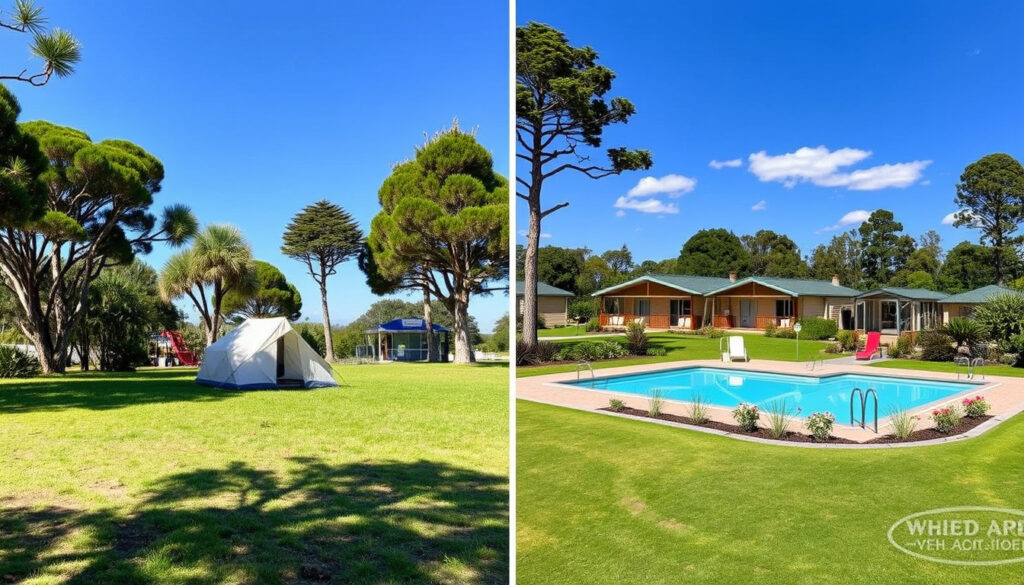
DOC Campground vs Holiday Park: Which Is Right for You
Picture this: you’ve just landed in New Zealand, your campervan is humming, and the open road stretches out. But as the sun starts to dip, a question looms — should you pull into a DOC campground for the night or make for a holiday park? It’s a decision that boils down to more than just cost; it’s about whether you crave the raw beauty of a mountain-side basic site or the hot shower, kitchen, and Wi-Fi of a powered site. Here’s how the trade-offs actually play out, based on official DOC rules, pricing, and real traveler experience.
DOC campsites in New Zealand: over 300 sites managed by the Department of Conservation ·
Holiday parks in New Zealand: over 400 commercial holiday parks ·
Typical cost per adult per night at DOC (basic site): $6–$15 NZD ·
Typical cost per adult per night at holiday park (powered site): $25–$50 NZD ·
Maximum stay limit at DOC campsites: 28 days in any 4-month period (standard rule)
Quick snapshot
- DOC (Department of Conservation) runs over 300 campsites across New Zealand (Department of Conservation).
- Most DOC huts do not supply toilet paper; bring your own (Department of Conservation).
- The 28‑day rule is a legal limit for stays at any particular DOC campsite within a 4‑month period (Freedom Camping Act 2011).
- Exact pricing for the DOC Campsite Pass may shift seasonally.
- Holiday park costs vary significantly by location and season.
- Enforcement of the 28‑day rule differs by region.
- DOC increased the Campsite Pass price on 1 July 2025 (Department of Conservation).
- 169 DOC campsites saw price increases of 11% to 67% in the 2025 review (DOC campsite pricing review 2025).
- The 30‑night campsite pass option was discontinued in 2025 (DOC accommodation price changes).
- Expect more DOC site upgrades as tourism demand grows.
- Holiday parks are adding glamping and luxury cabin options.
- Freedom camping rules may tighten in high‑impact areas.
Here’s a side-by-side comparison of the main numbers that matter for your camping decision.
| Metric | DOC Campsite | Holiday Park |
|---|---|---|
| Number of sites | Over 300 | Over 400 (Top 10, Kiwi Holiday Park network etc.) |
| Cheapest per adult/night | $6 NZD (basic, unserviced) | $25 NZD (unpowered site, low season) |
| DOC Campsite Pass (5 nights, 2025) | $50–$60 NZD | Not applicable |
| Max consecutive stay at same site | 28 days (by law) | Variable, often no limit |
| Typical facilities | Toilet, water, picnic table (basic); showers, kitchen (serviced) | Powered sites, showers, kitchen, laundry, pool, WiFi, play areas |
| Booking method | DOC online portal | Direct or via booking platforms |
The pattern is clear: DOC sites win on price and nature, holiday parks on amenities and comfort.
What is ‘DOC’ in the context of New Zealand campsites?
DOC stands for the Department of Conservation, a New Zealand government agency responsible for managing public conservation land and its facilities. It runs over 300 campsites across the country, ranging from basic to serviced (Department of Conservation).
Who manages DOC campsites?
All DOC campsites are managed by the New Zealand Department of Conservation, a central government agency. The campsites are part of the wider network of conservation areas that include national parks, reserves, and marine areas. The DOC website provides detailed information on each site, including category, fees, and booking requirements.
What types of DOC campsites exist?
- Basic campsites – very limited facilities, may be free (DOC).
- Standard campsites – toilets, water supply, vehicle access (DOC).
- Scenic campsites – may include wood BBQs, fireplaces, cold showers (DOC).
- Serviced campsites – flush toilets, hot showers, kitchen, rubbish collection (DOC).
- Backcountry campsites – minimal facilities, often remote.
The category you choose directly affects your wallet and your comfort. A traveler who picks a basic DOC site saves up to $20 per night compared to a serviced DOC site – and up to $40 compared to a holiday park.
This means budget-conscious campers gain the most by staying at basic DOC sites, while those needing hot showers and cooking shelters should step up to serviced sites.
Are DOC campsites in New Zealand expensive?
Compared to holiday parks, DOC campsites are significantly cheaper. Basic sites cost $6–$15 NZD per adult per night; serviced sites run $15–$25 NZD (Department of Conservation). Children (5–17) often pay around $5–$12 NZD; under 5s are free (DOC fee schedule). For multiple stays, the DOC Campsite Pass (annual pass as of 2025) costs $295 for adults, $147.50 for children – a good deal for frequent campers (DOC Campsite Pass).
DOC campsite pricing per night for adults and children
The table below lays out the nightly costs for each site type.
| Site type | Adult (18+) | Child (5–17) | Infant (0–4) |
|---|---|---|---|
| Basic | $6–$15 NZD | $3–$8 NZD | Free |
| Standard/scenic | $10–$20 NZD | $5–$12 NZD | Free |
| Serviced | $15–$25 NZD | $8–$15 NZD | Free |
The trade-off: Even the cheapest holiday park powered site ($25–$50) is often double the cost of a DOC serviced site. For a family of four staying a week, choosing DOC basic vs holiday park can save $200–$400 NZD.
Budget‑conscious travelers and long‑trip explorers will find DOC campsites far cheaper. But the savings come with fewer amenities – you trade a hot shower for a cold stream and a toilet block for a long‑drop.
What is the difference between a DOC campground and a holiday park?
Holiday parks are commercial operations that cater to campers, caravans, and motorhomes. They typically offer powered sites, shared kitchens, bathrooms, laundry, and often include pools, play areas, and WiFi (100% Pure New Zealand). DOC campsites focus on natural settings with limited infrastructure. The table below shows the main contrasts.
| Aspect | DOC Campground | Holiday Park |
|---|---|---|
| Cost (adult/night) | $6–$25 NZD | $25–$50 NZD |
| Powered sites | Rare (only serviced may have) | Standard |
| Hot showers | Only at serviced sites | Usually included |
| Kitchen facilities | Basic (cold water, maybe cooking shelter) | Full shared kitchen |
| WiFi / TV lounge | None | Common |
| Playground / pool | Unlikely | Often |
| Booking | DOC online | Direct / platforms |
The pattern: Holiday parks offer comfort and convenience; DOC offers nature and solitude. “We choose DOC for the scenery, holiday park for the showers,” a camper told The Press (2024).
Upsides: DOC campgrounds
- Low cost – ideal for budget trips
- Stunning natural locations
- Quiet, uncrowded (off‑peak)
- Great for self‑contained campervans
Downsides: DOC campgrounds
- Minimal facilities (no power, hot water)
- No WiFi, no pool
- 28‑day stay limit
- Some sites require booking online
If you’re travelling with small children or need reliable power for a medical device, a holiday park’s amenities may be non‑negotiable. The savings from a DOC site can vanish if you then pay for external showers and laundry.
What is the 28 day rule regarding camping in New Zealand?
Under the Freedom Camping Act 2011, you cannot stay more than 28 days in any 4‑month period on the same DOC campsite unless explicitly allowed (New Zealand legislation). Some holiday parks may allow longer stays, but you pay per night.
How does the 28 day rule apply to DOC campsites?
This rule applies to all DOC‑managed campgrounds. If you stay 28 days, you must leave that site for at least 4 months before returning. The rule is in place to prevent overcrowding and environmental damage. Enforcement varies, but DOC rangers do carry out checks (DOC booking advice).
What happens after 28 days on a DOC campsite?
You must vacate that specific campsite. You can move to another DOC site, as long as it’s not the same one. Alternatively, you can move to a holiday park, which does not have the same legal restriction (though they may set their own maximum stay).
Can you camp anywhere on DOC land in New Zealand?
No. You may only camp on DOC land in designated campsites or areas where freedom camping is explicitly allowed (DOC freedom camping). Many conservation areas prohibit camping outside marked sites to protect native ecosystems.
Rules for freedom camping on DOC land
- Only camp where signs allow freedom camping.
- Self‑contained vehicles with a toilet are often required.
- You must be at least 50 metres from waterways.
- Maximum 3 nights in any location (typically) (DOC).
The NZ Government’s freedom camping app (freedomcamping.nz) lists legal spots. Ignoring the rules can lead to fines of up to $200.
Do DOC huts have toilet paper?
Most DOC huts do not supply toilet paper; you must bring your own (Department of Conservation). Some serviced huts may have basic supplies, but it is not guaranteed.
What to expect at DOC hut facilities
DOC backcountry huts typically provide bunks, a heating source, and basic cooking benches. Toilet paper is almost never provided. Campers should pack their own supply along with other essentials.
Amenities at DOC backcountry huts
Facilities range from basic (drop toilet, cold water) to serviced (gas cooktops, solar lighting). Always check the specific hut listing on the DOC website before heading out. The rule of thumb: if you need it, bring it.
Confirmed facts vs what remains unclear
Confirmed facts
- DOC stands for Department of Conservation (Department of Conservation).
- DOC campsites are cheaper than holiday parks on average (100% Pure New Zealand).
- Most DOC huts do not supply toilet paper (Department of Conservation).
- The 28‑day rule is a legal limit at any particular DOC campsite (Freedom Camping Act 2011).
- You cannot camp on any DOC land; only designated sites and permitted freedom camping areas (DOC freedom camping).
What’s unclear
- Exact pricing for DOC Campsite Pass may shift seasonally.
- Holiday park costs vary significantly by location and season.
- The 28‑day rule enforcement practices differ by region.
“Holiday parks offer comfort, DOC gives you peace and quiet.”
— Traveller’s Autobarn blog
“We choose DOC for the scenery, holiday park for the showers.”
— Camper quoted in The Press / Nelson Mail (2024)
For someone planning a week‑long road trip, the choice is clear: if you value solitude and cost‑savings, DOC campsites deliver the real New Zealand backcountry experience. If your trip revolves around comfort and amenities, holiday parks are worth the premium. For families with young children, the pools and play areas of a holiday park often justify the extra cost.
duncwilson.co.nz, aucklandjournal.nz, campervanalerts.nz, wotif.com, campingapp.nz, nzcamping.com, travellers-autobarn.co.nz, doc.govt.nz
Frequently asked questions
How do I book a DOC campsite?
You can book online via the DOC booking portal. Some basic sites are first‑come, first‑served.
Can I use a self-contained campervan at a DOC campsite?
Yes, many DOC campsites accept self‑contained campervans. Check the site’s vehicle access information before arriving.
What is the refund policy for DOC campsite bookings?
DOC allows cancellations up to 48 hours before arrival for a refund, minus a small fee. See the DOC booking terms.
Do I need to book a holiday park in advance in peak season?
Yes, especially in summer (December–February) and around public holidays. Popular holiday parks fill up quickly.
Is it allowed to have campfires at DOC campsites?
Only where fireplaces are provided. In summer, fire bans are common due to fire risk. Always check current restrictions.
Can I bring pets to DOC campsites or holiday parks?
Pets are generally not allowed at DOC campsites (to protect native wildlife). Many holiday parks accept well‑behaved dogs – check their policy.
Which is better for families with young children: DOC or holiday park?
Holiday parks are usually better because of play areas, pools, and safer enclosed environments. DOC sites can work for older kids who enjoy hiking and nature.
More related posts
 What Does SUV Stand For – Meaning, History and Key Differences
 English County Crossword Clue: Answers by Letter Count
 Spider-Man: Across the Spider-Verse 3 Release & Delay Answers
 Can You Get Pregnant from Precum? Risks & Odds Explained
 Cake in a Cup NZ – Quick Microwave Desserts Using Kiwi Staples
 Bay of Islands NZ Guide: Towns, Things to Do & Best Time
 Work and Income Palmerston North – Address, Hours, Appointments and Services
 James Jordan (Actor) – Career, Filmography and Key Facts