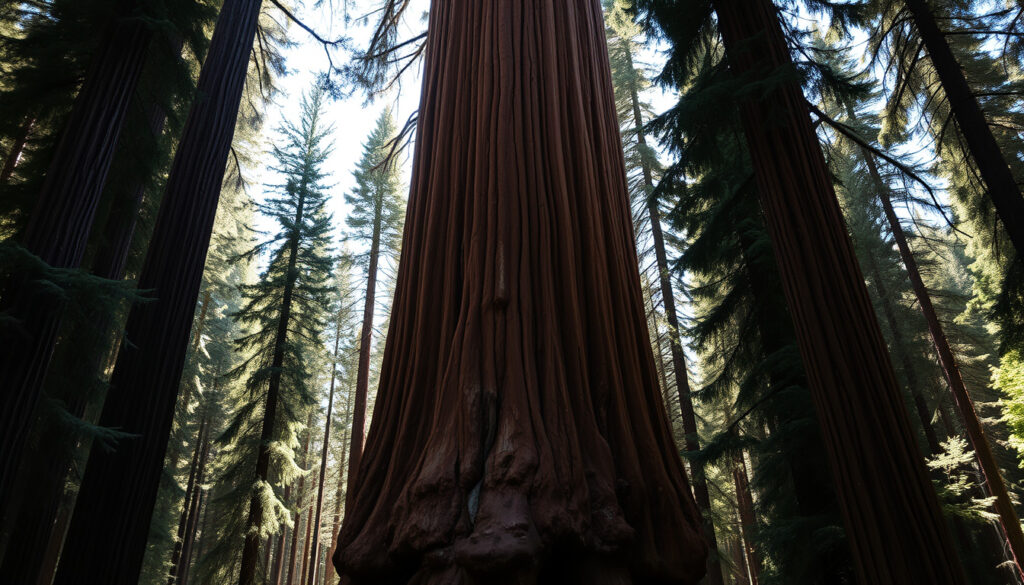
Biggest Tree in the World: General Sherman Facts & Age
There is something quietly staggering about a living thing that has been standing in the same spot since before the Roman Empire fell. The General Sherman Tree in California’s Sequoia National Park is the largest single-stem tree on Earth by volume, estimated at 52,500 cubic feet.
Volume: 52,500 cubic feet · Height: 275 feet (83.8 m) · Diameter: 7.7 m (25 ft) · Location: Sequoia National Park, California · Age estimate: 2,200 – 2,700 years
Quick snapshot
- Largest tree by volume: 52,500 cu ft (National Park Service)
- Height: 274.9 ft (83.8 m) (National Park Service)
- Location: Sequoia National Park, California (Wikipedia)
- Exact age of General Sherman — only a range of 2,200–2,700 years (NPS History)
- Exact age of the oldest known sequoia — estimates vary by several centuries (USDA Forest Service)
- Exact number of remaining giant sequoias — approximate 75,000 (Save the Redwoods League)
- General Sherman’s age estimated at 2,200–2,700 years (National Park Service)
- Giant sequoias can live up to ~3,200 years (USDA Forest Service)
- Coast redwoods live up to ~2,200 years (USDA Forest Service)
- Climate change and wildfires threaten giant sequoia groves (National Park Service)
- Ongoing monitoring and conservation efforts are critical (Save the Redwoods League)
Here are the confirmed measurements for the largest tree by volume.
| Attribute | Value |
|---|---|
| Scientific name | Sequoiadendron giganteum |
| Common name | Giant sequoia |
| Location | Sequoia National Park, California |
| Height | 275 ft (83.8 m) |
| Diameter | 7.7 m (25 ft) |
| Volume | 52,500 cubic ft |
| Age estimate | 2,200 – 2,700 years |
| Status | Endangered |
Where is the largest tree in the world?
In which national park is the General Sherman Tree located?
The General Sherman Tree stands in the Giant Forest grove of Sequoia National Park, California. The park, managed by the National Park Service, protects the grove as part of a designated wilderness area. Visitors can reach it via a short paved trail from the park’s main road.
What is the exact GPS location?
The tree’s coordinates are approximately 36°34′51″N 118°45′03″W. The National Park Service provides detailed directions to the General Sherman Tree parking area, which is about a 0.5-mile walk from the tree itself.
The tree’s location inside a protected national park buffers it from direct logging, but the grove remains vulnerable to wildfires and drought — threats that don’t respect park boundaries.
The implication: Sequoia National Park is the only place on Earth where the largest tree by volume can be seen, but its protection is not absolute.
What are the big 5 trees?
Which trees are considered the top 5 largest by volume?
The five largest living single-stem trees by volume — all giant sequoias in California — are:
- General Sherman – 52,500 cu ft
- General Grant – 46,608 cu ft
- President – 45,148 cu ft
- Lincoln – 44,471 cu ft
- Stagg – 42,557 cu ft
These figures come from the Wikipedia entry on General Sherman, which notes that volumes are based on trunk measurements and may vary slightly with new data.
What are the approximate volumes of each?
As listed above, the volumes range from General Sherman’s 52,500 cu ft down to Stagg’s 42,557 cu ft. The National Park Service confirms that General Sherman is the largest of the five, and the group is collectively known as the “Big 5” among giant sequoia enthusiasts.
Volume rankings are impressive, but they don’t account for height. The tallest tree on Earth — Hyperion, a coast redwood — reaches 379 feet, far shorter in volume but much taller in stature.
The pattern: The Big 5 are all giant sequoias, meaning the title of “biggest tree” is a intra-species competition among trees that share the same grove conditions.
Which is bigger, giant sequoia or redwood?
What is the difference in height?
Coast redwoods are taller. The USDA Forest Service states that coast redwoods can reach up to 370 feet, while giant sequoias top out at about 311 feet. General Sherman, at 275 feet, is well below the redwood maximum.
What is the difference in volume?
Giant sequoias win on volume. The Save the Redwoods League explains that giant sequoias are the world’s largest trees by volume, with General Sherman at 52,500 cu ft. Coast redwoods, despite their height, have smaller trunks and less total wood.
What is the difference in trunk diameter?
Giant sequoia trunks are thicker. The National Park Service reports General Sherman’s maximum base diameter at 36.5 feet. Coast redwoods typically have diameters under 20 feet at breast height.
Two species, one pattern: giant sequoias are the volume champions; coast redwoods are the height champions. A comparison table makes the contrast clear.
| Attribute | Giant Sequoia (General Sherman) | Coast Redwood (Hyperion) |
|---|---|---|
| Maximum height | 311 ft (USDA Forest Service) | 379 ft (USDA Forest Service) |
| Maximum volume | 52,500 cu ft (NPS) | ~40,000 cu ft (estimated) |
| Maximum trunk diameter | 36.5 ft (NPS) | ~15 ft |
| Maximum lifespan | ~3,200 years (USDA Forest Service) | ~2,200 years (USDA Forest Service) |
| Natural range | Western slopes of Sierra Nevada, CA (Save the Redwoods League) | Coastal California to Oregon |
The catch: If you want sheer height, see a coast redwood. If you want the biggest tree in the world by volume, the General Sherman is the one.
How many giant sequoia trees are left?
What is the current population estimate?
Approximately 75,000 giant sequoia trees remain. This estimate comes from the Save the Redwoods League, which notes that the number is an approximation and may be revised as surveys improve.
Where do giant sequoias naturally grow?
Giant sequoias are confined to about 73 groves on the western slopes of the Sierra Nevada in California, at elevations between 5,000 and 7,000 feet. The National Park Service confirms that these groves are disjunct — isolated from each other by valleys and ridges.
With only 75,000 individuals left, giant sequoias are classified as Endangered. Climate change intensifies drought and wildfire, reducing the already limited habitat.
The trade-off: The groves are protected, but their small, fragmented distribution makes them especially vulnerable to a single catastrophic fire season.
How old is the oldest living sequoia tree?
What is the oldest known giant sequoia individual?
The oldest known giant sequoia is the President tree, estimated at around 3,200 years. The USDA Forest Service states that giant sequoias can live up to approximately 3,200 years, though individual ages vary. The President tree’s age is based on core samples and growth ring counts.
What tree is 9000 years old?
No giant sequoia is 9,000 years old. The 9,000-year-old tree is a clonal spruce called Old Tjikko in Sweden, which is a clonal colony of Norway spruce — not a single-stem tree. The distinction is important: clonal trees can regenerate from roots, while sequoias are single-stem individuals.
Is there a 10,000 year old tree?
Not as a single-stem tree. The oldest known non-clonal tree is Methuselah, a bristlecone pine in California, at 4,854 years. No living sequoia approaches that age.
How old is the Grizzly Giant?
Grizzly Giant, a giant sequoia in Mariposa Grove, is estimated at about 1,900 years old.
What does a 50-year-old sequoia look like?
A 50-year-old giant sequoia is still relatively small — about 20–30 feet tall with a narrow trunk, according to growth patterns observed in the groves.
The implication: Sequoia ages are estimates, not exact dates, because the oldest trees have hollow centers that prevent complete ring counts.
Are sequoias older than dinosaurs?
When did sequoias first appear on Earth?
The sequoia family (Cupressaceae) dates back to the Jurassic period, around 200 million years ago. That means the ancestors of modern sequoias coexisted with dinosaurs. The Wikipedia article on giant sequoias notes that the genus Sequoiadendron evolved later, but its lineage is ancient.
When did dinosaurs go extinct?
Non-avian dinosaurs went extinct about 66 million years ago, at the end of the Cretaceous period. The sequoia lineage survived that extinction event.
Do modern giant sequoias date back to the age of dinosaurs?
Modern giant sequoias (Sequoiadendron giganteum) evolved much later, but the family to which they belong — the redwood subfamily — has been present on Earth since the Jurassic. So yes, sequoias as a family are older than dinosaurs, though the individual species we see today is younger.
The pattern: The sequoia family is a living fossil, but the current giant sequoia species is a relative newcomer.
Clarity: What we know and what we don’t
Confirmed facts
- General Sherman is the largest tree by volume (52,500 cu ft) — National Park Service
- Height is 274.9 ft (83.8 m) — National Park Service
- Location is Sequoia National Park, California — Wikipedia
- Volume was measured and confirmed by the NPS and Wikipedia
What’s unclear
- Exact age of General Sherman — only a range of 2,200–2,700 years is available
- Exact age of the oldest known giant sequoia — estimates vary by centuries
- Exact number of remaining giant sequoias — approximate 75,000
Perspectives from experts
“General Sherman is the largest tree in the world by volume, estimated at 52,500 cubic feet.”
— National Park Service
“General Sherman is a giant sequoia and the largest known living single-stem tree on Earth.”
— Wikipedia
“The General Sherman tree is the biggest tree in the world alive today, by volume.”
Three sources, one verdict: General Sherman holds the volume crown. But the Natural History Museum’s phrasing — “by volume” — reminds us that tallest, oldest, and biggest are separate titles.
Summary: What this means for the future
The General Sherman Tree is the largest single-stem tree on Earth by volume, a title it has held for decades. But its age — likely between 2,200 and 2,700 years — makes it a living witness to climate shifts that are now accelerating. For the National Park Service, the choice is clear: invest in fire management and drought mitigation, or risk losing the biggest tree in the world to a single wildfire season.
Related reading: State Highway 1 Trees Block
npshistory.com, a-z-animals.com, forestsource.io, yosemite.ca.us, plantly.io, shakaguide.com
Frequently asked questions
How tall is the General Sherman Tree?
General Sherman is 274.9 feet (83.8 meters) tall, according to the National Park Service.
What is the diameter of the General Sherman Tree?
The maximum base diameter is 36.5 feet (11.1 meters), as recorded by the National Park Service. At breast height, the diameter is about 7.7 meters (25 feet).
How old is the General Sherman Tree?
Age estimates range from 2,200 to 2,700 years. The National Park Service gives a recent estimate of about 2,200 years, while an older NPS History brochure suggests 2,000–2,700 years.
Can you visit the General Sherman Tree?
Yes. The tree is accessible via a paved trail from the General Sherman Tree parking area in Sequoia National Park. The National Park Service provides directions and visitor tips.
Why is the General Sherman Tree so big?
Its size is due to a combination of genetics, favorable climate, and millennia of uninterrupted growth. The Save the Redwoods League notes that giant sequoias have evolved to maximize volume in the Sierra Nevada environment.
What threats do giant sequoias face?
Climate change, drought, and high-severity wildfires pose the greatest risks. The National Park Service monitors these threats and implements fire management strategies.
How does the General Sherman Tree compare to the tallest tree (Hyperion)?
General Sherman is larger in volume (52,500 cu ft) but much shorter. Hyperion, a coast redwood, is 379 feet tall but has a smaller trunk volume. The two trees hold different records: volume vs. height.
More related posts
 Pak’nSave Rotorua: Hours, Location & Grocery Price Guide
 Best Android Phone 2025: Expert-Rated Picks & Comparisons
 What Is a Wind Chill Factor? Definition, Formula & Safety
 South Island New Zealand Heavy Rain: Live Warnings & Forecast
 The Fat Duck Te Anau: Menu, Prices, Reviews & Reservations
 AA Distance Calculator NZ: Plan Drives with the AA Trip Tracker
 Flights Wellington to Nelson: Direct, Cheap & Flight Time
 New Balance Shoes Near Me: Stores & Fit Guide in Ireland