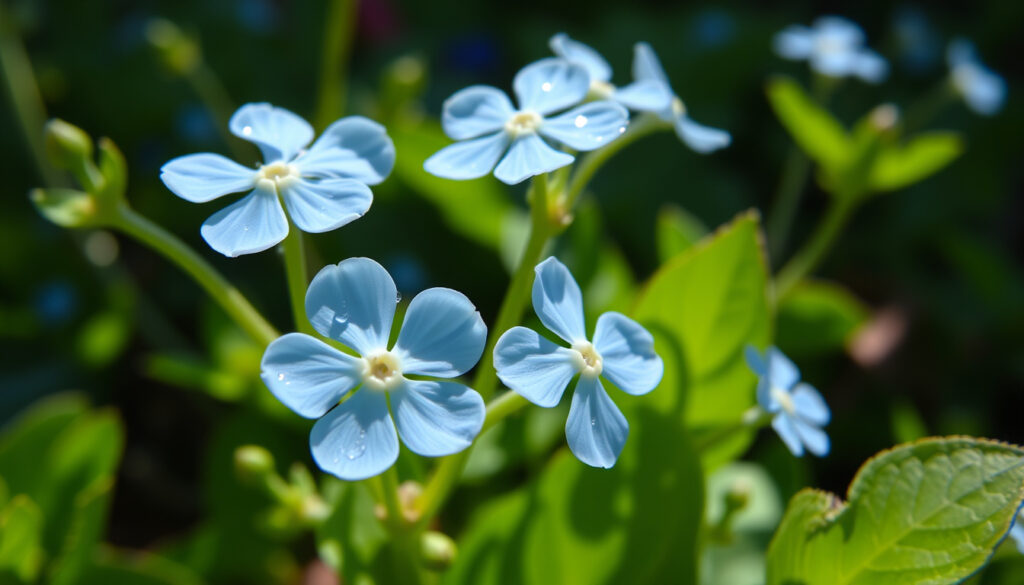
Forget Me Not Flowers: Symbolism, Growth, and Care Guide
There’s something quietly compelling about a flower that asks to be remembered. Forget-me-nots have carried that request across centuries and continents, from Greek myths to Irish hedgerows. The field forget-me-not (Myosotis arvensis) is a native annual that flowers from April to September across Ireland, according to Irish Wildflowers (native flora database). We’ll unpack their symbolism, their growth habits, and why they remain a favourite in both wild landscapes and garden arrangements.
Scientific name: Myosotis (genus) ·
Flower color: Mostly blue, also pink, white ·
Bloom time: Spring to early summer ·
Symbolism: Remembrance, true love, fidelity
Quick snapshot
- Forget-me-nots symbolize remembrance and true love (Gardenia (horticultural guide))
- Field forget-me-not (Myosotis arvensis) is native to Ireland (Irish Wildflowers (native flora database))
- Bloom from April to June (Gardeners’ World (UK gardening magazine))
- Exact origin of the name is debated (Bouqs Blog (flower symbolism resource))
- Whether Princess Diana’s favorite flower was forget-me-not is unconfirmed (Gardenia (horticultural guide))
- Ancient Greece: myth of a flower crying ‘Forget me not’ (Gardenia (horticultural guide))
- Medieval Europe: knights wore flower as pledge of faithfulness (Bouqs Blog (flower symbolism resource))
- 20th century: emblem for Alzheimer’s awareness (Gardenia (horticultural guide))
- Plant seeds in late summer or early autumn for spring blooms (Gardeners’ World (UK gardening magazine))
- Expect self-seeding for naturalized display (Gardenia (horticultural guide))
Six key facts about forget-me-not flowers, one pattern: they are small but rich in meaning, blending botanical detail with cultural weight.
| Label | Value |
|---|---|
| Scientific name | Myosotis scorpioides, Myosotis arvensis, etc. |
| Family | Boraginaceae |
| Native range | Europe, Asia, and temperate regions |
| Bloom time | April to June |
| Flower color | Typically blue with yellow eye |
| Symbolism | Remembrance, fidelity, true love |
What do forget-me-not flowers symbolize?
Historical meanings
Forget-me-nots have been linked to remembrance and true love for centuries. In the Victorian era, they were given as tokens of devotion (Gardenia (horticultural guide)). During the 15th century, knights wore the flower as a pledge of faithfulness to their ladies (Bouqs Blog (flower symbolism resource)). The theme of fidelity runs deep across cultures and eras.
Cultural significance
Today, the flower carries a dual meaning. It is both a romantic symbol and a modern emblem for Alzheimer’s awareness, hospice care, and child abuse prevention (Gardenia (horticultural guide)). The association with memory loss gives the flower a poignant, almost contradictory role — it asks to be remembered even as it represents forgetting.
Forget-me-nots carry a dual legacy: they are both a romantic token and a symbol of memory loss awareness. That emotional range is rare in a flower that measures just a few millimetres across.
The implication: forget-me-nots have been used as a quiet signal of loyalty across very different eras — from a knight’s pledge to a modern charity ribbon. Their symbolic adaptability is what keeps them in demand.
Do forget-me-nots flower each year?
Perennial growth habit
Most forget-me-nots are biennial or short-lived perennials. They grow leaves in the first year, bloom in the second, and then die — but they self-seed readily, so they often appear to be perennial (Gardeners’ World (UK gardening magazine)). The field forget-me-not (Myosotis arvensis) is an annual in Ireland, flowering and seeding in a single season (Irish Wildflowers (native flora database)).
Bloom time
Forget-me-nots typically bloom from April to June, with some varieties extending into September if conditions are cool and moist (Gardenia (horticultural guide)). In Ireland, the field forget-me-not flowers from April to September (Irish Wildflowers (native flora database)).
Gardeners who plant forget-me-nots expecting a perennial that returns year after year from the same root may be disappointed. The secret is in the self-seeding — let the flowers go to seed, and you’ll have a continuous display.
The catch: while they appear perennial thanks to self-seeding, individual plants rarely live more than two years — so consistent blooms require a bit of garden management, mainly allowing seed heads to mature.
Why are they called forget-me-not flowers?
Greek myth
The name is rooted in a Greek myth where a flower cried out “Forget me not” when plucked by a goddess (Gardenia (horticultural guide)). The genus name Myosotis comes from the Greek words for “mouse” and “ear” — a reference to the leaf shape (Irish Plants Direct (Irish seed retailer)).
German legend
A German legend tells of a knight who drowned while picking flowers for his lady, throwing the bouquet to her and shouting “Forget me not!” (Bouqs Blog (flower symbolism resource)). This story cemented the flower’s connection to love and remembrance.
Medieval symbolism
In medieval Europe, the flower was a symbol of faithfulness and was often used in love tokens and remembrance customs (Bouqs Blog (flower symbolism resource)).
The pattern: the name itself is a story — a flower that became a verb, a plea, and a cultural touchstone all in one.
Do forget-me-nots grow in Ireland?
Native Irish species
Yes, the field forget-me-not (Myosotis arvensis) is a common native wildflower in Ireland. It is an annual that grows in hedgerows, damp fields, and roadside verges (Irish Wildflowers (native flora database)). The wood forget-me-not (Myosotis sylvatica) is also found in ancient and wet woodlands, along rides and edges (The Wildlife Trusts (UK conservation charity)).
Where to find them
Forget-me-nots prefer damp, shady areas — think stream banks, woodland edges, and the margins of damp gardens. In Ireland, they are especially common in the west and north where rainfall is higher. They are also popular in Irish gardens as border plants and ground cover (Irish Plants Direct (Irish seed retailer)).
Why this matters: for Irish gardeners, these are not exotic imports but local wildflowers that thrive with minimal fuss. They support native pollinators and fit naturally into the Irish landscape.
Which birth month is forget-me-not?
September birth flower
Forget-me-nots are the birth flower for September (Gardenia (horticultural guide)). They are also associated with the 40th wedding anniversary, representing lasting love and fidelity.
Other meanings
Beyond birth flowers, forget-me-nots are used as a symbol for Alzheimer’s awareness and memory-related causes. Their small blue flowers are instantly recognizable and carry a gentle emotional weight (Gardenia (horticultural guide)).
The trade-off: being a birth flower gives it a commercial niche, but its deeper meaning as a memory symbol gives it a more universal appeal — one that transcends monthly calendars.
Confirmed facts
- Forget-me-nots are associated with remembrance (Gardenia (horticultural guide))
- Field forget-me-not is native to Ireland (Irish Wildflowers (native flora database))
- They bloom in spring to early summer (Gardeners’ World (UK gardening magazine))
What’s unclear
- Exact origin of the name is debated (Bouqs Blog (flower symbolism resource))
- Whether Princess Diana’s favorite flower was forget-me-not is unconfirmed (Gardenia (horticultural guide))
- The life cycle of forget-me-nots is often misunderstood due to self-seeding (Gardeners’ World (UK gardening magazine))
“Forget-me-nots are a diverse genus of plants that thrive in moist, well-drained soil and partial shade, making them ideal for woodland gardens.”
— Royal Horticultural Society
“Field forget-me-not is one of our most common native wildflowers, flowering from April to September in hedgerows and damp fields across the country.”
— Wildflowers of Ireland
For Irish gardeners, the choice is clear: forget-me-nots offer a low-maintenance, self-seeding burst of blue that honours both native biodiversity and centuries of symbolic meaning. Plant them in autumn, let them naturalise, and they’ll ask to be remembered year after year.
Related reading: **Ground Cover Plants NZ: Low-Maintenance, Blooming Weed Blockers** · **Raspberry Leaf Tea NZ: When to Drink, Benefits & Safety**
farmersalmanac.com, youtube.com, reddit.com, lifetips.alibaba.com, en.wikipedia.org, illinoiswildflowers.info
For a deeper dive into the cultural significance of these blooms, the forget-me-not flower meaning guide provides an excellent overview.
Frequently asked questions
What is the best soil for forget-me-nots?
Moist but well-drained soil is ideal. They thrive in rich, loamy soil but can adapt to average garden soil as long as it doesn’t dry out completely (Gardeners’ World (UK gardening magazine)).
How often should I water forget-me-nots?
Water regularly to keep the soil consistently moist, especially during dry spells. They prefer cool, damp conditions (Gardenia (horticultural guide)).
Do forget-me-nots need fertilizer?
Generally no. They are light feeders and grow well in average soil. A thin layer of compost in spring can help, but avoid heavy fertiliser which can encourage leaf growth at the expense of flowers.
Can forget-me-nots grow in shade?
Yes, they do well in partial shade. In fact, they prefer cool, shady spots and moist soil (Gardeners’ World (UK gardening magazine)).
How to prevent forget-me-nots from taking over?
Deadhead flowers before they set seed to control spread. Alternatively, pull up unwanted seedlings in spring. They self-seed aggressively, so regular thinning is required.
Are forget-me-nots toxic to pets?
Forget-me-nots are generally considered non-toxic to dogs and cats. However, ingestion of large quantities may cause mild digestive upset. Always consult a vet if concerned.
How to dry forget-me-not flowers?
Cut stems just before full bloom, hang them upside down in a warm, dark, well-ventilated place for two to three weeks. The small blue flowers dry well and retain their colour.
More related posts
 How to Post on Instagram from Desktop: Step-by-Step Guide
 Ninja Slushie NZ Price: Cost, Alternatives & Where to Buy
 Used Cars for Sale in Christchurch, Dorset: 6k+ Listings
 Spider-Man: Across the Spider-Verse 3 Release & Delay Answers
 Houses for Sale in Maraetai: Prices, Buying Rules & Guide
 Two by Two Religion: What the BBC 2025 Investigation Found
 New Balance Lifestyle Mode de Vie – Guide to Everyday Classics