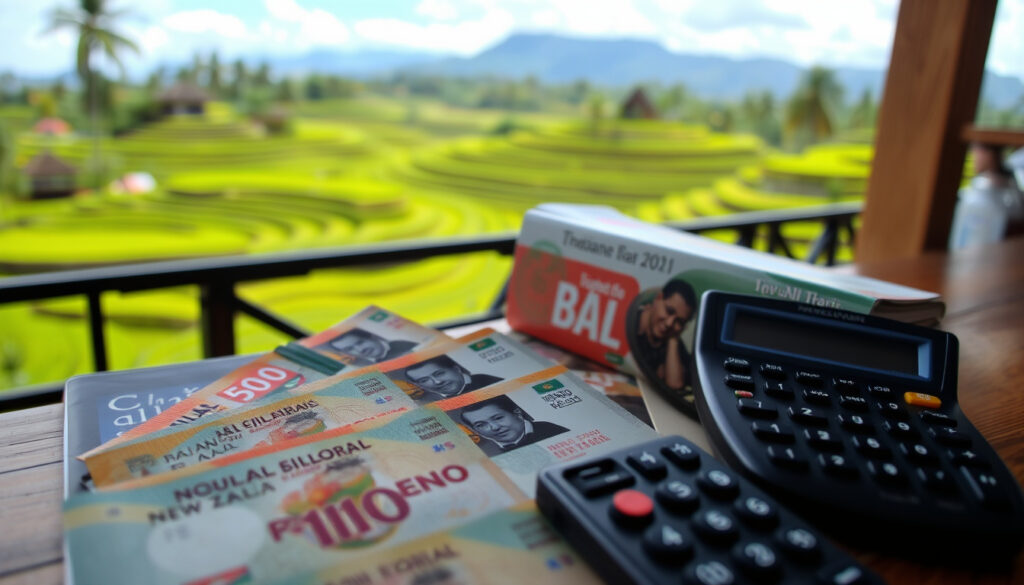
NZD to Bali Currency: Exchange Rates, Tips & Cost of Living Guide
There’s a moment in every Bali trip plan when the currency math stops being exciting and starts feeling like homework: 1 NZD gets you roughly 9,500 rupiah, so a 100,000 IDR dinner is about $10 NZD. Before the beach, you need a money plan.
Exchange rate (approximate): 1 NZD ≈ 9,500 IDR ·
Cost of living difference: Bali is 35.5% cheaper than New Zealand ·
Flight duration: ~7–9 hours direct from Auckland ·
Cheapest month to fly: Usually February or March ·
Visa requirement: Visa-free for up to 30 days
Quick snapshot
- Bali’s official currency is the Indonesian rupiah (IDR), and it’s the only currency commonly accepted in shops and restaurants (Thomas Cook’s Bali travel money guide)
- Foreign currencies such as Australian dollars are generally not usable for transactions in Bali (Travelex Australia’s Bali currency guide)
- You don’t need to exchange NZD before arriving — Bali’s ATMs and licensed money changers handle it once you land (Wise’s Bali travel money guide)
- Exact fees depend on the service provider — banks, ATMs, and money changers all set their own margins (Traveloka’s Bali currency guide)
- Rate benchmarks disagree: one source put 1 USD near 16,000 IDR in July 2024 (Traveloka’s Bali currency guide) while another later put it near 18,000 IDR (Finns Beach Club’s Bali currency guide)
- The best exchange method varies depending on the amount you carry and your travel dates (Traveloka’s Bali currency guide)
- Earlier rule-of-thumb rates of about 1 USD = 15,000 IDR are no longer current; newer benchmarks sit higher (Finns Beach Club’s Bali currency guide)
- As of July 2024, 1 USD was about 16,000 IDR and 1 AUD about 10,800 IDR (Traveloka’s Bali currency guide)
- Major banks, airports, and hotels in Indonesia typically have money exchange services (Western Union’s Indonesia currency guide)
- Look for the PVA Berizin sign to identify Bank Indonesia-authorized money changers (PickYourTrail’s Bali money guide)
- NZ passport holders get visa-free entry for up to 30 days (Western Union’s Indonesia currency guide)
NZD to Bali currency at a glance
Eight facts, one pattern: the flight and visa figures stay fixed for everyone, but the rupiah numbers move with the market, so treat this table as a planning range rather than a quote.
| Fact | Value |
|---|---|
| 1 NZD to IDR (approximate) | 9,500 IDR |
| Cost of living difference | Bali 35.5% cheaper than New Zealand |
| Flight duration (NZ to Bali) | 7–9 hours direct |
| Cheapest month to fly | February or March |
| Visa requirement for NZ passport | Visa-free up to 30 days |
| Visa on arrival (B1) | About 500,000 IDR, extendable once |
| Daily budget (backpacker) | 300,000–500,000 IDR |
| Licensed money changer marker | PVA Berizin sign from Bank Indonesia (PickYourTrail’s Bali money guide) |
The pattern: the fixed inputs — flight time, visa window, budget range — set the frame, and the live exchange rate fills in the details. Check the mid-market rate a week before you leave, then again the day you fly.
Is it better to exchange money in NZ or Bali?
Where should you hand over your New Zealand dollars? The simplest answer, from travel money specialists: wait until you land, rather than paying for the convenience of doing it at home.
Exchange rates in New Zealand vs Bali
- New Zealand banks and FX counters will sell you rupiah before you fly, but the pre-departure convenience is built into the rate you’re offered.
- In Bali, licensed money changers compete openly for tourist business — Hotels.com’s Bali money changer guide lists operators such as BMC Money Changer and Central Kuta Money Exchange across Seminyak, Legian, Kuta, and Ubud.
- Wise’s Bali travel money guide says you don’t need to exchange before arriving — you can exchange once you’re on the island.
Wise also suggests a simpler route: withdraw rupiah directly from an ATM when you land (Wise’s Bali exchange-rate tips). You get the local rate at the moment of withdrawal, minus whatever your New Zealand bank charges for foreign transactions.
Fees and commissions
- Money changers make their money on the exchange margin, so the final rate can differ from the board rate you first see.
- Major banks, airports, and hotels in Indonesia typically have money exchange services, according to Western Union’s Indonesia currency guide — so you’re never stuck with only one option.
- ATMs charge a combination of the machine owner’s fee and your home bank’s foreign transaction fee; those fees, not the exchange rate, can be the real cost of using a card.
The catch: convenience has a price at every counter. Hotel desks exist for ease, but their rates rarely match what a dedicated licensed money changer will offer two streets away.
Safety and convenience
- Look for the PVA Berizin sign — it marks money changers authorized by Bank Indonesia (PickYourTrail’s Bali money guide).
- Some licensed counters post long hours: one Seminyak branch operates daily from 7:30am to 1am, and a Legian branch runs from 8am to 9pm (Hotels.com’s Bali money changer guide).
- Travelex Australia’s Bali currency guide warns that foreign currencies such as Australian dollars are generally not accepted for transactions in Bali — so carrying NZD cash “just in case” buys you less than you think.
The implication: if you’re comfortable using an ATM on arrival and checking the PVA Berizin sign before a cash exchange, Bali offers better rates and more options than New Zealand’s FX counters.
New Zealand’s FX counters sell convenience, and convenience has a margin. Bali’s licensed money changers compete for your business in a market that stays open until 1am in Seminyak — more options, and more reasons to check the math.
How far does $1 go in Bali?
At the 9,500 IDR working rate, one New Zealand dollar becomes a sizable stack of rupiah. Once you convert the big numbers back into NZD, the island’s prices feel small — and the daily budget math gets a lot clearer.
Cost of a meal
- Street food and local warungs: roughly 20,000–40,000 IDR — about $2–$4 NZD.
- Use the same multiplier for anything else on the menu: 50,000 IDR is roughly $5 NZD, and 100,000 IDR is roughly $10 NZD.
The rates themselves move, though. Traveloka’s Bali currency guide recorded 1 USD at about 16,000 IDR in July 2024, while Finns Beach Club’s Bali currency guide later put 1 USD near 18,000 IDR and 1 AUD near 13,000 IDR. Currency specialists at Wise’s Bali exchange-rate guide recommend checking the real mid-market rate with a quick online search before you commit.
Transportation costs
- A typical taxi or ride-hailing trip within tourist areas runs roughly 50,000–100,000 IDR — about $5–$10 NZD.
- The exact fare depends on distance and traffic, so it’s the range, not the number, that belongs in your budget.
Put that next to the meal range, and a day of eating out plus a couple of rides lands between 160,000 and 320,000 IDR — right inside the backpacker budget range discussed below.
Accommodation prices
- Budget accommodation starts from about 150,000 IDR per night — roughly $16 NZD at the 9,500 rate.
- A week in a budget guesthouse can cost less than a single night at many New Zealand hotels.
What this means: how expensive Bali feels depends on where you eat, how far you ride, and where you sleep. The rupiah’s big numbers are psychological — the real question is how many days you’re planning to spend them.
Does NZ need a visa for Indonesia?
The visa question comes up almost as often as the exchange-rate question, because both decide how much time and money you need to prepare. For most New Zealanders, the answer is simple: no visa is required for stays up to 30 days.
Visa-free entry for New Zealand passport holders
- New Zealand passport holders can enter Indonesia visa-free for up to 30 days.
- The visa-free entry is not extendable, so a trip longer than 30 days requires a different visa category.
Visa on arrival (B1) details
- The visa on arrival (B1) costs roughly 500,000 IDR — around $35 NZD.
- It grants 30 days from arrival and can be extended once for another 30 days.
Extension options
- Your passport must be valid for at least six months beyond your arrival date.
- If you plan to stay beyond 30 days, budget for the B1 extension and leave room in your itinerary to handle it.
The catch: visa rules sit outside the currency market, so they won’t show up in an exchange rate. Confirm the current requirements before you book — the 30-day visa-free window is generous, but it doesn’t stretch.
Is Bali expensive to visit?
Compared with New Zealand, no — and the gap is wide enough to change how long you can afford to stay.
Cost comparison with New Zealand
- Bali is roughly 35.5% cheaper than New Zealand overall.
- At the working 9,500 IDR rate, things priced in rupiah convert back to NZD at a fraction of what similar items cost back home.
A 10-day trip at the backpacker budget works out to about 3,000,000–5,000,000 IDR on the island — roughly $315–$525 NZD before flights.
Budget estimates per day
- Backpackers typically spend 300,000–500,000 IDR per day — about $32–$52 NZD.
- That range covers street food, short rides, and budget-to-mid-range accommodation using the prices above.
Cheapest times to visit
- February and March, when low season lowers both airfares and room rates, are usually the cheapest months to fly from New Zealand.
- Those months also fall outside the peak-season rush, which keeps beaches and roads quieter.
Why this matters: the cost gap is the difference between a shorter trip and a longer one. If the 35.5% figure held evenly, two weeks in New Zealand would buy close to three weeks in Bali — and that’s exactly why the exchange-rate conversation is worth having before you book.
Can you fly direct from NZ to Bali?
Yes — and the direct flight matters for your money plan, because it removes the temptation to do something clever with currency at a stopover airport.
Airlines offering direct flights
- Air New Zealand and Garuda Indonesia both operate direct flights from Auckland to Denpasar.
- A direct route means your rupiah needs start when you land, not midway through a connection.
Flight duration
- The direct flight from Auckland to Denpasar takes roughly 7–9 hours.
That’s short enough that the flight itself is rarely the costly part of the trip — the exchange rate and the visa are the numbers that deserve 10 minutes of planning.
Best time to book
- February and March are the cheapest months to fly, once holiday demand has eased.
- For the lowest fares, search those dates from Auckland with flexible dates and compare across airlines.
The trade-off: cheap low-season fares come with quieter streets and lower room rates, so the savings show up in both the airfare and the daily budget.
If you’re weighing Bali against other holidays in the region, our NZD to INR rate guide and New Zealand Dollar to LKR guide show how far the same NZD travels elsewhere in Asia.
The best way to exchange NZD for Bali
Four ways to get rupiah, one honest pattern: every channel charges something between the mid-market rate and the rate you actually receive. The table weighs convenience against cost.
| Method | Convenience | Watch out for | Best for |
|---|---|---|---|
| Exchange in New Zealand | Sorted before you fly | Wider margins at banks and FX counters | Travelers who want rupiah in hand at arrival |
| ATM withdrawal in Bali | ATMs are widespread in tourist areas | Foreign transaction fees from your New Zealand bank | Most travelers — simple and near the local rate |
| Licensed money changer in Bali | Long hours, including counters open until 1am (Hotels.com’s Bali money changer guide) | The rate on the board can differ from the rate you get | Cash-focused travelers who want a competitive rate |
| Travel money card | Load NZD, spend in IDR | Card fees and ATM withdrawal limits | Travelers who prefer to avoid cash |
The pattern: every method gets you rupiah; the difference is who takes a cut. ATMs and licensed money changers are the channels most guides steer travelers toward, and both beat carrying a pile of NZD cash that Bali businesses generally won’t accept.
The rate on a street board is an invitation, not a contract. Only money changers displaying the Bank Indonesia PVA Berizin sign are authorized, and the difference between a licensed and unlicensed counter is the difference between a fair rate and a costly mistake.
What’s confirmed, what’s unclear
Confirmed facts
- Bali uses the Indonesian rupiah (IDR), the same currency used across Indonesia (Travelex Australia’s Bali currency guide)
- Direct flights operate from Auckland to Denpasar, taking about 7–9 hours.
- New Zealand passport holders get visa-free entry to Indonesia for up to 30 days.
- Bali is cheaper than New Zealand overall — roughly 35.5% cheaper by cost-of-living comparisons.
What’s unclear
- Exact exchange fees depend on the service provider; there is no single published rate that applies everywhere.
- The best exchange method can vary with the amount you carry and your travel dates.
- Published guidelines disagree on the current dollar rate: Traveloka’s Bali currency guide put 1 USD near 16,000 IDR in July 2024, while Finns Beach Club’s Bali currency guide later put it near 18,000 IDR — a gap that signals how fast the market moves.
- Whether a New Zealand bank’s FX counter beats Bali’s licensed money changers depends on your bank’s margin, which is rarely published upfront.
What other travelers say
“I stopped using street money changers and just hit the ATM when I land. The rate is close to the real rate, and I don’t have to count cash on a corner.”
— Traveler, r/newzealand, on the ATM approach in Bali
“The visa-on-arrival desk was straightforward, but I wish I’d planned for the extension earlier — the 30 days run faster than you expect.”
— Member, Bali travel Facebook group, on the B1 visa on arrival
The takeaway for your Bali money plan
The cheapest, lowest-hassle way to spend NZD in Bali is to keep the exchange simple: don’t load up on rupiah in New Zealand, use ATMs for most of your cash, and when you do exchange in person, use only licensed money changers with the PVA Berizin sign. Sort the visa first — visa-free if you’re under 30 days, B1 visa on arrival if you’re not — and target February or March if the airfare matters. For a New Zealander heading to Bali, the choice is clear: sort your rupiah after you land, using ATMs and licensed money changers — or accept the wider margin at home and arrive with cash in your pocket.
travelex.com.au, thehoneycombers.com, baliholidaysecrets.com, wise.com
Frequently asked questions
What is the current exchange rate for NZD to IDR?
The rate moves daily, but a working planning figure is 1 NZD ≈ 9,500 IDR. Check a live mid-market converter before you go, since the rate shifts.
Should I exchange money before leaving New Zealand?
Not usually. Travel money specialist Wise says you don’t need to exchange before arriving — you can use an ATM or a licensed money changer once you’re in Bali and get the local rate while carrying less NZD cash.
How much cash should I bring to Bali?
Bring a debit card you can use at ATMs and only a little NZD cash. A typical backpacker budget runs 300,000–500,000 IDR per day ($32–$52 NZD), so a week on the island means roughly 2,100,000–3,500,000 IDR in spending money — about $220–$370 NZD.
What is the best travel money card for Bali?
A travel money card that lets you load NZD and spend in IDR is convenient, but the best choice depends on your bank’s fees. Compare card fees and foreign transaction charges before you leave.
Can I use New Zealand dollars in Bali?
Not in practice. Travelex notes that foreign currencies such as Australian dollars are generally not used for transactions in Bali, so your NZD needs to be converted to rupiah first.
Is it safe to use ATMs in Bali?
ATMs are widely available in tourist areas, and withdrawing on arrival is the approach Wise recommends. For larger cash exchanges, stick to licensed money changers with the PVA Berizin sign.
More related posts
 Palmerston North Death Notices: Recent Obituaries & How to Find
 Harbour Town Gold Coast: Australia’s Largest Outlet Mall
 ANZ Mortgage Interest Rates 2026: Current Rates & Forecast
 Ninja Double Stack Air Fryer: Is the Vertical Design Worth It?
 PB Tech Price Match: Conditions, How to Request, and Alternatives
 Cake in a Cup NZ – Quick Microwave Desserts Using Kiwi Staples
 New World Three Parks: Wanaka Hours, Location & Reviews
 Tasman Holiday Park Miranda: Prices, Reviews & Amenities