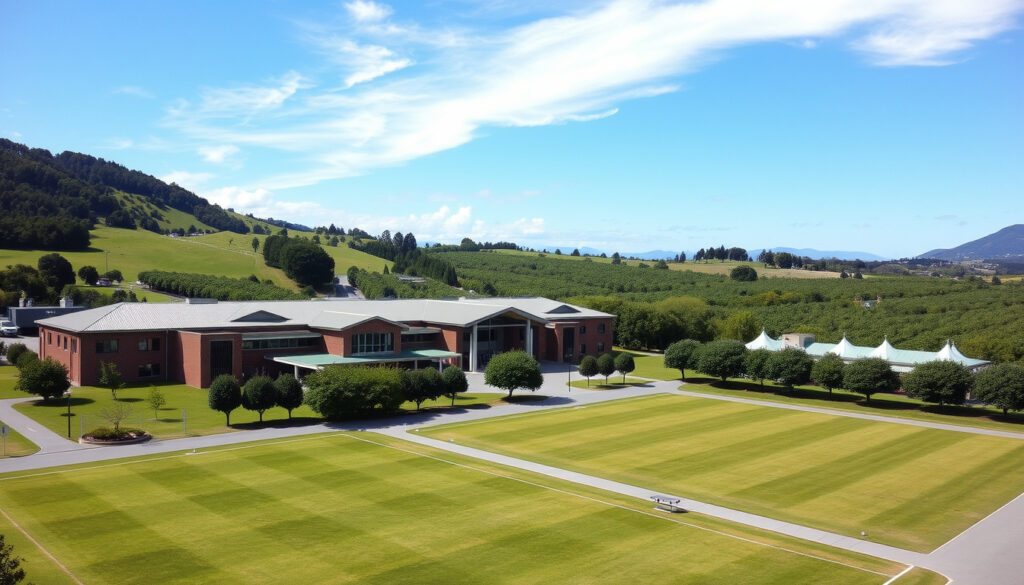
Te Puke High School – Location, Decile, Principal and Facts
Where is Te Puke High School located?
Te Puke High School sits in the heart of the Bay of Plenty region on New Zealand’s North Island. The school is located at 19 Tui Street, Te Puke 3119, positioned at coordinates 37°47′17.49″S 176°19′5.33″E. This location places the school within the town of Te Puke, which is widely recognized as the kiwifruit capital of New Zealand due to the region’s intensive horticultural industry. The town serves a diverse community with strong ties to both agricultural traditions and modern educational expectations.
The school’s address makes it accessible to students from the surrounding rural areas and townships throughout the Western Bay of Plenty district. As a state secondary institution, it operates under the Ministry of Education framework and serves students in Years 9 through 13, covering the full secondary education pathway from early adolescence through to pre-university preparation. For more information about the school’s location and campus layout, visitors can explore the school’s official website.
Location
Te Puke, Bay of Plenty, NZ
Decile
3
Roll Size
977 (Nov 2024)
Years Offered
9–13
Key facts about Te Puke High School
- State co-educational secondary school operating as Ministry of Education institution number 123
- Serves the Western Bay of Plenty community with a focus on multicultural values and diversity
- School roll has grown from 915 students in February 2017 to 977 in November 2024
- Socio-economic decile rating of 3 reflects the community’s demographic profile
- Describes itself as “small enough to care and large enough to compete”
- Emphasizes student-centered learning approaches and lifelong skill development
Contact and administrative details
| Detail | Information |
|---|---|
| Principal | Alan Liddle |
| Website | tphs.nz |
| Physical Address | 19 Tui Street, Te Puke 3119 |
| Coordinates | 37°47′17.49″S 176°19′5.33″E |
| Phone | Not publicly listed in available sources |
| Not publicly listed in available sources |
Direct phone and email contact details for Te Puke High School were not available in publicly accessible sources. The primary point of contact is through the school’s website at tphs.nz, which serves as the main communication portal for parents and prospective students.
What is the decile rating of Te Puke High School?
Te Puke High School holds a socio-economic decile rating of 3, placing it among the lower third of schools in New Zealand based on socio-economic indicators. This decile classification, assigned by the Ministry of Education, reflects factors including household income levels, occupation patterns, educational qualifications, and household crowding within the school’s surrounding community. The decile system helps determine funding allocations and resources provided to schools to support educational outcomes.
A decile 3 rating indicates that the school serves a community experiencing moderate socioeconomic challenges compared to national averages. This classification enables Te Puke High School to access additional government funding and support programs designed to address educational barriers that may arise from socioeconomic circumstances. Such resources can include targeted literacy and numeracy interventions, counseling services, and enrichment programs that might otherwise be unavailable.
The decile rating should be considered alongside the school’s actual performance and community engagement rather than as a definitive measure of educational quality. According to available data, Te Puke High School has demonstrated strong NCEA achievement rates across various student groups, suggesting effective educational practices that transcend socioeconomic indicators. Parents and community members can find additional context about school funding and decile calculations through official Education Counts records.
Understanding New Zealand’s school decile system
New Zealand’s school decile ratings range from 1 to 10, with decile 1 representing the 10% of schools serving communities with the highest levels of socio-economic disadvantage, and decile 10 representing those in the most advantaged areas. Each decile corresponds to approximately 10% of schools nationwide. Schools with lower deciles receive proportionally higher operational funding through the Equity Index, which replaced the previous decile-based funding model in 2024.
Who is the principal of Te Puke High School?
Alan Liddle serves as the principal of Te Puke High School. In this leadership role, Liddle oversees the educational programs, staff management, student welfare, and overall operational functions of the school. The principal works collaboratively with the Board of Trustees to set strategic direction and maintain alignment with Ministry of Education requirements and educational best practices.
Under the current leadership structure, the school operates with a governance model typical of New Zealand state secondary schools. The Board of Trustees, comprising elected parent representatives, the principal, and staff members, holds responsibility for setting school policies, managing finances, and monitoring educational performance outcomes. This governance arrangement ensures community input into school decision-making processes.
The principal’s position at Te Puke High School represents significant responsibility for managing a student population of nearly 1,000 across five year levels. School leadership in New Zealand secondary institutions typically involves balancing academic achievement goals, student wellbeing initiatives, staff development, property management, and community relations.
Student enrolment and demographic profile
Te Puke High School enrolled 977 students as of November 2024, representing a notable increase from the 915 students recorded in February 2017. This growth of 62 students over approximately seven years demonstrates steady demand for secondary education places within the Te Puke area. The school serves students from Year 9 through Year 13, covering the full spectrum of New Zealand’s secondary education system.
The demographic composition of the student body reflects the multicultural character of the wider Te Puke community. Data from 2017 provides insight into the ethnic breakdown of enrolment, though more recent figures were not available in published sources. According to this data, 45% of students identified as New Zealand European, while 37% identified as Māori, representing the two largest ethnic groups. Smaller populations included Indian students at 5%, Other European at 4%, Kiribati at 3%, Other Pacific at 2%, South East Asian at 2%, and Other Asian and Other categories each at 1%.
Gender distribution shows a slight majority of female students at 51%, with male students comprising 49% of the roll. This near-equal distribution is consistent with the co-educational nature of the school and typical patterns observed across New Zealand secondary institutions. The balanced gender composition supports the school’s ability to offer a comprehensive range of programs catering to all students.
House system and school culture
Te Puke High School organizes students into five houses that compete in various inter-house competitions and events throughout the academic year. The house system fosters school spirit, friendly competition, and a sense of belonging among students across different year levels. Each house carries a name and associated colour.
Blake house competes in red colours, while Hillary house represents another traditional house name. Morihana house wears purple, Ngata house competes in green, and Sheppard house wears blue. Ngata house carries particular cultural significance as it was named in honor of Sir Āpirana Ngata, a prominent Māori politician and advocate for Māori rights and cultural preservation. Sheppard house commemorates Joan Chapple, who holds the distinction of being New Zealand’s first plastic and hand surgeon.
The school motto “Aim High – Plus Ultra Whaia Te Matauranga Tiketike” reflects aspirations for academic excellence and the pursuit of higher learning. School colours of navy blue, white, and maroon are displayed through the uniform and at sporting events and school functions. Events celebrating cultural diversity form a regular part of the school calendar, recognizing the multicultural nature of the student community.
Academic programs and curriculum structure
Te Puke High School delivers a comprehensive curriculum designed to meet the diverse learning needs of students across all year levels. The junior school program, covering Years 9 and 10, underwent significant redesign between 2015 and 2016 to incorporate “21st Century Learning” principles. This pedagogical approach emphasizes integrated learning experiences rather than traditional subject isolation.
The junior curriculum organizes learning around integrated “Themes” that combine multiple subject areas into cohesive learning units. Students engage with English, History and Social Science, Mathematics, Physical Education and Health, and Science through themed projects and collaborative learning experiences. This integrated approach is supported by purpose-built junior “pods” featuring shared science laboratories positioned between learning spaces, creating flexible environments for varied teaching methods.
Senior students in Years 11 through 13 access a comprehensive range of subject options that prepare them for National Certificate of Educational Achievement (NCEA) qualifications at Levels 1, 2, and 3. The school provides academic support services to assist students in achieving their educational goals. NCEA serves as the primary national qualification system for secondary school students in New Zealand, with results reported through NZQA.
NCEA academic performance
The latest publicly available NCEA performance data for Te Puke High School dates from 2016, as 2024 results were not published in accessible sources. These figures represent achievement rates for students who attained the relevant qualification within the examination year.
At Level 1 (Year 11), the school achieved an 88.3% pass rate. Performance varied across demographic groups, with female students marginally outpacing male students at 89% compared to 88%. Māori students achieved 87% qualification rates, NZ European students ranged between 87-88%, Pacific students achieved 82%, and Asian students attained 100% achievement.
Level 2 (Year 12) results demonstrated stronger performance with a 94.9% achievement rate. Female students significantly exceeded male counterparts at 98% compared to 92%. Māori students achieved 95% overall, with a notable gender gap of 91% for males and 100% for females. NZ European, Pacific, and Asian student groups all achieved at or near 100% at this level.
Level 3 (Year 13) showed an 83.5% achievement rate. The school has expressed pride in these results, with staff, trustees, parents, and community members recognizing the achievements across all student groups. Full details on ethnicity-specific performance at Level 3 were not available in published sources. For comprehensive NCEA data, visitors can consult NZQA official records.
The academic results presented here are the most recent publicly available figures, dating from 2016. Updated NCEA performance data for 2023 or 2024 was not accessible through available sources. Readers seeking current academic performance information should consult the school’s official website or contact administration directly.
Extracurricular activities and sports programs
Te Puke High School offers an extensive range of co-curricular activities designed to develop student talents beyond the classroom. Sports participation forms a significant component of the extracurricular program, with students representing the school at local, regional, and national competitions. The variety of sports offered reflects both traditional New Zealand sporting culture and contemporary student interests.
Inter-house competitions provide opportunities for all students to participate in fun, competitive activities throughout the school year. These events involve both students and staff, fostering community spirit and school pride. House competitions span various sports and activities, ensuring broad participation across different year levels and ability ranges.
Beyond athletics, the school supports cultural activities, arts programs, and special interest clubs that cater to diverse student preferences. These programs contribute to the holistic development approach valued by the school, supporting students in developing teamwork skills, leadership qualities, and personal interests that complement academic learning.
School facilities and learning environment
Te Puke High School maintains facilities designed to support contemporary learning approaches. The junior learning area features innovative “pod” structures that accommodate integrated, collaborative learning experiences. Science laboratories are positioned strategically between these pods, allowing for hands-on scientific investigation that connects with broader thematic learning units.
The school’s physical environment reflects ongoing investment in educational infrastructure to meet the needs of modern pedagogy. Learning spaces are configured to support flexible teaching arrangements, enabling teachers to adapt instructional approaches based on learning objectives and student needs. The campus provides facilities for both academic and recreational activities, supporting the comprehensive educational mission of the institution.
Specific details regarding Te Puke High School’s uniform policy were not available in publicly accessible sources. Parents and prospective students seeking uniform requirements, including dress code specifications, color schemes, and supplier information, should contact the school directly or consult official documentation through the school office.
School history and development
Te Puke High School was established as a state secondary school under Ministry of Education institution number 123. While exact founding documentation was not available in public records, the school’s establishment as a numbered Ministry institution indicates it was founded during the period when New Zealand was significantly expanding its secondary education infrastructure to accommodate growing post-war populations and increasing educational aspirations.
A significant milestone in the school’s development occurred during 2015-2016 when the junior curriculum underwent comprehensive redesign to implement “21st Century Learning” principles. This transformation reflected broader educational shifts across New Zealand toward integrated, inquiry-based learning approaches that better prepare students for contemporary challenges and opportunities.
Confirmed and unverified information
Confirmed facts
- Location: 19 Tui Street, Te Puke 3119
- Principal: Alan Liddle
- Decile: 3
- Roll: 977 (November 2024)
- Years: 9-13
- Co-educational state school
- Website: tphs.nz
- Motto and house system confirmed
Unverified or unavailable
- Exact founding year
- 2024 NCEA results
- Uniform policy details
- Phone and email contact
- Recent academic comparisons
- Parent testimonials
- Current demographic breakdown
Role in Bay of Plenty education
Te Puke High School occupies an important position within the educational landscape of the Western Bay of Plenty region. As one of the secondary schools serving this growing district, it contributes to the educational infrastructure that supports families choosing to reside in the Bay of Plenty for its lifestyle offerings, employment opportunities in horticulture, and community atmosphere.
The school’s location in Te Puke places it within a community shaped significantly by the kiwifruit industry, which provides employment for many local families. This economic context influences the student population’s background and creates particular opportunities for contextual learning that connects educational content to local industry and community life.
Competing with other secondary schools in the broader Bay of Plenty area, Te Puke High School differentiates itself through its comprehensive curriculum, multicultural values, and community-focused approach. The school motto “Aim High” reflects aspirations shared by the institution, families, and the wider community for educational achievement and student success.
Sources and credibility
“The school describes itself as ‘small enough to care and large enough to compete,’ focusing on student-centered learning and lifelong skills.”
— School website, tphs.nz
Information in this article draws from publicly accessible sources including Wikipedia’s entry on Te Puke High School, the school’s official website (tphs.nz), and the school’s academic results page. Additional context comes from school documentation and the Ministry of Education’s school profile system.
For verification of specific details or access to the most current information, readers should consult the following primary sources: Te Puke High School official website, Wikipedia encyclopedia entry, and Education Counts school profile.
Summary
Te Puke High School represents a significant educational institution serving the Bay of Plenty community with nearly 1,000 students across five year levels. The school operates under principal Alan Liddle’s leadership at 19 Tui Street in Te Puke, maintaining a socio-economic decile rating of 3 that reflects the community’s demographic profile. Academic programs include an innovative junior curriculum redesign and comprehensive senior secondary options leading to NCEA qualifications. The school embraces multicultural values, offers diverse extracurricular activities, and maintains a house system that fosters school spirit and competition. While certain administrative details and current academic results were unavailable in accessible sources, the information presented reflects documented records and official school communications.
For families considering secondary education options in the Te Puke area, the school presents an established option with demonstrated commitment to student achievement and community engagement. Additional insights into educational approaches and comparison opportunities can be found through regional sporting achievements which covers local sports coverage.
Frequently asked questions
What years does Te Puke High School cater for?
Te Puke High School provides education for students in Years 9 through 13, covering the full span of New Zealand secondary education from early adolescence to pre-university preparation.
How many students attend Te Puke High School?
The school had an enrolment of 977 students as of November 2024, representing growth from 915 students recorded in February 2017.
What is the decile rating of Te Puke High School?
Te Puke High School holds a socio-economic decile rating of 3, placing it in the lower third of New Zealand schools based on community socio-economic indicators.
Does Te Puke High School have a uniform policy?
Specific uniform policy details were not available in publicly accessible sources. Interested families should contact the school directly through its official website to obtain uniform requirements and supplier information.
What sports does Te Puke High School offer?
The school offers a wide range of co-curricular sports with opportunities for students to compete at local, provincial, and national levels. House competitions provide additional participation opportunities for all students.
How can I contact Te Puke High School?
The school can be contacted through its official website at tphs.nz. Publicly listed phone and email contact details were not available in accessible sources.
What are the school house names?
Te Puke High School has five houses: Blake (Red), Hillary, Morihana (Purple), Ngata (Green), and Sheppard (Blue). Ngata house is named after Sir Āpirana Ngata, and Sheppard house honors Joan Chapple.
What was the latest NCEA pass rate?
The most recent publicly available NCEA data is from 2016, showing Level 1 achievement at 88.3%, Level 2 at 94.9%, and Level 3 at 83.5%. Updated 2024 results were not accessible in available sources.
More related posts
 Pocket Full of Spices Rolleston: Menu, Reviews & BYO
 Capital of New Zealand: Why It’s Wellington, Not Auckland
 KiwiSaver Contribution Minimum Increase 2026: Rate Changes
 Blood of My Blood Season 2: Release Date & Episodes
 Are Honey Soy Chicken Chips Australian? Calories & Ingredients
 Ooni Pizza Oven NZ: Prices, Reviews & Buyer’s Guide
 A3 Size in cm: Dimensions, Comparisons, and Common Questions
 Argentina vs New Zealand Rugby: Score, History & Wins