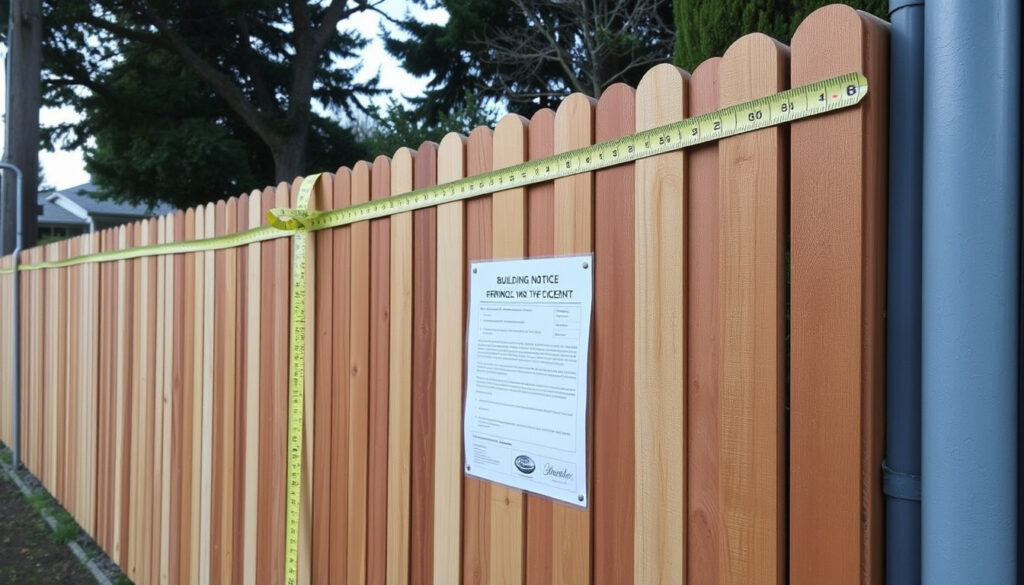
Point Chevalier Fence Height Dispute: Auckland Rules & Permits
No one puts up a front fence expecting an infringement notice in the post. But that is what happened on a Point Chevalier street, where Auckland Council ordered several front fences lowered from about 1.8 m to 1.4 m after a single complaint, national broadcaster Radio New Zealand reports — and the dispute is a useful window into how Auckland’s fence rules actually work before you build, buy or argue.
Maximum fence height in Auckland front yard: 1.4 m (4.6 ft) ·
Maximum fence height in Auckland rear yard: 2.0 m (6.6 ft) ·
Standard fence post depth: 600 mm ·
Typical concrete set time for posts: 24–48 hours
Quick snapshot
- Rear and side fences in Auckland cap at 2 m; front fences at 1.4 m (Auckland Council, the local planning authority)
- Fences above the standard height need resource consent (Auckland Council’s fence guidance)
- The Fencing Act 1978 governs neighbour contributions and maintenance on boundary fences (New Zealand Legislation, official statute database)
- The exact height of the disputed Point Chevalier fence is not publicly confirmed; the notices ordered fences down from about 1.8 m to 1.4 m (RNZ’s report)
- Whether the owners held any consent for the disputed fence is unconfirmed (RNZ) (RNZ’s report)
- The NZ$1,000 retrospective-consent estimate is a resident’s figure, not an official fee schedule (RNZ) (RNZ’s report)
- The council investigated three addresses on one street after a single complaint, RNZ reported
- Retrospective resource consent is the main path back to compliance for an existing breach (Auckland Council; RNZ) (RNZ reported)
- Affected Point Chevalier owners face a choice: lower the fence to 1.4 m and make it permeable, or seek retrospective consent (RNZ) (Auckland Council’s fence guidance)
- Before building, run the design through Auckland Council’s consent tool (Auckland Council’s fence guidance)
Eleven numbers, one pattern: the national rulebook sounds generous, but Auckland’s front-yard rule is the one that bites.
| Measure | Value | Rule or authority |
|---|---|---|
| Max fence height, rear/side yards (Auckland) | 2 m | Auckland Council |
| Max fence height, front yards (Auckland) | 1.4 m | Auckland Council |
| General building-consent exemption (NZ) | Fences under 2.5 m usually exempt | Consumer NZ |
| Point Chevalier infringement notices | Front fences down to 1.4 m and made permeable | RNZ |
| Unitary Plan rule cited in the notices | H5.6.15.1 | RNZ report |
| Resource consent trigger | Fences over 2 m, or non-compliant with the Unitary Plan | Auckland Council |
| Resource consent cost estimate | NZ$300–$1,000 depending on complexity; a resident’s estimate for a retrospective application was about NZ$1,000 | RNZ |
| Retrospective consent | Possible for existing non-compliant fences | RNZ |
| Fencing Act 1978 jurisdiction | All boundary fences in New Zealand | Fencing Act 1978 |
| Fencing Act cross-notice window | 21 days | Fencing Act 1978 |
| Typical fence post hole depth | 600 mm (about one-third of post height) | Common practice |
Can I put up a 10 foot fence?
Short answer: not in Auckland, and especially not in a front yard. Ten feet is about 3 m — more than double the 1.4 m front-yard limit and a metre above the 2 m rear limit. In Point Chevalier, the council has already acted on fences far shorter than that.
What is the maximum fence height in Auckland?
- Front yards: 1.4 m maximum (Auckland Council, the local planning authority)
- Side and rear yards: 2 m maximum (Auckland Council)
- Anything above 2 m needs resource consent under the Auckland Unitary Plan (Auckland Council’s fence guidance)
Those limits sit on top of national rules. Consumer NZ’s fencing law guide says a fence can usually be built up to 2.5 m without building consent, but it warns that district-plan rules can impose stricter limits — which is exactly the situation in Auckland front yards (Consumer NZ, independent consumer organisation).
The Point Chevalier notices centre on rule H5.6.15.1 of the Auckland Unitary Plan, according to a resident quoted by RNZ’s reporting. Auckland Council told RNZ the rules are intended to balance privacy, streetscape, pedestrian and child safety, and community outcomes.
The 2.5 m national exemption gives homeowners false confidence. In an Auckland front yard the Unitary Plan cuts in at 1.4 m — and Point Chevalier shows the council is enforcing that on the basis of a single complaint.
Are there exceptions for corner lots or sloping land?
- Corner sites carry extra visibility restrictions at intersections, on top of the height cap.
- Sloping sections get no blanket exemption; the fence’s height and location still have to comply.
There is no Point Chevalier loophole for a sloping garden. What matters is the fence’s dimensions, location on the property, the section size and the existing building coverage — the checklist Auckland Council’s fence guidance asks applicants to work through before using its online consent tool.
The implication: if the fence already exists and breaches the rule, the council’s starting position is enforcement, not negotiation.
The pattern: a 1.4 m front-yard cap is not a suggestion in Auckland; the Point Chevalier notices were triggered by a single complaint.
What are the four types of boundary disputes?
In practice, fence fights usually fall into four overlapping types, and which type you are in decides which law applies.
How do fence height disputes fit into these categories?
- Boundary location: the fence sits on the wrong side of the legal boundary.
- Maintenance and cost: who pays for repair, replacement or a new shared fence.
- Appearance and materials: what the fence looks like and which side faces which neighbour.
- Height and encroachment: the fence exceeds the permitted height or intrudes into a required yard.
The Point Chevalier dispute is squarely a height case, but it began as a complaint. RNZ’s coverage reported that the council investigated three addresses on one street after a single complaint — a reminder that a tall fence is never purely private business.
A single complaint moved the council to investigate three addresses in Point Chevalier. In fence law, whoever files first often frames the outcome.
When the fence sits exactly on the boundary, the Fencing Act 1978 provides the main statutory framework for disputes about contributions, maintenance and proposed work, according to New Zealand Legislation, the official statute database.
What this means: a height dispute is rarely just about height. The neighbour often frames it as a view problem, a property-value problem or a safety issue — and the label chosen decides the procedure.
Do I need a permit to build a fence around my house?
The honest answer in Auckland: it depends on which rule you ask. Two different permissions are in play, and confusing them is how dispute letters get written.
When is an Auckland Council building consent required?
- Fences below 2.5 m: generally no building consent required (Community Law New Zealand, free legal information service)
- Fences at or above 2.5 m: outside the standard exemption; check with the council
- Retaining walls and structures attached to the fence can trigger separate building consent requirements
Community Law’s fencing manual states that building consent is generally not needed for a fence below 2.5 m. Consumer NZ agrees and flags the trap: district-plan rules can impose stricter limits. In Auckland, the Unitary Plan is that stricter rule.
For most Point Chevalier front gardens, the practical threshold is not 2.5 m — it is 1.4 m. The infringement notices were not about structural safety; they were about compliance with a planning rule.
What is the difference between a building consent and resource consent?
- Building consent: confirms the fence is structurally sound and safe.
- Resource consent: confirms the fence is allowed where it is, at that height, under the Unitary Plan.
- The Point Chevalier case is about the second, not the first.
Building consent asks whether the fence will fall down; resource consent asks whether it is allowed to be there. A 1.8 m front fence can be structurally perfect and still unlawful in an Auckland front yard.
Auckland Council’s fence guidance directs applicants to its online consent tool and tells them to sort out the fence’s dimensions, location, property size, existing building coverage and hard-surface area before starting.
For a fence already built, the route back to legality is retrospective resource consent. RNZ’s report said council staff confirmed this was an option for owners with fences that breach the Unitary Plan; one resident quoted in the same report estimated that lodging an application with neighbour approval could cost about NZ$1,000.
The catch: the consent tool is free to use, but the failure to use it is not.
Do you have to give your neighbour the good side of the fence?
This is the most asked fence question in New Zealand, and the short answer is no. The law does not direct which way the rails face — but the longer answer is where disputes quietly begin.
What does the Fencing Act 1978 say about fence orientation?
- No orientation rule: the Act focuses on fence adequacy, contributions and notice, not on whose side looks better (the Fencing Act 1978, official text)
- A fencing notice must identify the boundary, proposed work, materials, estimated cost and proposed cost split (Community Law’s fencing guide)
- The “good side” is a negotiating point, not a legal entitlement
Community Law’s guide walks through what a fencing notice needs to contain: boundary, work, materials, estimated cost and proposed cost-sharing. Nowhere in the statute is the prettier side allocated. The common compromise is a rail-and-picket layout that gives each side a reasonable face, because a neighbour who feels slighted today is the same neighbour who withholds half the cost tomorrow.
How to handle a neighbour who refuses to share costs?
- Serve a formal fencing notice identifying the work, boundary, materials, estimated cost and proposed cost split (Community Law’s fencing guide)
- Expect a 21-day window for objection or a cross-notice (the Fencing Act 1978)
- No cross-notice within the window means the proposal is treated as agreed (Community Law NZ, free legal information service)
The Fencing Act process forces clarity. Serve a notice, and the neighbour must respond or be presumed to agree. Community Law notes the recipient may be treated as having agreed if no cross-notice arrives within the applicable 21-day period.
Where a fence is already built and already the subject of a council notice, the Fencing Act machinery is less useful. At that stage the council holds the cards: the owner’s options are to lower the fence or apply for retrospective consent, as RNZ reported from Auckland Council’s position.
The 21-day cross-notice window is the quiet deadline that binds neighbours silently: fail to respond in time, and the law treats the fencing proposal as agreed.
How deep should a fence post hole be?
However the dispute is resolved, someone will eventually dig a hole. Get this wrong and the height argument becomes academic, because the fence will be leaning.
What happens if fence posts aren’t deep enough?
- Shallow posts lean under wind and soil pressure, and a lean shows up in the first storm season.
- Posts set in damp ground without drainage rot fastest at the ground line.
- A 1.8 m fence with a 300 mm post is a sail with a weak anchor.
The failure modes are predictable. A visibly slumping fence also weakens any argument that the build is temporary or harmless — which matters when an infringement file is already open.
Should fence posts be set in concrete or dirt?
- Concrete: recommended for stability, especially in exposed, windy Auckland sites.
- Depth rule: dig the hole about one-third of the post’s above-ground height.
- Drainage and wind loads: both should be considered before backfilling.
The standard rule of thumb is a hole depth of about one-third of the post height — for a 2 m fence, roughly 600 mm. A 1.4 m front fence needs less depth but the same principle: concrete at the base, drainage around it, and no shortcuts in soft ground.
Why this matters: the regulations decide what you can build, but the installation decides whether it survives. A fence that collapses is a new dispute before the old one closes.
Auckland fence rules at a glance
Nine criteria, one pattern: the national default is generous, Auckland’s local rules are not, and enforcement has already begun.
| Measure | Auckland / NZ requirement | Authority |
|---|---|---|
| Front-yard height cap | 1.4 m (4.6 ft) | Auckland Council |
| Rear and side yard height cap | 2 m (6.6 ft) | Auckland Council |
| General building-consent exemption | Fences under 2.5 m usually exempt | Community Law NZ |
| National exemption vs Unitary Plan | Local height rules override the national default | Consumer NZ |
| Rule cited in Point Chevalier notices | Unitary Plan H5.6.15.1 | RNZ |
| Consent above height cap | Resource consent required above 2 m, or for any non-compliant fence | Auckland Council |
| Retrospective consent path | Available; about NZ$1,000 to lodge per a resident | RNZ |
| Fencing Act cross-notice window | 21 days | Fencing Act 1978 |
| Typical post hole depth | 600 mm (about one-third of post height) | Common practice |
The pattern: whenever someone says a fence is fine because it is under 2.5 m, they are quoting the wrong rulebook for an Auckland front yard.
Should you fight the fence or seek retrospective consent?
For owners in Point Chevalier the fence is already built, and the decision has narrowed to two paths: argue the notice or regularise the fence. The trade-offs are uneven.
Upsides
- Retrospective consent can make the existing fence lawful and end the compliance risk (RNZ)
- The decision stays with a planning specialist rather than becoming a neighbour versus neighbour fight
- A granted consent protects the property from the same complaint resurfacing later
Downsides
- Consent is not guaranteed; the Unitary Plan rule still caps height, and the Point Chevalier fences may not meet it (Auckland Council)
- Cost is real: one resident’s estimate put lodging at about NZ$1,000 (RNZ)
- A refused application leaves the infringement notice in force and the money spent
The trade-off: consent buys legality, not victory. If the planning rule exists for streetscape and safety, the planner’s answer can still be no — at which point the fence comes down anyway.
How to work through a fence height dispute in Auckland
The sequence below is the one council guidance, community law resources and fencing contractors tend to follow — and every step is cheaper than the step after it.
- Confirm the rule that applies to your property. Check the Auckland Unitary Plan limit for your yard and measure the finished fence height (Auckland Council’s fence guidance).
- Run the design through Auckland Council’s online consent tool, with the fence’s dimensions, location, property size, building coverage and hard-surface area ready.
- Talk to your neighbour before the council does. Put the conversation in writing and agree on materials, cost split and the finishing side.
- If the fence is already up and non-compliant, ask the council about retrospective resource consent before the infringement process hardens (RNZ’s report).
- If the dispute is about money, serve a formal fencing notice identifying the boundary, proposed work, materials, estimated cost and proposed contribution (Community Law’s fencing guide).
- Watch the 21-day window. A neighbour who does not serve a cross-notice in time is treated as having agreed (the Fencing Act 1978).
- If the deadlock continues, try mediation or the Disputes Tribunal before instructing a lawyer.
For any Auckland street, a single complaint can trigger an investigation of several properties at once — compliance stopped being a private matter the moment the fence went up.
The catch: every step has a deadline, and the first deadline is the one you set yourself. Councils act on complaints; neighbours act on silence.
What’s confirmed and what’s still unclear
For a story that spread quickly, the public record is thin. Here is the line between what is established and what remains open.
Confirmed facts
- Auckland Council caps rear and side fences at 2 m and front fences at 1.4 m; fences above the standard height require resource consent (Auckland Council)
- The Fencing Act 1978 governs cost-sharing and notices on boundary fences (New Zealand Legislation)
- Point Chevalier residents received infringement notices to cut front fences to 1.4 m and make them permeable (RNZ)
What’s unclear
- The exact height of the disputed fence or fences has not been publicly confirmed (RNZ)
- Whether the owners held any consent for the disputed fence is unknown (RNZ)
- The NZ$1,000 consent-cost figure is a resident’s estimate, not a council fee schedule (RNZ)
- Whether enforcement will spread to other streets after the single-complaint investigation is unclear (RNZ)
The full text of the Point Chevalier infringement notices has not been made public; the details above are as reported by Radio New Zealand and have not been independently confirmed by the council.
Why this matters: with public information this thin, the safest assumption in Auckland is that the written rule is the rule — and that a complaint is all it takes to start an investigation.
Voices from the fence line
The Point Chevalier story echoes a pattern familiar to councils across New Zealand: strong feelings on both sides, little common ground, and a fence that keeps standing while people argue.
“The fence still up and doesn’t look any prettier.”
— Richard Jordan, New Plymouth district councillor, on a similar fence dispute in a 2016 Stuff report
“The relevant rules are intended to balance privacy, streetscape, pedestrian and child safety, and community outcomes.”
— Auckland Council, quoted in Radio New Zealand’s coverage
The pattern: nobody wants an ugly fence, but nobody wants to lose control of the boundary either. The law is less interested in feelings than in measurements — which is why 20 cm can decide the outcome.
For Point Chevalier homeowners, the decision is now clear: make the fence comply with the 1.4 m rule and keep the dispute from spreading, or spend the time and money arguing a planning rule that was written before the fence went up.
Frequently asked questions
Can I put up a 7ft fence?
7 ft is about 2.13 m. In Auckland, that exceeds the 2 m rear and side limit and sits well above the 1.4 m front limit, so resource consent would be required — and a front fence that tall is very unlikely to be approved (Auckland Council).
Can my neighbour put up an 8ft fence?
8 ft is about 2.44 m — under the 2.5 m national building-consent exemption but above Auckland’s 2 m rear limit (Consumer NZ). The neighbour can build it only with resource consent, and the 1.4 m front-yard limit still applies.
Is an 8 foot privacy fence too high?
For an Auckland front yard, yes — 2.44 m is far above the 1.4 m cap. In a rear yard it is also above the 2 m limit, so a privacy fence that tall needs resource consent before construction (Auckland Council’s fence guidance).
Should a privacy fence touch the ground?
There is no rule requiring a fence to seal against the ground. A small gap improves drainage and reduces rot; what councils regulate is height, location and permeability — the Point Chevalier notices required front fences to be made permeable as well as lower.
Can you put a trellis on top of a 2 metre fence?
Only if the combined height stays within the applicable limit. In an Auckland rear yard the limit is 2 m, so adding a trellis above an existing 2 m fence takes it over the cap and into resource-consent territory (Auckland Council).
How deep should a 2m fence post be?
For a 2 m fence, dig the hole roughly 600 mm deep — about one-third of the post’s above-ground height — and set the post in concrete.
More related posts
 NZD to Bali Currency: Exchange Rates, Tips & Cost of Living Guide
 Job Vacancies Christchurch NZ: 2025 Guide
 Opal Hot Springs & Holiday Park Photos: Reviews & Guide
 Lucky Color of the Year 2026: Zodiac & Feng Shui Guide
 Gifts for Men NZ: How to Pick a Present He’ll Love
 Mag and Turbo Christchurch: Tyres, Mags & Services
 Clip and Climb Christchurch: Prices, Age & Attire Guide
 Grey Lynn Family Medical Centre: Guide to Services & Reviews