State Highway 1 Trees Block: Closures, Safety & Liability
Fallen trees on State Highway 1 have repeatedly stranded motorists, from Karapiro to Taihape. This guide tracks the recent SH1 blockages, outlines safety steps, and unpacks the legal maze of tree ownership and liability in New Zealand.
SH1 total length: 2,033 km ·
Karapiro tree closure: 3 Oct 2025, 11:35am ·
Taihape tree closure: Feb 2026 ·
Motorists stranded near Ōhingaiti: slept in cars
Quick snapshot
- Karapiro closure on 3 October 2025 (RNZ)
- Hunterville–Taihape closure in February 2026 (NZTA Journey Planner)
- Roadside trees on private land owned by landowner
- Trees on public land owned by council or NZTA
- Stop safely away from fallen tree
- Call 111 if the tree is a hazard
- Report to NZTA via their traffic portal
- Owner liable if negligence is proven
- Acts of God may limit claims
The pattern is clear: tree blockages on SH1 are a recurring hazard, not a rare event. Motorists need both safety know-how and a grasp of who bears responsibility.
| Fact | Detail |
|---|---|
| Longest motorway in NZ | State Highway 1 (2,033 km) – the longest single highway in New Zealand |
| Recent SH1 tree closure (Karapiro) | 3 October 2025 at 11:35am, north of Karapiro township (RNZ) |
| Recent SH1 tree closure (Taihape) | February 2026, SH1 between Hunterville and Taihape (NZTA Journey Planner) |
| Liability for falling tree | Owner liable if tree was a known hazard (negligence standard) |
The implication: while SH1’s length is a point of pride, its vulnerability to tree falls demands vigilance from both road authorities and drivers.
Is there a closure on New Zealand State Highway 1?
Yes — and fallen trees are a recurring reason. In the last two years, multiple tree-related incidents have shut down sections of SH1, the 2,033 km artery that runs the length of both islands. Below are the most significant recent events.
Recent closures caused by fallen trees
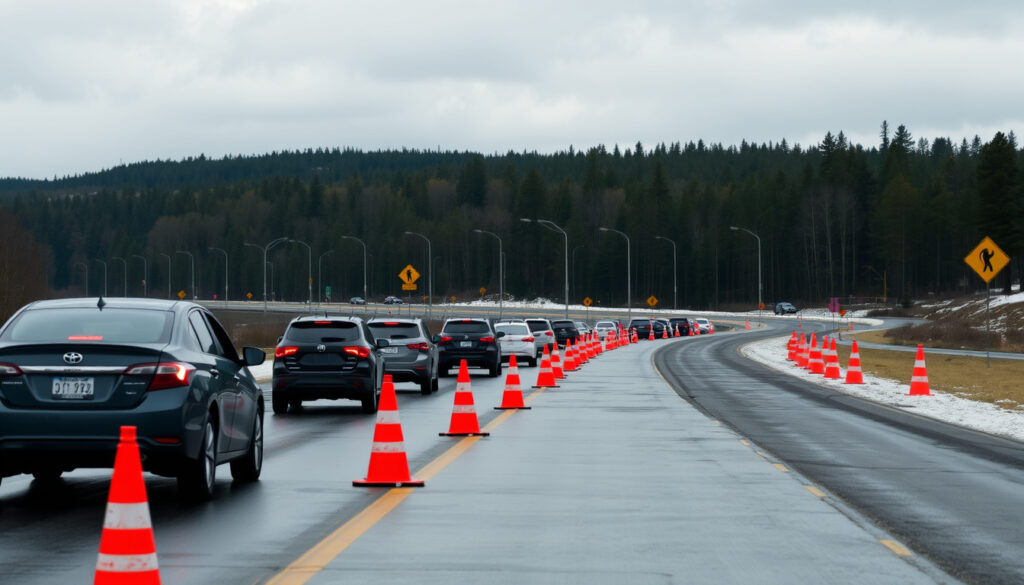
On 3 October 2025, a tree fell onto SH1 at Karapiro in the Waikato region. Police were notified at 11:35am, and the road was closed just north of the Karapiro township. Traffic backed up from Cambridge, and a cordon was placed at the SH1–SH27 intersection. Motorists were asked to delay travel because the road was expected to be closed for some time, according to RNZ (national public broadcaster).
A few months later, in February 2026, multiple fallen trees closed SH1 between Hunterville and Ohingaiti, near Taihape in the Manawatū-Whanganui region. The NZTA Journey Planner (official national traffic authority) reported the closure on 16 February 2026, adding that SH1 between Hunterville and Weka Street in Taihape reopened the same day. The disruption was severe enough that some motorists were forced to sleep in their cars, according to NZ Herald (major national daily).
“Motorists were forced to sleep in cars overnight after trees blocked State Highway 1 near Ōhingaiti.”
— NZ Herald report, February 2026
How to check live SH1 road status
The quickest official source is the NZTA Journey Planner website, which shows real-time traffic bulletins and planned closures. You can also get push alerts by following NZTA’s regional social media accounts. For urgent updates, local radio stations in the affected area (Waikato, Manawatū-Whanganui) also carry live traffic reports.
Tree blockages on SH1 are not rare events — they cluster around stormy periods, particularly in the North Island’s central and northern regions. The difference between a minor delay and an overnight stranding often comes down to how quickly you can find real-time data from NZTA.
What to do if there is a tree blocking the road?
Encountering a fallen tree on SH1 is jarring, especially at highway speed. The steps you take in the first 60 seconds matter.
Immediate safety steps
- Stop safely: Reduce speed gradually and pull well clear of the tree. Do not slam on brakes if other traffic is close behind. Use hazard lights immediately.
- Assess the hazard: If the tree is blocking the carriageway or has taken down power lines, treat it as a critical hazard. Stay inside the vehicle if lines are down — the car may be electrified.
- Call 111: If the tree creates an immediate danger to traffic or pedestrians, dial 111 and ask for Police. They coordinate road closure with NZTA.
- Report to NZTA: Use the NZTA Journey Planner website or call 0800 4 HIGHWAYS to log the blockage. This ensures the official traffic management system gets the alert.
Reporting a fallen tree on SH1
For non-emergency reports (e.g., a tree on the verge that might fall), contact your local council or NZTA’s customer services. If the tree is on private land adjacent to the road, the landowner is responsible for clearing it. For trees on the road reserve, NZTA or the local council will handle removal.
Do not assume a tree that has already fallen is safe — trunks and branches can shift, roll, or drop further debris as other vehicles pass. Maintain a large gap and let emergency crews assess it first.
Who owns the trees next to a road?
The legal answer in New Zealand depends on where the tree sits.
Ownership of roadside trees in New Zealand
Trees on private land are owned by the landowner, even if they overhang the road. If a tree on your property drops a branch on a passing car, you are generally the responsible party. Trees on public land — road reserves, berms, parks — are owned and managed by the local council or NZTA, depending on the road classification. But the law governing tree damage in New Zealand hinges on a negligence standard, not strict liability.
Liability when a tree falls onto a road
New Zealand courts have held that a tree owner is liable for damage only if they knew (or ought to have known) the tree was a hazard and failed to act. This is the negligence standard. If a tree falls due to a sudden storm or an “Act of God” — a severe weather event that no reasonable inspection would have predicted — the owner may not be held liable.
A key distinction: if the tree is on public land and the council or NZTA knew it was diseased or unstable, they can be sued for negligence. In practice, proving that knowledge is difficult. The onus is on the person who suffered damage to show that the owner had notice of the risk.
“It was a scary night. We had no idea if we’d be stuck there until morning — we just had to wait for the tree to be cleared.”
— Motorist stranded on SH1 near Ohingaiti, February 2026
Who is liable if a tree falls down?
This question cuts to the heart of the legal issues for New Zealand motorists.
Liability for vehicle damage
If a tree falls on your car on SH1, your first port of call is your own comprehensive car insurance. Most policies cover falling objects, including trees. The insurer then has the right to pursue the tree owner for recovery, but only if they can prove negligence.
In a standard negligence case, the landowner is liable only if the tree showed visible signs of decay or danger, and the owner ignored them. A healthy tree that falls in a storm shifts the financial burden back to the vehicle owner’s insurance.
Liability for road closure costs
When a tree shuts down SH1, NZTA and Police incur costs for traffic management, road clearing, and detour signs. Under New Zealand law, these costs can be recovered from the tree owner only if negligence is established. In practice, most tree-fall closures on public roads are treated as weather events, and NZTA absorbs the cost as part of its road maintenance budget.
Is Taihape Road currently closed?
As of the latest NZTA data, SH1 in the Taihape area experienced a significant tree-related closure in February 2026, but it has since reopened. Here is a breakdown of events in the Taihape area.
Taihape road closure history from fallen trees
On 16 February 2026, NZTA reported that SH1 was closed between Ohingaiti and Taihape due to multiple fallen trees. According to the NZTA Journey Planner (official national traffic authority), the closure stretched SH1 from Hunterville to Weka Street in Taihape. The same bulletin confirmed that SH1 between Hunterville and Weka Street reopened later that day.
Alternate routes around Taihape
When SH1 is blocked south of Taihape, the most practical detour is via SH3 through Whanganui, or using SH49 through Ohakune to bypass the Central Plateau. For local traffic between Hunterville and Taihape, the back roads — Rangiwahia Road and Kiwi Valley Road — can serve as alternates, though they are narrow gravel surfaces in sections.
What is the longest motorway in NZ?
State Highway 1 holds the record as New Zealand’s longest single highway, running 2,033 km across both main islands. It connects Cape Reinga at the top of the North Island to Bluff at the bottom of the South Island. By comparison, the next longest — State Highway 2 — is roughly half that length at 970 km.
Can a neighbor plant big trees next to the fence?
In New Zealand, a neighbour generally can plant trees on their own land, even if they are large species, as long as they comply with local council rules.
Legal rights in NZ
The right to plant trees on private property is broad under New Zealand law. However, district and city councils impose rules on tree height and species, particularly in urban zones. For example, some parts of Auckland require consent for planting certain tall species within 2 metres of a boundary. The Resource Management Act 1991 (central environmental legislation) is the primary law governing such land-use restrictions.
When trees block light or views
If a neighbour’s tree blocks your light, the legal remedy is limited. The common law right to light does not exist in New Zealand in the same form as in the UK. There is no automatic right to a view or to sunlight. The dispute becomes a civil matter — you can request the neighbour trim the tree, and if they refuse, you may apply to the Disputes Tribunal, but only if the tree causes actual damage (like roots damaging your foundation) rather than just blocking light.
Related reading: Tree blocks Karapiro’s SH1
journeys.nzta.govt.nz, nzta.govt.nz, journeys.nzta.govt.nz, southlandapp.nz, journeys.nzta.govt.nz, nzta.govt.nz, journeys.nzta.govt.nz, marlboroughapp.co.nz, journeys.nzta.govt.nz
For drivers navigating State Highway 1, the risk of unexpected blockages extends beyond fallen trees, as seen in a recent SH1 crash near Hinds that closed the road during the evening commute.
Frequently asked questions
What should I do if I see a tree blocking State Highway 1?
Stop safely away from the tree, activate hazard lights, call 111 if the tree is a hazard to traffic or near power lines, and report the blockage to NZTA via their website or 0800 4 HIGHWAYS.
Who is responsible for clearing a fallen tree from SH1?
NZTA is responsible for clearing trees on state highways. If the tree is on private land adjacent to the road, the landowner is required to remove it, though in practice NZTA may clear it for safety and recover costs.
Does my car insurance cover damage from a falling tree?
Yes, comprehensive car insurance in New Zealand typically covers damage from falling trees. If negligence can be proven against the tree owner, the insurer may pursue them for recovery.
How can I check if SH1 is open today?
The best source is the NZTA Journey Planner website, which provides real-time traffic bulletins, closures, and planned roadworks.
What is the penalty for not maintaining roadside trees in New Zealand?
There is no specific penalty. If a poorly maintained tree causes damage, the landowner may face a negligence claim in court, which can result in damages awarded to the injured party. Council fines may apply under the Resource Management Act in extreme cases.
Are there any known tree blockages on SH1 right now?
Current blockages are updated live on the NZTA Journey Planner. The site shows all ongoing closures, incidents, and hazards on the state highway network.
Can I cut down a tree on public land blocking my driveway?
No. You must not cut or remove a tree on public land without permission from the local council or NZTA. Report the obstruction to them, and they will arrange clearance.
More related posts
 How to Fix Phone Microphone – iPhone and Android Solutions
 KiwiSaver Contribution Minimum Increase 2026: Rate Changes
 S&P Global 100 Index: Top Companies, S&P 500 Comparison, ETF
 Is Mounjaro Available in New Zealand? 2026 Cost & Alternatives
 Apple Cider Vinegar Netflix: True Story, Cast, and Accuracy
 The Fantastic Four: First Steps Showtimes & Streaming Guide
 Biggest Tsunami Ever Recorded: Height, Death Toll & Facts
 Mileage Rate 2025 NZ: IRD Kilometre Rates Explained