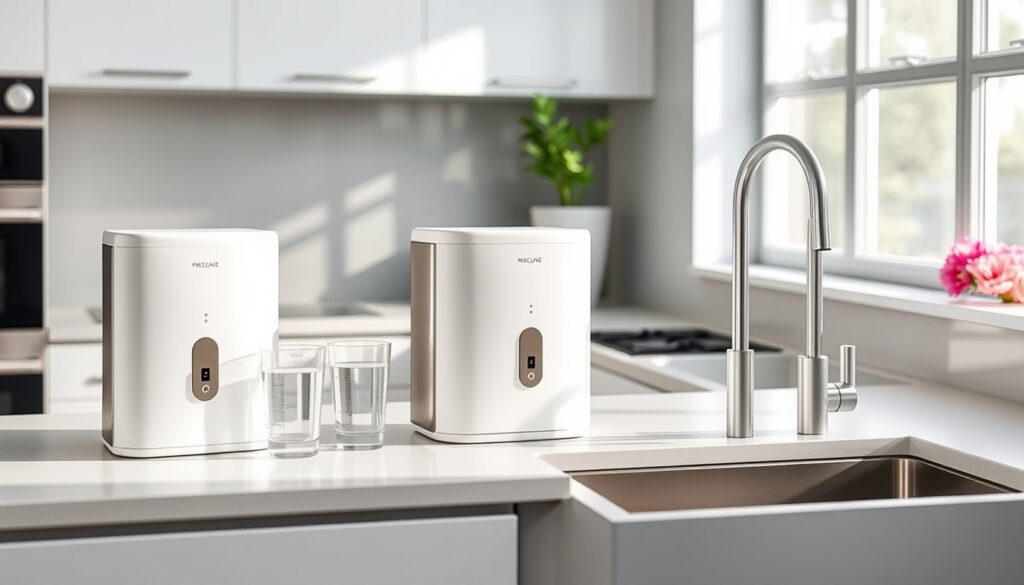
Bench Top Water Filters: Reviews, Costs, and Comparison
Anyone who has stood in the kitchen aisle staring at a row of water pitchers knows the feeling: every option claims to be pure, but none say what they actually remove. Bench top water filters promise a middle path — real filtration without an under-sink installation project. The catch is that the category stretches from $25 faucet-mounted filters to countertop units that typically run $150 to $250, according to Modernize (home improvement cost guide), so “bench top” tells you less about performance than the name suggests.
Types of bench top water filters: Countertop, faucet-mounted, and pitcher ·
Installation time: 5 to 10 minutes ·
Average filter lifespan: 3 to 6 months ·
Cost range: $50 to $200
Quick snapshot
- Bench top filters sit beside the sink and connect via a diverter hose, refillable tank, or gravity-fed design. (Water Filtration Systems Australia (water treatment retailer))
- Faucet-mounted filters start around $25, while countertop units typically run $150–$250. (Modernize (home improvement cost guide))
- Under-sink systems usually cost more up front but less per year because cartridges last longer (TechGearLab (water filter testing site)).
- Effectiveness against emerging contaminants like microplastics varies by model. (Consumer Reports (independent testing nonprofit))
- Long-term health differences between filtered and unfiltered tap water are not fully studied. (Consumer Reports (independent testing nonprofit))
- Bacteria and virus removal depends on the technology; most carbon-only bench top units don’t do it. (Consumer Reports (independent testing nonprofit))
- Replace cartridges roughly every 3–6 months. (Water Filtration Systems Australia (water treatment retailer))
- Budget $40–$120 a year for bench top cartridges. (Modernize (home improvement cost guide))
- Under-sink replacements run $60 to almost $300, depending on the system. (Wirecutter (product review arm of The New York Times))
- Check certification before buying: NSF/ANSI 42 and 53 are the labels that mean something. (Consumer Reports (independent testing nonprofit))
- Compare annual cartridge cost, not just the sticker price. (TechGearLab (water filter testing site))
- Renting or short on cabinet space? Bench top is the practical default. (Modernize (home improvement cost guide))
Eight data points, one pattern: the true cost of bench top or under-sink filtration is spread across installation, cartridges, and how much water your household actually runs through the filter.
| Fact | Typical value | Source |
|---|---|---|
| Under-sink professional installation | About $150 on some systems | Good Housekeeping (consumer product testing lab) |
| Under-sink installation, unit plus labor | $170–$580 | HomeGuide (home services cost database) |
| Labor for a water-filter system | $120–$600 | HomeGuide (home services cost database) |
| Under-sink filters in Consumer Reports tests | $86 to nearly $700 | Consumer Reports (independent testing nonprofit) |
| Under-sink RO yearly cost (estimate) | About $145 at 40 gallons/month | TechGearLab (water filter testing site) |
| Replacement filters, tested under-sink systems | $60 to almost $300 | Wirecutter (product review arm of The New York Times) |
| Annual filter cost, under-sink guide | Roughly $130–$440 | Water Filter Guru (water filtration review site) |
| Tested cost per gallon | $0.10–$0.26 | Water Filter Guru (water filtration review site) |
Do countertop water filters really work?
Short answer: yes, for the things they are designed to remove. The long answer depends on the filter media, the certification, and your local water quality.
How does a bench top water filter work?
- Direct tap connection through a diverter hose
- Activated carbon or ceramic filtration
- No permanent installation
Most bench top units are compact point-of-use systems that sit beside the sink and connect through a diverter hose, refillable tank, or gravity-fed design, according to Water Filtration Systems Australia (water treatment retailer). Turn a lever on the tap and water flows into the filter instead of down the drain; turn it back and the faucet behaves normally.
The media does the actual work. Activated carbon grabs chlorine, sediment, and a wide range of organic compounds; ceramic elements physically strain particles. That combination is why bench top filters change how water tastes within the first glass.
What contaminants do bench top water filters remove?
Carbon is a strong all-rounder for taste, odor, and chlorine, but it is not a catch-all. Lead, PFAS, and bacteria each demand a filter certified for that specific contaminant.
Independent testers at Consumer Reports (independent testing nonprofit) are blunt about what matters: buy a filter certified for the contaminant you actually have. Certified carbon models advertise chlorine reduction of 90–99% and lead reduction of up to 99%, but those numbers apply only to units that carry the certification — not to every filter with a faucet attachment.
Performance also shifts with local water quality. A filter that solves a chlorine-heavy municipal supply may do little for well water with sediment or iron, which is why “does it work” always starts with “what’s in your water.”
The pattern: a bench top filter is only as good as its certification. If the box doesn’t name a standard, treat the removal claims as marketing.
Are benchtop water filters good?
Good at what, though? For renters, small kitchens, and tight budgets, they make a strong case. For heavy daily use, the math gets more interesting.
What are the pros of using a benchtop water filter?
- No permanent installation — it moves with you
- Lower entry cost than most under-sink systems
- Cartridge swaps happen at the counter, not inside a dark cabinet
Prices explain the appeal: faucet-mounted filters start around $25, countertop units typically run $150 to $250, and under-sink systems cost $100 to $400 for the unit alone, excluding installation, according to Modernize (home improvement cost guide). That entry price makes bench top the natural default for renters and temporary setups.
The convenience shows up in daily use, too. There’s no plumber, no hole in the counter, and no landlord conversation. If you move apartments, the filter moves with you.
How do benchtop filters compare to under-sink systems?
Under-sink systems win on capacity and looks; bench top wins on ease and price. The right answer depends on whether you own the kitchen or just live in it.
The trade-off is physical. Under-sink systems generally offer greater cartridge capacity and a cleaner appearance, and they usually require plumbing work, a dedicated tap, or cabinet changes, notes Water Filtration Systems Australia (water treatment retailer). Bench top flips that: no plumbing, but the unit lives on your counter.
So “good” depends on the constraint. If counter space is plentiful and you plan to stay put, the under-sink route delivers more capacity per square inch of kitchen. If you rent or move often, bench top is the shorter, cheaper path to the same glass of water.
The trade-off: bench top saves the installation headache but spends counter space, and the cartridge bill comes due more often.
What is the best bench top water filter?
There is no single “best” filter, but there is a best way to choose one.
What is the best countertop water filter according to Consumer Reports?
- Models certified for the contaminants in your water
- Independent test results over best-seller lists
- Brands that appear across repeated independent tests: PUR, Brita, and ZeroWater
Consumer Reports keeps its advice simple: the best filter is certified for what’s actually in your tap water, and in independent testing, PUR, Brita, and ZeroWater are the names that keep appearing. Its under-sink tests ranged from $86 to nearly $700 — and the priciest system was not automatically the best performer.
What is the best water filter for your money?
- Capacity — gallons before the cartridge gives out
- Cartridge cost and change interval
- Width of certification (what it actually removes)
TechGearLab concludes that under-sink models have higher upfront costs but typically lower yearly costs because filters last much longer. The same logic applies in reverse to bench top: the cheap countertop box often carries a more expensive per-gallon habit, which is why the annual cartridge bill matters more than the sticker price.
The honest answer for most households: the best value is a mid-priced countertop unit with NSF/ANSI 42 and 53 certifications, a cartridge that lasts at least three months, and a price per gallon below the pitcher aisle.
The implication: certification and per-gallon cost beat brand names every time.
Are there any drawbacks to using a water filter?
Yes — and most of them are the flip side of bench top’s advantages: speed, space, and scope.
Do bench top water filters reduce water flow?
A countertop filter slows the stream. If you fill a two-liter pot every morning, you’ll notice the slower pour long before you notice the better taste.
Flow rate is the most common complaint. Countertop units push tap water through a compact cartridge, so output is slower than a full-size under-sink system with a larger cartridge and tank. It’s rarely a dealbreaker, but it’s the first thing guests notice.
Counter space is the second pinch, and scope is the third: a bench top unit sits on the counter permanently, and a basic carbon filter won’t remove bacteria or viruses unless it includes a UV or other microbe-rated stage.
What maintenance is required?
- Replace the cartridge on schedule
- Sanitize the reservoir or hoses occasionally
- Check that the replacement cartridge is the certified one
Filter changes are the recurring cost. Wirecutter reports replacement filter costs from $60 to almost $300 for the under-sink systems it reviewed; bench top cartridges are generally cheaper but need swapping more often. HomeGuide estimates a full under-sink install at $170 to $580, with labor alone at $120 to $600 — none of which exists on the bench top path.
That’s the quiet case for bench top: the only recurring job is a cartridge swap. The maintenance is boring, which is exactly what you want from something touching your drinking water.
The catch: the filter you ignore is the filter that fails — set a reminder and buy the certified cartridge.
Which water filter removes the most toxins?
If “toxins” means the widest possible net, the answer is clear — but the right answer for your kitchen may be narrower.
What is the healthiest water filtering system?
- Reverse osmosis: widest range (lead, arsenic, PFAS, and more)
- Activated carbon blocks: chlorine, taste, and many organics
- Multi-stage systems: combine several media for broader coverage
Reverse osmosis and advanced carbon blocks remove the widest range of contaminants, including lead, arsenic, and PFAS. The trade-off is size, cost, and waste: RO systems are the most complex and typically the most expensive to maintain, which is why they’re usually under the sink, not on the counter.
Water Filter Guru found that the Clearly Filtered under-sink system it tested cost less, was quicker and easier to install, and did not waste water or reduce pH and alkalinity compared with reverse osmosis systems. The implication for bench top buyers: a good carbon block can cover a surprising amount of the health checklist without the RO complexity.
Why stop using Brita filters?
Brita-style pitchers are everywhere because they fix the one problem most people notice: taste. They were never designed to be a heavy-metal defense.
Mainstream pitcher filters like Brita primarily target chlorine and taste. Standard cartridges are not certified to reduce heavy metals such as lead, or fluoride, which is exactly what people assume filtered water means. Moving from a pitcher to a bench top filter usually buys a wider contaminant net — but only if the new filter carries a certification for the contaminants you care about.
For comprehensive removal, look for multi-stage systems that combine sediment, carbon, and RO or anion-exchange media. One-stage carbon catches the everyday stuff; it won’t catch everything, and no amount of marketing changes that.
Why this matters: the filter that removes the most toxins only helps if it’s actually working in your house — so certification and a replacement schedule matter more than the number of stages on the box.
Bench top vs under-sink: side by side
Four rows capture the decision, one pattern: bench top is the low-friction compromise, under-sink is the higher-capacity commitment.
| Factor | Bench top | Under-sink | Source |
|---|---|---|---|
| Setup and footprint | Diverter hose at the tap; sits on the counter | Plumbing work, dedicated tap; hidden in the cabinet | Water Filtration Systems Australia (water treatment retailer) |
| Capacity | Compact cartridge | Larger cartridges, more capacity | — |
| Upfront cost | From $25; countertop typically $150–$250 | $100–$400 unit; $150–$400 install | — |
| Long-term cost | Higher per-gallon cost; more frequent changes | Higher upfront, lower yearly cost | — |
The pattern: bench top removes the installation barrier; under-sink removes the per-gallon cost. Choose the barrier you’d rather live with.
Bench top water filter specs at a glance
Seven specs separate a smart bench top purchase from a regretful one, one pattern: connection type and certified media tell you almost everything.
| Spec | Typical value |
|---|---|
| Unit types | Countertop (bench top), faucet-mounted, or pitcher |
| Filter media | Activated carbon and/or ceramic |
| Connection | Diverter hose, refillable tank, or gravity-fed |
| Installation time | 5 to 10 minutes, no plumber |
| Typical filter life | 3 to 6 months |
| Typical annual filter cost | $40 to $120 |
| Certifications worth looking for | NSF/ANSI 42 and NSF/ANSI 53 |
The trade-off: these numbers describe the category, not a specific box — always check the label on the exact model, because certification is the spec that actually tells you what the filter removes.
The case for and against bench top filters
Upsides
- No permanent installation — ideal for renters and temporary kitchens
- Lower entry price: faucet-mounted from $25, countertop typically $150–$250
- Easy to move, easy to maintain, no plumber required
Downsides
- Occupies visible counter space
- Slower flow than larger under-sink systems
- Narrower contaminant range than multi-stage or RO systems
The trade-off: bench top is the best compromise for most renters, but it’s still a compromise — the under-sink system is the answer for households that filter a lot of water.
Confirmed facts and open questions
Confirmed facts
- Bench top water filters reduce chlorine taste and odor. (Consumer Reports (independent testing nonprofit))
- Activated carbon is the filtration medium most bench top filters use.
- Filters require periodic replacement. (Good Housekeeping (consumer product testing lab))
What’s unclear
- Effectiveness against emerging contaminants like microplastics varies by model and isn’t consistently tested.
- Long-term health differences between filtered and unfiltered tap water are not fully studied.
- Bacteria and virus removal depends on the technology; most carbon-only bench top filters aren’t designed for it.
- Claims about “alkaline” or “mineral-boosting” filters outpace the independent evidence.
The takeaway: the confirmed list is short because the category is simple; the unclear list is longer because the marketing runs ahead of the data.
What testers and cost guides say
“Countertop units typically run $150 to $250, while under-sink systems cost $100 to $400 for the unit alone — and installation can add $150 to $400.”
Modernize (home improvement cost guide)
“Professional installation can add about $150 to the project cost for some water filters.”
Good Housekeeping (consumer product testing lab)
“Under-sink reverse osmosis systems can cost more than $1,200 up front, and replacement filters run from $60 to almost $300.”
Wirecutter (product review arm of The New York Times)
The pattern: the industry’s own numbers make the bench top case convincingly — as long as you skip the installation line items.
The short version
Bench top filters work — the real question is which trade-off fits your kitchen. The price and cost data point one way: bench top is the cheapest way to remove the installation barrier, while under-sink wins on per-gallon cost over the long run. For renters and first-time buyers, the bench top route is the low-risk entry point; for households with heavy daily water use and a spare cabinet, an under-sink system is the stronger long-term value — provided you budget for installation and cartridge changes.
nestpath.com.au, qualitywaterlab.com, driplifecorp.com, bos-water.com
Frequently asked questions
Are bench top water filters worth the investment?
For most renters and first-time buyers, yes: the entry price is low, installation is zero, and the taste improvement shows up in the first glass. The real cost is the cartridge schedule, so check the replacement price before you buy.
Can bench top water filters remove bacteria and viruses?
Only if the specific model includes a microbe-rated stage such as UV or a fine ceramic element. A basic activated-carbon bench top filter is not certified to remove bacteria or viruses.
How long do bench top water filters last before replacement?
Most manufacturers recommend changing the cartridge every 3 to 6 months. Heavy use or poor source water shortens that window, and some systems with larger tanks stretch it to a year.
Do bench top water filters require electricity?
No. Most bench top filters run on tap pressure or gravity. Add-ons like UV purifiers and some reverse-osmosis pumps do need power, but the core countertop filter does not.
Can I use a bench top water filter with well water?
It depends on what’s in the well. A bench top filter can improve taste and sediment, but well water with bacteria, iron, or nitrate needs a lab test and often a dedicated treatment system first.
What is the difference between a bench top and a pitcher filter?
Both are counter-friendly point-of-use options. A bench top unit connects to the tap or a refillable tank and filters on demand with more capacity; a pitcher is gravity-fed, simpler, and almost always slower with a smaller cartridge.
Related reading
More related posts
 Wood Fired Hot Tub NZ: Prices, Brands & Buying Guide
 Houses for Rent Timaru – Current Listings Prices Suburbs
 We Are the World: The Untold Drama Behind the Charity Anthem
 Keno Result Today Live – Check Winning Numbers & Hot Picks
 Is Mounjaro Available in New Zealand? 2026 Cost & Alternatives
 Liquor Stores Near Me: Buying Alcohol in Ireland Hours & Locations
 Te Wiki o te Reo Māori 2025: Theme, Dates & Resources