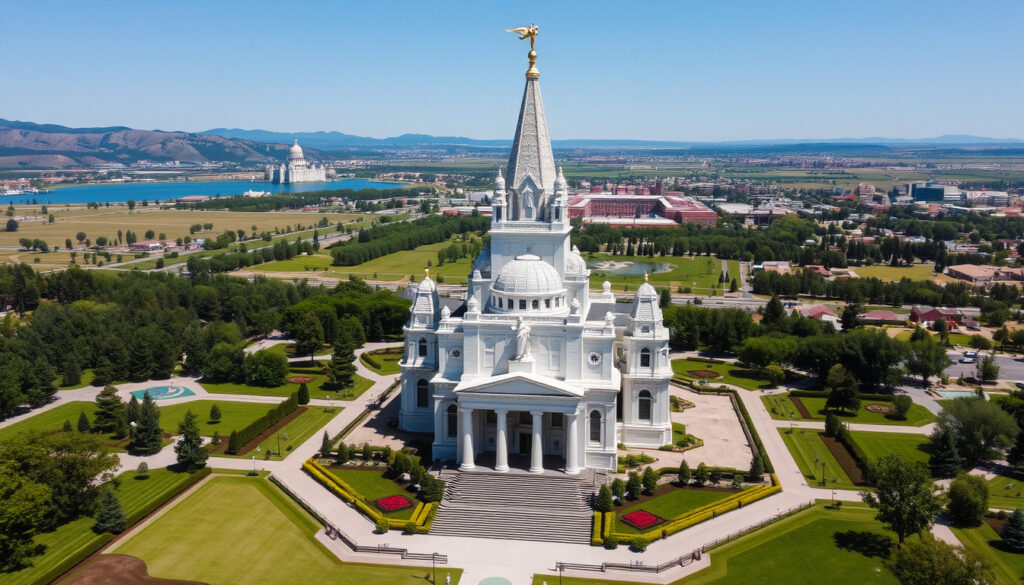
Church of Jesus Christ of Latter-day Saints: Beliefs & History
There’s a reason the name “The Church of Jesus Christ of Latter-day Saints” often sparks more curiosity than clarity. For both outsiders and members, separating official doctrine from persistent rumor can feel like navigating a maze.
Full Name: The Church of Jesus Christ of Latter-day Saints ·
Founded: April 6, 1830 ·
Headquarters: Salt Lake City, Utah, USA ·
Membership: Approximately 17 million ·
Scriptures: Holy Bible, Book of Mormon, Doctrine and Covenants, Pearl of Great Price ·
Current Prophet and President: Russell M. Nelson
Quick snapshot
- Godhead as three separate beings (Religion Media Centre (UK fact-checking resource))
- Jesus Christ is the Savior (Church Newsroom (official communications office))
- Restoration through Joseph Smith (Encyclopaedia Britannica (general reference publisher))
- Modern prophets and continuing revelation (Encyclopaedia Britannica (general reference publisher))
- Holy Bible (King James Version) (Religion Media Centre (UK fact-checking resource))
- Book of Mormon (Encyclopaedia Britannica (general reference publisher))
- Doctrine and Covenants (Religion Media Centre (UK fact-checking resource))
- Pearl of Great Price (Religion Media Centre (UK fact-checking resource))
- Sunday worship services – sacrament meeting (Church Newsroom (official communications office))
- Temple ordinances (baptisms for the dead, eternal marriage) (Encyclopaedia Britannica (general reference publisher))
- Missionary service (Church Newsroom (official communications office))
- Fasting and prayer (Encyclopaedia Britannica (general reference publisher))
- President (prophet) and Quorum of the Twelve Apostles (Encyclopaedia Britannica (general reference publisher))
- Hierarchy from general to local levels (Church Newsroom (official communications office))
- Worldwide membership with headquarters in Salt Lake City (Church Newsroom (official communications office))
With multiple sacred texts and a governance structure centered on a living prophet, Latter-day Saint identity resists easy comparison. The same institution that insists on the full name also holds beliefs that put it at odds with mainstream Christian creeds — a paradox that drives much of the public confusion.
Six core facts, one pattern: every official claim traces back to a restoration narrative that began with a teenage boy in 1820.
The table below summarizes the church’s key identifiers.
| Label | Value |
|---|---|
| Official Name | The Church of Jesus Christ of Latter-day Saints |
| Founded | April 6, 1830, by Joseph Smith (National Humanities Center (U.S. educational institute)) |
| Headquarters | Salt Lake City, Utah, USA (Encyclopaedia Britannica (general reference publisher)) |
| Membership | ~17 million (2023) (Encyclopaedia Britannica (general reference publisher)) |
| Current Prophet | Russell M. Nelson (Church Newsroom (official communications office)) |
| Canon | Bible, Book of Mormon, D&C, Pearl of Great Price (Religion Media Centre (UK fact-checking resource)) |
Is there a difference between Mormon and Latter-day Saints?
Official stance on the term Mormon
In 2018, church president Russell M. Nelson publicly urged members and the media to stop using the nickname “Mormon” and instead refer to the church by its full name, The Church of Jesus Christ of Latter-day Saints (Church Newsroom (official communications office)). The directive applied to publications, websites, and even the iconic “Mormon Tabernacle Choir,” which was renamed “Tabernacle Choir at Temple Square.”
Historical use of the term
The label “Mormon” dates to the 1830 publication of the Book of Mormon and was adopted by early members and outsiders alike. For much of the 20th century, the church itself embraced the term in materials like the “Mormon” newspaper and “Mormon Trail” tours (Encyclopaedia Britannica (general reference publisher)).
Current church guidelines
The official style guide now instructs: “The term ‘Mormon’ should not be used as a substitute for the full church name” (Church Newsroom (official communications office)). However, the church still sells the Book of Mormon and does not object to the term when referring to its ancient scripture. The implication: respectful outsiders should say “Latter-day Saints” to refer to members, not “Mormons.”
What do the Church of Jesus Christ of Latter-day Saints believe in?
Core doctrines of the restored gospel
Latter-day Saints hold that after centuries of apostasy, the original Christian church was restored through the prophet Joseph Smith beginning in 1820. This restoration includes priesthood authority, baptism by immersion, and continuing revelation through living prophets (Church Newsroom (official communications office)).
The nature of God and Jesus Christ
Unlike trinitarian Christianity, LDS theology teaches that the Father, Son, and Holy Ghost are three distinct beings united in purpose but not in substance. The first Article of Faith states: “We believe in God, the Eternal Father, and in His Son, Jesus Christ, and in the Holy Ghost” (Religion Media Centre (UK fact-checking resource)). Jesus Christ is considered the literal Son of God and the Savior whose Atonement makes salvation possible.
Plan of salvation
The plan of salvation spans a premortal existence, mortal life, and a postmortal progression through three degrees of glory: celestial, terrestrial, and telestial (Religion Media Centre (UK fact-checking resource)). Exaltation in the highest kingdom, the celestial, is described as a form of theosis — humans can become like God.
The role of scriptures
The LDS canon includes four volumes: the King James Bible, the Book of Mormon, the Doctrine and Covenants, and the Pearl of Great Price (Religion Media Centre (UK fact-checking resource)). The Book of Mormon is presented as “Another Testament of Jesus Christ,” detailing God’s dealings with ancient inhabitants of the Americas.
How many wives can a Mormon man have?
Historical practice of polygamy
Plural marriage was practiced by a minority of Latter-day Saints in the 19th century, beginning under Joseph Smith and continuing under Brigham Young. Estimates suggest that between 20 and 30 percent of LDS families in Utah were polygamous at the peak (Encyclopaedia Britannica (general reference publisher)).
Current church policy on marriage
Today, marriage in the LDS Church is strictly monogamous. The church teaches that marriage between one man and one woman is essential for exaltation and that polygamy is forbidden (Church of Jesus Christ (official church website)).
Legal and doctrinal changes
The 1890 Manifesto, issued by church president Wilford Woodruff, officially ended the practice of plural marriage in the church. Members who engage in polygamy today face excommunication (Encyclopaedia Britannica (general reference publisher)).
The pattern: what was once a tolerated (and divisive) practice is now a bright-line doctrinal and legal boundary. For outsiders asking “How many wives?” the answer is exactly one.
What is the most controversial Mormon belief?
Historical polygamy
Polygamy remains the most publicly associated — and contested — aspect of early LDS history. Even though the practice ended 130 years ago, it continues to be cited in critiques of the church’s legitimacy (Encyclopaedia Britannica (general reference publisher)).
Race and priesthood restrictions
Until 1978, the LDS Church did not ordain Black men to the priesthood or allow Black members to participate in temple ordinances. The reversal, announced as a revelation by President Spencer W. Kimball, was a watershed moment (Religion Media Centre (UK fact-checking resource)). The church has since repudiated past racial theories but the episode remains a source of tension.
Exclusive claims to truth
The LDS Church teaches that it is “the only true and living church” and that its priesthood authority is necessary for salvation (Religion Media Centre (UK fact-checking resource)). This exclusivity puts it at odds with ecumenical movements and other Christian denominations.
What this means: each controversy cuts in a different direction — one historical, one institutional, one theological. Collectively they explain why the church faces persistent scrutiny from both secular critics and fellow Christians.
Can Mormons kiss before marriage?
The Law of Chastity
The LDS Law of Chastity prohibits any sexual relations outside of legal marriage between a man and a woman. This includes abstaining from all forms of sexual intimacy (Church Newsroom (official communications office)).
Dating guidelines for youth
Church handbooks advise that “passionate kissing” and “lying on top of another person” are not appropriate before marriage. However, moderate kissing is generally permitted (Church of Jesus Christ (official youth resource)).
Kissing and physical affection
There is no official church rule banning all kissing before marriage. Leaders encourage members to “set personal standards that will keep them in control of their emotions and actions” (Church of Jesus Christ (official youth resource)). The catch: local bishops and parents may impose stricter guidelines, leading to varied enforcement among families.
What is the 72 hour intimacy rule?
Origin of the rule
The “72 hour intimacy rule” emerged from a 2017 talk by apostle Jeffrey R. Holland, who suggested that engaged couples consider abstaining from any physical intimacy for three days before marriage to “enter the temple with a clean start” (Church of Jesus Christ (official conference archive)).
Official church teaching vs. cultural practice
The rule is not an official church doctrine and does not appear in any handbook or policy document. It was a pastoral suggestion, not a commandment (Church of Jesus Christ (official youth resource)).
Purpose and interpretation
Holland’s intent was to help couples focus on spiritual preparation rather than physical distraction. Some members treat it as a guideline; others are unaware it exists. The trade-off: a cultural rule that sounds authoritative but has no official enforcement.
For engaged Latter-day Saints planning a temple marriage, the 72-hour idea is one of the most Googled — and misunderstood — pieces of advice. The church’s silence on an official rule leaves couples and bishops to decide locally, which creates uneven expectations across the global membership.
How Latter-day Saint beliefs compare with mainstream Christianity
Five key differences, one pattern: LDS theology redefines nearly every classic Christian doctrine in ways that make it a distinct category — restorationist, not Protestant or Catholic.
The comparison table below highlights the major contrasts.
| Aspect | Church of Jesus Christ of Latter-day Saints | Mainstream Christianity |
|---|---|---|
| Godhead | Three separate beings (Religion Media Centre (UK fact-checking resource)) | One God in three persons (Trinity) |
| Scripture | Bible + Book of Mormon, D&C, Pearl of Great Price (Religion Media Centre (UK fact-checking resource)) | Bible only (sola scriptura) |
| Revelation | Continuing through living prophets (Encyclopaedia Britannica (general reference publisher)) | Closed canon; no new public revelation |
| Salvation | Grace + works; exaltation to godhood (Religion Media Centre (UK fact-checking resource)) | Grace through faith alone; heaven/hell |
| Sacraments | Baptism by immersion; temple ordinances (Church Newsroom (official communications office)) | Baptism; Eucharist (varies by denomination) |
The implication: calling Latter-day Saints “a Christian denomination” is accurate only if one accepts a very broad definition. Many evangelical groups explicitly do not, citing the non-Trinitarian Godhead and extra-biblical canon as incompatible with historic Christianity.
Timeline: Key moments in LDS history
- 1820 — Joseph Smith reports a vision of God the Father and Jesus Christ (Encyclopaedia Britannica (general reference publisher))
- 1830 — Church organized; Book of Mormon published (National Humanities Center (U.S. educational institute))
- 1844 — Joseph Smith killed; succession crisis (Encyclopaedia Britannica (general reference publisher))
- 1847 — Brigham Young leads pioneers to Salt Lake Valley (Encyclopaedia Britannica (general reference publisher))
- 1890 — Official end of plural marriage (polygamy) (Encyclopaedia Britannica (general reference publisher))
- 1978 — Priesthood revelation allowing all worthy men regardless of race (Religion Media Centre (UK fact-checking resource))
Confirmed facts
- The church’s official name and central doctrines are well documented (Church Newsroom (official communications office))
- Polygamy was practiced historically but officially ended in 1890 (Encyclopaedia Britannica (general reference publisher))
- The Book of Mormon was published in 1830 (National Humanities Center (U.S. educational institute))
- Current prophet is Russell M. Nelson (Church Newsroom (official communications office))
What’s unclear
- Exact membership numbers due to variations in counting (Encyclopaedia Britannica (general reference publisher))
- Internal debates on historical accuracy of some early accounts (Religion Media Centre (UK fact-checking resource))
- Enforcement of the 72 hour intimacy rule varies by local leadership (Church of Jesus Christ (official youth resource))
What leaders say
“The Lord has made it clear that the name with which the Church is to be called is The Church of Jesus Christ of Latter-day Saints. … The use of the term ‘Mormon’ is an implication of a nickname and is not appropriate.”
— Russell M. Nelson, church president, 2018 (Church Newsroom (official communications office))
“If you are engaged to be married, you might consider, for a 72-hour period before your marriage, abstaining from all physical affection so that you can enter the temple with a clean start.”
— Jeffrey R. Holland, apostle, October 2017 (Church of Jesus Christ (official conference archive))
“Sexual intimacy is sacred. It is reserved for marriage between a man and a woman. … The Lord’s standard is chastity.”
— Church of Jesus Christ, ‘For the Strength of Youth’ (Church of Jesus Christ (official youth resource))
The takeaway: official statements are consistent and unambiguous on the core doctrines. The 72-hour rule is the only exception — a single talk by one apostle that generated a cultural rule far beyond what the church ever codified.
For anyone researching the Church of Jesus Christ of Latter-day Saints, the core challenge is separating the restored gospel’s own claims from the noise of historical controversy and cultural rumor. The church insists on its full name, but the content of its beliefs — a distinct Godhead, an open scriptural canon, temple ordinances for the dead — will always set it apart from mainstream Christianity. For journalists covering the faith, the choice is clear: use the official name, cite primary sources from churchofjesuschrist.org, and treat the 72-hour rule as a pastoral suggestion, not a doctrine. For curious believers and seekers, the best starting point remains the church’s own resources — with an awareness that the church’s self-description and public perception are often two very different things. Journalists covering the LDS Church must navigate this gap carefully to provide accurate reporting.
For a comprehensive overview of its global leadership and historical development, one can refer to a detailed article on the Church of Jesus Christ of Latter-day Saints.
Frequently asked questions
Do Latter-day Saints consider themselves Christians?
Yes. The church’s full name includes Jesus Christ, and its core teachings center on His Atonement. However, many mainstream Christians do not recognize Latter-day Saints as Christians because of the non-Trinitarian view of the Godhead and the addition of the Book of Mormon as scripture (Religion Media Centre (UK fact-checking resource)).
What is the role of temple work?
Temples are used for sacred ordinances such as eternal marriage (sealing), baptism for the dead, and endowments. These are considered essential for exaltation and are only performed by authorized members (Church Newsroom (official communications office)).
Can non-members visit a temple?
No. LDS temples are open only to members who hold a current temple recommend, which requires adherence to church standards. Visitors can enter visitors’ centers on temple grounds (Church of Jesus Christ (official temple site)).
Why do Latter-day Saints send missionaries?
Missionary work is seen as a duty to share the restored gospel. Young men typically serve for two years, young women for 18 months, and senior couples for shorter periods (Church Newsroom (official communications office)).
What is the Word of Wisdom?
A health code that prohibits alcohol, tobacco, coffee, and tea, and encourages consumption of grains, fruits, and limited meat (Encyclopaedia Britannica (general reference publisher)).
How does the church handle LGBTQ+ issues?
The church opposes same-sex marriage and sexual relations outside of a legal marriage between a man and a woman. It maintains that same-sex attraction is not a sin, but acting on it is. Policies have shifted in recent years, including reinstating baptism for children of same-sex parents (Church Newsroom (official communications office)).
Are Latter-day Saints allowed to drink alcohol or coffee?
No. The Word of Wisdom prohibits alcohol, tobacco, coffee, and tea. Caffeinated soft drinks are not prohibited but are discouraged by some leaders (Encyclopaedia Britannica (general reference publisher)).
For non-members researching LDS beliefs, the gap between official doctrine and cultural practice — especially around dating, intimacy, and the “Mormon” nickname — is where most misunderstandings grow. The church’s official position is clear; local application is not.
More related posts
 South Island New Zealand Heavy Rain: Live Warnings & Forecast
 Ear Wax Removal Cost NZ: 2024 Prices & Clinic Guide
 Harbour Town Gold Coast: Australia’s Largest Outlet Mall
 A3 Size in cm: Dimensions, Comparisons, and Common Questions
 1L Stainless Steel Drink Bottle NZ: Best Picks & Prices
 Weather Warnings New Zealand: Red, Orange, and Cyclone
 How to Post on Instagram from Desktop: Step-by-Step Guide
 EB Games Closing Down: NZ Shutdown and AU Updates 2026