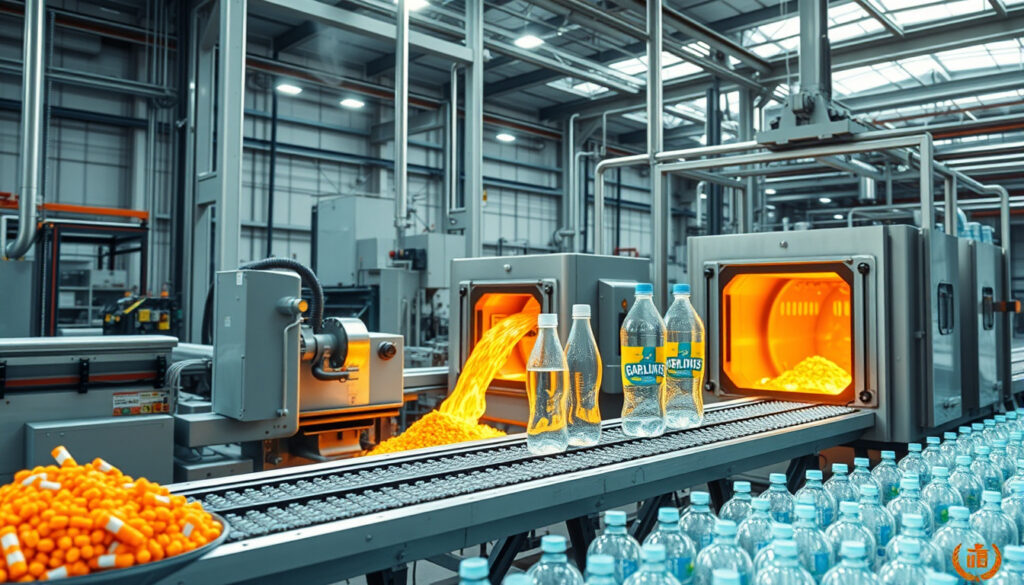
How Is Plastic Made? Step-by-Step Guide to Plastic Manufacturing
Anyone who has ever held a plastic water bottle has stumbled into a surprisingly unglamorous story: most plastics begin as crude oil or natural gas, refined and reorganized molecule by molecule. The world now produces more than 380 million tons of plastic every year from a path filled with trade-offs that usually stay out of sight (Our World in Data, a data-driven research group).
Plastic waste never recycled: 91% (Geyer et al. in Science Advances) · Global annual plastic production: 380+ million tons (Our World in Data, data-driven research group) · Crude oil used in plastic production: ~6% of total global oil consumption (Ellen MacArthur Foundation, circular-economy research charity)
Quick snapshot
- Almost all plastics start from fossil-fuel feedstocks (Ellen MacArthur Foundation, circular-economy research charity). (Environmental Investigation Agency briefing)
- About 99% of plastics are produced from petrochemical feedstocks derived from fossil fuels (Environmental Investigation Agency briefing).
- Only about 9% of all plastic ever produced has been recycled (Geyer et al., peer-reviewed journal Science Advances). (Environmental Investigation Agency briefing)
- Long-term health effects of microplastics are still being studied (National Geographic, science media).
- 1907: Bakelite becomes the first fully synthetic plastic (Science History Institute, chemistry history nonprofit).
- Petrochemical expansion, led by China, is now a key driver of global oil demand growth (International Energy Agency oil-market commentary).
Six numbers, one pattern: plastic’s usefulness and its waste problem come from the same molecular design.
| Label | Value |
|---|---|
| Primary raw material | Mostly crude oil and natural gas; a small share comes from plant biomass (PlasticsEurope, European plastics industry association) |
| Main polymer types | Polyethylene, polypropylene, PVC, PET (Wikipedia’s plastics overview) |
| Global annual production | 380+ million tons (Our World in Data, data-driven research group) |
| Global recycling rate | Only about 9% of all plastic ever produced has been recycled (Geyer et al. in Science Advances) |
| Packaging’s share of plastic output | 36% — the largest single-use waste category (UNEP’s waste-pollution interactive) |
| BPA classification | Endocrine disruptor, according to the US EPA (US EPA, federal environmental regulator) |
How is plastic made step by step?
Plastic production is a pipeline, not a single factory step. The typical fossil-plastic route runs from extraction to refining, cracking, polymerization, pelletizing, and conversion — and each stage leaves its own footprint.
Step 1: Extraction of raw materials
- Crude oil is drilled from underground reservoirs and shipped to refineries.
- Natural gas is often extracted alongside it and piped to petrochemical plants.
- Both carry the hydrocarbon molecules that end up in plastic.
Plastic’s raw materials are the same fluids that fuel cars and heat homes. PlasticsEurope, the European plastics industry association, describes plastics as being made from natural materials such as crude oil, natural gas, and coal — with petroleum the dominant source. The extraction step matters because it connects plastic prices directly to oil markets and drilling decisions.
Step 2: Refining crude oil into naphtha and monomers
- Refineries heat crude oil in a distillation column and separate it into fractions.
- Naphtha, LPG, and ethane are the fractions that matter most to plastics.
- These fractions still need cracking before they become monomers.
Refiners do not set out to make plastic; they make fuels and end up with petrochemical building blocks. The International Energy Agency’s oil-market analysis identifies naphtha, LPG, and ethane as the key petrochemical feedstocks for plastic production. The separation is physical — different hydrocarbon molecules boil at different temperatures — but the real chemical transformation happens in the next stage.
Step 3: Polymerization into plastic resins
- Monomers such as ethylene and propylene are the building blocks.
- Catalysts force these small molecules to link into long chains.
- The resulting resin is cooled and cut into pellets for shipping.
This is the step where chemistry becomes material. Polymerization links ethylene into polyethylene and propylene into polypropylene; the Environmental Investigation Agency, an independent environmental watchdog, maps the process from monomer to resin pellet. The pellet — about the size of a lentil — is the universal currency of the plastics industry.
Step 4: Forming into final products
- Extrusion pushes melted resin through a die to make film, pipe, and sheet.
- Injection molding forces resin into a mold for caps, toys, and housings.
- Blow molding inflates hot resin inside a mold to create hollow bottles.
Converters melt the pellets and shape them. HowStuffWorks, the educational science series, explains that extrusion, injection molding, and blow molding are the core conversion processes behind most plastic goods. Cooling locks the molecules into their final arrangement, which is why recycling later requires re-melting and re-forming rather than simple cleaning.
The pattern: every stage after extraction adds cost and emissions, so the cheapest plastic is the one closest to raw resin — and the hardest to recover is the one spread thin as packaging.
What is the main ingredient in plastic?
The short answer is hydrocarbons. The longer answer involves where they come from and which monomers they become.
Crude oil as the primary source
- Crude oil provides the majority of hydrocarbon molecules used in plastic.
- Refineries separate it into fuel fractions and chemical feedstocks.
As covered in Step 2, naphtha, LPG, and ethane from crude oil and natural gas are the main feedstocks, with ethylene and propylene dominating the monomer mix. That is why crude oil is listed as the primary ingredient in almost every introductory explainer on plastic production.
Natural gas as an alternative feedstock
- Natural gas liquids such as ethane and propane feed steam crackers directly.
- Regions with abundant gas, such as the United States and the Middle East, rely heavily on this route.
Natural gas is not a side note; it is a primary plastic feedstock in its own right. When gas prices fall, petrochemical plants built near gas fields gain a decisive cost advantage, which is why new plastic production capacity has clustered around cheap gas regions.
Monomers: ethylene, propylene, styrene
- Ethylene becomes polyethylene — film, bags, and bottles.
- Propylene becomes polypropylene — containers, textiles, and car parts.
- Styrene becomes polystyrene — foam cups and insulation.
The Science History Institute, a chemistry research nonprofit, traces how these simple monomers became the backbone of the modern plastics industry. The monomer chosen at the cracker determines the entire family of plastics that can be made from a batch of naphtha.
What this means: plastic is not manufactured from scratch in a single vessel. It is refined from hydrocarbons already in the ground, which is why fossil-fuel prices, plastic prices, and climate policy stay tangled together.
How is plastic made from petroleum?
Petroleum-based plastic is the default for a reason: crude oil is energy-dense, cheap, and chemically packed with exactly the molecules plastic needs.
Crude oil distillation and cracking
- A distillation column heats crude oil and separates it by boiling point.
- Naphtha comes off as one of the light liquid fractions.
- Steam cracking then breaks large hydrocarbon molecules into smaller ones.
Steam cracking is the chemical bridge between refinery and plastic factory. The International Energy Agency’s Future of Petrochemicals report describes how steam crackers convert hydrocarbon feedstocks into smaller molecules such as ethylene and propylene, which serve as plastic monomers. The same cracker can flex its output depending on which monomers the market wants.
Production of monomers like ethylene
- Ethylene is the workhorse monomer for plastic production.
- Monomers are separated and purified before polymerization because impurities disrupt chain growth.
Purification matters more than most people realize. A trace contaminant can poison a catalyst or produce an unusable polymer, so monomer purification is a standard stage in the UNEP-documented pathway from feedstock to plastic product.
Polymerization into polyethylene and polypropylene
- Polyethylene is built from ethylene monomers.
- Polypropylene is built from propylene monomers.
- Catalysts control chain length and branching, which set the plastic’s stiffness and clarity.
Polymerization is where chemists dial in a plastic’s personality. The educational science series HowStuffWorks explains that the length and branching of the polymer chains determine whether the final plastic comes out flexible like a bag or rigid like a crate — so the same base monomer can serve dozens of very different products.
The catch: the heavier the processing, the higher the energy bill. Refining, cracking, and polymerizing are why a large share of plastic’s climate impact is locked in before any product exists.
How is plastic made from plants?
Plastic does not have to start with oil. Encyclopaedia Britannica’s entry on bioplastics describes plant-based plastics made from renewable biomass such as corn starch, sugarcane, or potatoes.
Bioplastics from corn, sugarcane, or potatoes
- Corn is the dominant feedstock in North America.
- Sugarcane dominates in South America.
- Potatoes and other starches appear in European blends.
These crops are grown, harvested, and processed to extract sugars — the real raw material for the next stage. The feedstock choice is mostly economic: manufacturers use whichever crop produces the cheapest sugar in their region.
Fermentation of sugars into lactic acid
- Microorganisms ferment plant sugars into lactic acid.
- Lactic acid is the monomer for polylactic acid (PLA).
Fermentation is the biological mirror of steam cracking: instead of splitting large molecules, it rebuilds small sugars into a usable monomer. This is where bioplastics diverge from the petroleum route — the building block comes from biology, not from a cracker.
Polylactic acid (PLA) production
- Lactic acid molecules are linked into long PLA chains.
- PLA is used in cups, trays, food packaging, and disposable cutlery.
- It degrades reliably only under industrial composting conditions.
PLA is the most visible bioplastic on shelves, but “biobased” does not mean “disappears anywhere.” Its compostability depends on commercial facilities that maintain the right temperature and humidity — not on backyard piles.
Plant-based plastic solves the feedstock problem, not the waste problem. A bioplastic cup that reaches an industrial composter is a win; one that reaches a landfill behaves like ordinary plastic.
The trade-off: bioplastics swap oil for farmland, and farmland is not unlimited. The economics, not the chemistry, still decide whether they scale.
Is plastic toxic to the body?
The honest answer is that it depends on the plastic, the additives, and the conditions. The polymer itself is largely inert; the chemical mix inside the polymer is where the questions start.
Chemical additives: BPA, phthalates, PFAS
- BPA is used in polycarbonate and some food-can linings.
- Phthalates make PVC flexible.
- PFAS appears in some grease-proof food packaging.
The US EPA, the federal environmental regulator, classifies BPA as an endocrine disruptor that can interfere with hormone signaling, and it tracks a long list of other additives with similar concerns. The risk profile of a given container depends less on the plastic itself than on which additives were included during manufacturing.
Leaching from containers into food and water
- Heat can increase the release of additives into food.
- Acidic or fatty foods can accelerate migration.
- Scratched or worn containers release more particles.
This is why regulators test plastics under realistic use conditions. The US Food and Drug Administration, the food-safety regulator, evaluates food-contact substances before they can be sold and monitors migration data for compounds such as BPA. A container that is safe for water can behave differently when filled with hot soup or acidic tomato sauce.
Safer choices: PP, HDPE, LDPE
- Resin code 2 (HDPE): jugs, bottles, cutting boards.
- Resin code 4 (LDPE): wraps, squeeze bottles.
- Resin code 5 (PP): yogurt cups, straws, microwavable containers.
Recycling codes are not safety seals, but the plastics sold for food contact in the US have to comply with FDA food-contact rules, which is why codes 2, 4, and 5 are the low-drama choices for everyday storage. Codes 3 (PVC) and 7 (other) are where most of the additive uncertainty concentrates.
For everyday use, the hierarchy is simple: glass and steel beat plastic under heat, and among plastics, codes 2, 4, and 5 carry the least baggage.
The pattern: regulators approve plastics for specific uses, not for all uses. The same container that is fine for water can be a poor choice for hot, oily, or acidic food — which is why guidance always includes conditions, not just materials.
Could we live without plastic?
Almost certainly not entirely. But the question exposes how much of our plastic use is essential and how much is just default.
Historic alternatives: wood, glass, metal
- Before synthetic plastics, people used wood, stone, ceramics, glass, and metals.
- Natural materials like shellac, horn, and rubber covered many of the same jobs.
Wikipedia’s plastics overview notes that early consumers relied on natural materials for the roles plastic later filled — and that those materials were often heavier, rarer, or less hygienic. Plastic won because it was cheap, light, and easy to sterilize, not because it was the only option.
Health and safety trade-offs
- Plastics are central to sterile medical equipment, syringes, and food packaging.
- They are light enough to cut transport emissions compared with glass or metal.
- Their durability is exactly why discarded plastic persists in the environment.
Plastic’s value to modern medicine and food safety is real, and that value is not marketing — it is why hospitals, regulators, and food companies continue to depend on it. The same durability that makes a syringe safe makes a bottle cap nearly indestructible in a riverbed.
Reduction and recycling strategies
- Of all plastic ever produced, 91% has not been recycled (National Geographic, science media).
- Recycling handles only a fraction, so reduction and reuse carry the load.
The 91% figure comes from the materials-flow accounting popularized by National Geographic’s plastic-pollution coverage: most plastic ever made has been landfilled, incinerated, or leaked into the environment. Cutting plastic use at the source — especially packaging — is the strategy with the fastest measurable effect, because no recycling system can catch up with a waste stream that grows faster than recovery capacity.
The same durability that makes plastic useful in a hospital makes it dangerous in a river. A material designed to resist breakdown is, by definition, hard to eliminate.
Why this matters: the question is not whether to ban plastic, but which plastics genuinely improve health and safety, and which are simply convenient. That distinction, not blanket guilt, should drive the reduction agenda.
Pros and cons of plastic manufacturing
Upsides
- Lightweight, durable, and cheap to produce at scale.
- Critical for sterile medical devices and food-safety packaging.
- So versatile that one industry can produce films, foams, fibers, and rigid parts.
Downsides
- Nearly all plastics start as fossil fuels, locking in carbon emissions.
- Only 9% of plastic ever produced has been recycled.
- Additives such as BPA raise health questions under heat and repeated use.
- Bioplastics still depend on industrial-scale composting to break down.
The trade-off: plastic’s upside is its molecular stability, and that same stability is what makes it persist. You cannot have the durability without the disposal problem; you can only design around it.
Plastic manufacturing at a glance
- Extract crude oil and natural gas.
- Refine them into naphtha, LPG, and ethane.
- Crack those feedstocks into ethylene, propylene, and other monomers.
- Polymerize the monomers into resin.
- Cool and cut the resin into pellets.
- Melt and mold the pellets into final products using extrusion, injection molding, or blow molding (HowStuffWorks, educational science series).
Six steps, one pipeline. The plastic bottle in your hand is downstream of every one of them — and so is the waste problem attached to its disposal.
Confirmed facts vs open questions
Confirmed facts
- Plastics begin as hydrocarbon feedstocks, mostly crude oil or natural gas (UNEP, the UN’s environment program).
- Food-contact plastics are regulated before they reach shelves (US FDA food-contact program).
- The plastic packaging system is overwhelmingly single-use; most packaging value is lost after one cycle (Ellen MacArthur Foundation, circular-economy research charity).
What’s unclear
- Long-term health effects of additives at low doses, from BPA to phthalates, are still being reviewed (US FDA food-contact program).
- Whether bioplastics can scale affordably without competing with food crops (Encyclopaedia Britannica).
- Where exactly the unrecycled plastic ends up — ocean, landfill, or incinerator — and at what rate it breaks down (National Geographic, science media).
The pattern: what scientists agree on is the material flow — fossil feedstocks, near-zero recycling, persistent waste. What remains uncertain is the biological and economic timing of the consequences.
What agencies and analysts say
“Plastic production, use and disposal contribute to the climate, biodiversity and pollution dimensions of the triple planetary crisis.”
“Around 90% of plastics’ lifecycle emissions occur during primary plastic production and product manufacturing, with most occurring before polymerization.”
Environmental Investigation Agency lifecycle briefing
The common thread: both organizations push the same conclusion — the damage is mostly set before the product exists, which means upstream design matters more than downstream cleanup.
The state of plastic
Plastic is what happens when cheap fossil energy meets clever chemistry: a material so useful it replaced glass, metal, and wood in a single generation, and so persistent it now shows up in Arctic ice and human blood. The manufacturing process explains both outcomes — refinery, cracker, reactor, mold — but it does not explain the absence of an exit plan. For everyday consumers, the implication is clear: keep using plastic where it protects health and food, refuse it where it is purely decorative, or accept that the 380 million tons produced each year will keep flowing into a system that recycles only 9% of it.
Frequently asked questions
Can bioplastics replace regular plastic?
Only partially. Encyclopaedia Britannica notes that bioplastics are made from renewable biomass and can be compostable — but they need dedicated industrial facilities and currently represent a small share of the market, so they complement rather than replace conventional plastics.
How is plastic recycled?
Plastic is sorted by resin type, washed, shredded, melted, and re-pelletized. The US EPA’s plastics material data show that the recycling rate for plastics remains in single digits — which is why recycling alone cannot solve the waste problem.
What is the most common plastic used in bottles?
Beverage bottles are typically made from PET (polyethylene terephthalate), while grocery bags and films are usually polyethylene. Wikipedia’s plastics overview lists PET as the standard resin for drink bottles and polyethylene as the dominant plastic overall.
What is the role of catalysts in plastic production?
Catalysts speed up polymerization and help control the chain length and branching that determine the final material’s properties. The Science History Institute credits improved catalysts with enabling manufacturers to produce plastics at lower temperatures with far more control over structure.
What is the difference between thermoplastic and thermoset plastic?
Thermoplastics soften when heated and can be reshaped; thermosets undergo an irreversible cure and cannot be remelted. PlasticsEurope, the European plastics industry association, notes that thermoplastics are the family that can be re-melted and re-formed, which is why they dominate recyclable packaging.
More related posts
 Te Wiki o te Reo Māori 2025: Theme, Dates & Resources
 Man City vs Al Ain 6-0: Final Score, Goals, and TV Info
 NZ King Salmon Share Price: Forecast, History and Is It a Buy
 Travel Insurance with COVID Cover: Irish Guide 2024
 2 Degrees Top Up Online: How to Recharge Your Prepay Account
 Raspberry Leaf Tea NZ: When to Drink, Benefits & Safety
 1923 TV Serie : Ca t, Sea on & Yellow tone Watch Order
 North Island New Zealand Thunderstorms: Forecast and Safety