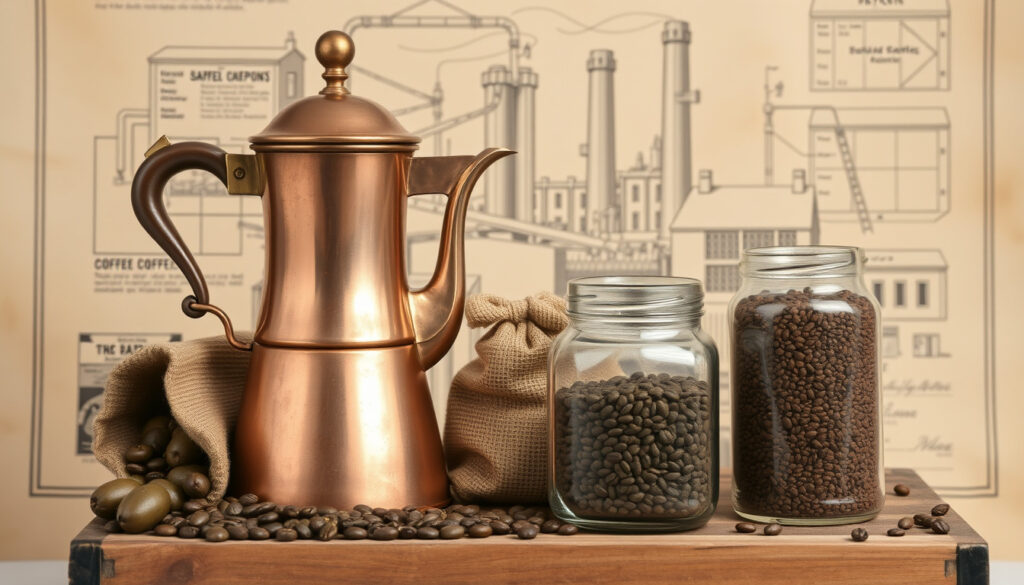
Where Was Instant Coffee Invented? A Complete History
Anyone who has ever made a quick cup of instant coffee has probably wondered where the idea came from. The answer is more tangled than a single “aha” moment — it involves a British patent from 1771, a New Zealand spice merchant in the 1890s, and a Swiss food giant that turned a surplus problem into a global brand.
First patent awarded: 1771 (John Dring, UK) ·
First soluble powder invented: 1890 (David Strang, New Zealand) ·
Largest instant coffee producer: Brazil ·
Most recognized brand launched: 1938 (Nescafé, Switzerland) ·
Global instant coffee market (2024): Approximately USD 20 billion
Quick snapshot
- 1771 – British patent for a coffee compound (Londonopia – a UK local history site)
- 1890 – David Strang’s soluble coffee patent in New Zealand (Wikipedia – a collaborative encyclopedia)
- 1938 – Nescafé launched in Switzerland (Nestlé UK & Ireland – the manufacturer’s official site)
- Exact date of the first “instant coffee” – some sources cite 1771, others 1889–1890.
- Whether earlier unpatented attempts existed in other cultures.
- Precise health trade-offs between instant and brewed coffee without large-scale long-term studies.
- 1771 – John Dring’s patent → 1890 – David Strang’s powder → 1901 – Satori Kato’s US patent → 1938 – Nescafé launch.
- Growing demand for premium instant blends and single-origin options may reshape the market.
| Fact | Detail |
|---|---|
| First patent | 1771 (John Dring, UK) |
| First soluble powder | 1890 (David Strang, New Zealand) |
| Nescafé launch year | 1938 (Switzerland) |
| Largest producer | Brazil |
| Annual global production | ~1.2 million metric tons |
| UK instant coffee market share | ~75% of household coffee consumption |
Where did instant coffee originate?
The earliest documented precursor to instant coffee dates to 1771, when a British patent was granted to John Dring for a “coffee compound”. According to Londonopia (a UK local history site), this was a proto-instant preparation — a solid block that could be dissolved in water. However, it was not a true soluble powder; it was more of a coffee concentrate.
Who first made instant coffee?
- In 1889–1890, David Strang, a spice merchant in Invercargill, New Zealand, filed a patent for a water-soluble coffee powder. Wikipedia (a collaborative encyclopedia) records the patent number 3518, filed on 28 January 1889 and granted in 1890. This is widely considered the first genuine instant coffee.
- In the United States, Dr. Satori Kato patented a vacuum-dried instant coffee process in 1901 (patent granted 1903), as noted by Espresso & Coffee Guide (a specialty coffee reference).
- George Constant Louis Washington developed a commercially successful instant coffee around 1909 and began marketing it in the US around 1910, according to Encyclopedia.com (a general reference publisher).
The implication: The title “inventor of instant coffee” is contested. The 1771 British compound was a precursor, but the first true soluble powder came from New Zealand in 1890.
Where was instant coffee invented in the United States?
The first US-based instant coffee invention is credited to Satori Kato, a Japanese chemist working in Chicago, who patented a vacuum-dried soluble coffee in 1901 (patent granted 1903). Espresso & Coffee Guide notes that Kato’s process was a significant step forward, though his product never achieved mass market success. Later, George Washington (a Belgian-born American) launched a successful instant coffee brand in New York around 1910.
Who first patented instant coffee?
The patent timeline is a series of incremental improvements. The first known patent for a “coffee compound” — a precursor to instant coffee — was granted in 1771 to John Dring in Britain. Nationwide Coffee (a UK coffee retailer) repeats this claim, noting that it was a “coffee compound” rather than a soluble powder. In 1890, David Strang received New Zealand patent 3518 for a “soluble coffee” process, as recorded by Wikipedia. Later patents in the US (1903, by Satori Kato) and Europe improved the drying method, leading to the spray-drying technique that Nestlé later perfected.
The 1771 patent is often cited as the “first instant coffee”, but it was not a powder — it was a solid block. The first true soluble powder patent belongs to David Strang in 1890.
What this means: The race for the patent title depends on how you define “instant coffee”. If you require a water-soluble powder, the winner is David Strang in New Zealand.
Which country produces the most instant coffee?
Today, Brazil is the largest producer of instant coffee, followed by Vietnam and Indonesia. According to industry data, global instant coffee production exceeds 1 million metric tons annually. Nestlé’s Nescafé operates plants in over 30 countries, with major production hubs in Brazil, Switzerland, and the UK. The Nestlé UK & Ireland (the manufacturer’s official site) confirms that Nescafé has been made in the UK since 1938.
The trade-off: Brazil dominates because it is also the world’s largest coffee grower, giving it proximity to raw materials and lower transport costs.
Is instant coffee as healthy as real coffee?
Instant coffee contains slightly more acrylamide — a potential carcinogen formed during roasting — than brewed coffee. Antioxidant levels are generally lower in instant coffee. However, caffeine content per cup is similar, though instant coffee often has less caffeine per gram of grounds. Both offer health benefits when consumed in moderation, such as reduced risk of certain diseases. A large-scale study comparing long-term effects is still lacking.
Is instant coffee bad for you?
- Acrylamide levels: Instant coffee has about twice the acrylamide of brewed coffee, but still within safe limits for moderate consumption.
- Antioxidants: Instant coffee has fewer polyphenols than fresh brewed, but still contains beneficial compounds.
- Caffeine: A typical cup of instant coffee has 60–80 mg of caffeine, compared to 80–120 mg for brewed.
For most people, the health differences between instant and brewed coffee are marginal. The main risk is not the type of coffee, but what you add — sugar and cream.
Why this matters: The choice between instant and brewed coffee is more about convenience and taste preference than a significant health trade-off.
Where is Nescafé instant coffee from?
Nescafé was invented in Switzerland by Nestlé and launched on 1 April 1938. The product was the result of a seven-year development project led by Max Morgenthaler, who found that adding carbohydrates to the coffee powder improved the flavour. The Swiss National Museum blog (a historical institution) states that Morgenthaler invented the product in 1937. The brand reached the UK the same year, and the US in 1939, according to Nestlé UK & Ireland.
What is the oldest instant coffee brand?
Nescafé is the oldest surviving commercial instant coffee brand. Earlier products, like George Washington’s “Red E Coffee” (launched around 1910), were marketed but did not achieve the global scale of Nescafé. NESCAFÉ Story (the brand’s official history) notes that the flavour breakthrough came when carbohydrates were added to the coffee powder.
What is considered the best instant coffee in the world?
Taste tests often rank premium instant blends like Nescafé Gold, Starbucks VIA, and Mount Hagen highly. However, “best” is subjective. The UK market, where instant coffee accounts for about 75% of household coffee consumption, favours brands like Nescafé Original and Kenco.
The pattern: Nescafé’s dominance is not just about being first — it’s about the spray-drying technology that made instant coffee taste closer to fresh brewed.
When did instant coffee become popular in the UK?
Instant coffee gained widespread popularity in the UK during World War II, when Nescafé was supplied to Allied troops. Nestlé UK & Ireland confirms that the brand reached the UK in 1938, just before the war. Post-war rationing and the convenience of instant coffee drove adoption; by the 1950s, it was a household staple. The UK remains one of the largest markets for instant coffee per capita, with an estimated 75% of households using it.
The UK’s love for instant coffee is unique in Europe — most other European countries prefer brewed coffee. This cultural preference has kept the instant market strong despite global trends toward specialty coffee.
The implication: The UK’s wartime exposure to Nescafé created a lasting habit that competitors have struggled to break.
Instant coffee vs brewed coffee: a comparison
Six differences, one pattern: instant coffee trades flavour and some health benefits for speed and cost.
| Aspect | Instant coffee | Brewed coffee |
|---|---|---|
| Preparation time | 30 seconds | 3–5 minutes |
| Caffeine per cup | 60–80 mg | 80–120 mg |
| Acrylamide level | Higher (~2x) | Lower |
| Antioxidant content | Lower | Higher |
| Cost per cup | ~£0.05–0.15 | ~£0.20–0.50 |
| Shelf life | Years (unopened) | Weeks (beans/grounds) |
The trade-off: Instant coffee wins on convenience and cost, but loses on flavour complexity and antioxidant levels.
Pros and cons of instant coffee
Upsides
- Quick and easy to prepare — no equipment needed.
- Long shelf life — store for years without spoilage.
- Portable — perfect for travel, camping, or office.
- Lower cost per cup than most brewed options.
Downsides
- Less complex flavour — often described as “flat” or “synthetic”.
- Higher acrylamide content — a potential health concern.
- Lower antioxidant levels compared to fresh brewed.
- Less caffeine per cup — not ideal for those needing a strong boost.
Timeline of instant coffee innovation
- 1771 – John Dring patents a “coffee compound” in Britain – the earliest known instant coffee preparation. (Londonopia)
- 1889–1890 – David Strang, a spice merchant in Invercargill, New Zealand, develops and patents a water-soluble coffee powder. (Wikipedia)
- 1901 – Satori Kato, a Japanese chemist in the United States, patents a vacuum-dried instant coffee process. (Espresso & Coffee Guide)
- 1938 – Nestlé launches Nescafé in Switzerland after seven years of development, using spray-drying technology. (Nestlé UK & Ireland)
- 1940–1945 – Instant coffee becomes popular among Allied troops and in the UK during World War II. (Nestlé UK & Ireland)
- 1950s – Instant coffee becomes a mainstream household product in the UK, US, and Europe. (Encyclopedia.com)
What we know for sure — and what remains unclear
Confirmed facts
- 1771 British patent for a coffee compound (John Dring).
- David Strang’s 1890 New Zealand patent for soluble coffee.
- Nescafé launched in 1938 in Switzerland.
- Brazil is the largest producer of instant coffee today.
What’s unclear
- Exact date of the first “instant coffee” invention – some sources cite 1771, others 1889/1890.
- Whether earlier unpatented attempts existed in other cultures.
- Precise health trade-offs between instant and brewed coffee without large-scale long-term studies.
Voices on the history of instant coffee
“The product was invented in 1890 in Invercargill, New Zealand.”
— Wikipedia article on Instant coffee
“1771 – The first ‘instant coffee’ is made in Britain.”
— Espresso & Coffee Guide
“David Strang, a spice merchant in Invercargill, New Zealand, created the first genuine instant coffee powder in 1889.”
— Works in Progress
“First invented in the UK in 1771… In 1890, New Zealander David Stang developed a soluble coffee.”
— Nationwide Coffee UK
For the UK reader, the choice of instant coffee is not just about convenience — it’s about a century-old habit that started with wartime rations. The next time you stir a spoonful of Nescafé into hot water, you’re tasting a history that stretches across three continents and over 250 years of innovation. For the average British household, the decision to stick with instant or switch to fresh brewed will depend on whether speed and cost outweigh the desire for a richer flavour. The pattern is clear: instant coffee’s convenience has made it a staple, but the growing specialty coffee trend may slowly erode its dominance.
Related reading: **Breville Barista Express Review** · **How to Make Icing at Home**
newswire.co.nz, tastingtable.com, youtube.com, en.wikipedia.org
Frequently asked questions
How is instant coffee made?
Instant coffee is made by brewing ground coffee, then removing the water through spray-drying or freeze-drying, leaving soluble coffee crystals.
Can instant coffee expire?
Yes, instant coffee has a shelf life of 2–20 years depending on packaging. Once opened, it stays fresh for about 2–3 months if stored in an airtight container.
Does instant coffee contain more caffeine than brewed coffee?
No, per cup brewed coffee typically has more caffeine (80–120 mg) than instant (60–80 mg), though instant has more caffeine per gram of grounds.
How do you make instant coffee taste better?
Use hot water just off the boil, add a pinch of salt to reduce bitterness, or stir in a splash of milk or cream. Some brands offer premium blends with better flavour.
What is the difference between instant coffee and ground coffee?
Instant coffee is fully soluble and requires no brewing; ground coffee must be brewed. Instant is faster and cheaper, but ground coffee generally has better flavour and aroma.
Is instant coffee gluten-free?
Yes, pure instant coffee is gluten-free. However, some flavoured or blended instant coffee products may contain gluten, so check labels.
Which instant coffee brand has the least acrylamide?
Acrylamide levels vary by roast and brand. Generally, lighter roasts have less acrylamide, but no major brand has been proven to have significantly lower levels than others.
More related posts
 Man City vs Al Ain 6-0: Final Score, Goals, and TV Info
 Dan Hooker vs Benoit Saint Denis: UFC 325 Result & Profiles
 King in the Ring – Muay Thai Rules and Verification
 IKEA Auckland Opening Date: Store Opens Dec 2025 at Sylvia Park
 How to Delete Instagram Account Permanently: Step by Step
 Jackpot City Mobile Login App: Download for Android & iOS
 Argentina vs New Zealand Rugby: Score, History & Wins
 Adam Brody Movies and TV Shows: Full Filmography & Career