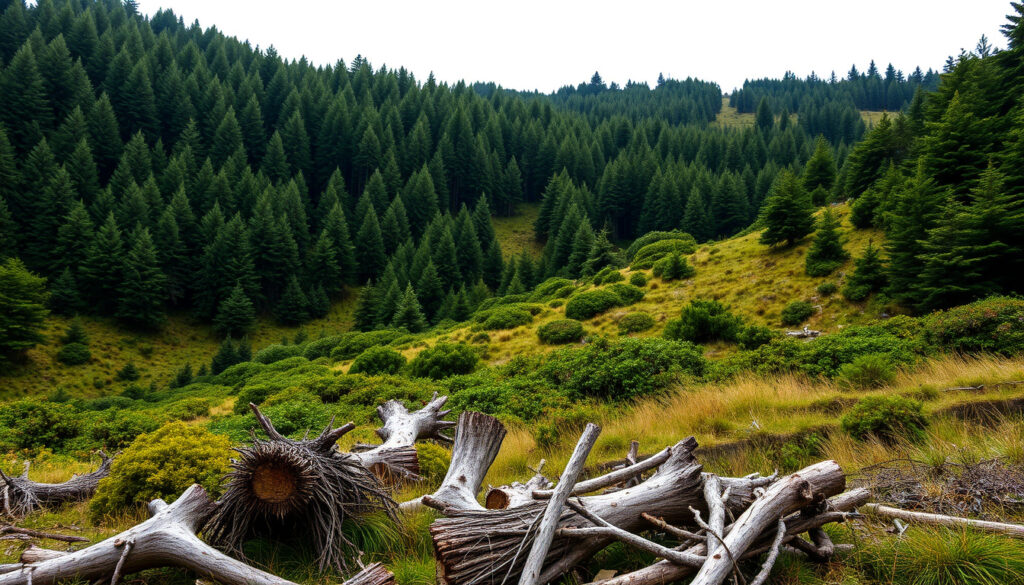
New Zealand Wilding Pine – Invasion, Impacts and Control
Wilding pines represent one of New Zealand’s most significant ecological threats, with self-sown conifers spreading unchecked across South Island landscapes and beyond. The invasive trees—descendants of species introduced for forestry and shelter—now occupy millions of hectares of native grassland and alpine terrain, fundamentally altering ecosystems, diminishing agricultural productivity, and obscuring the open landscapes that define much of the country’s high country character.
A coordinated national response has been underway since 2016, bringing together government agencies, regional councils, landowners, and community groups in an effort to contain and eventually eradicate these unwanted organisms. However, recent funding reductions have raised concerns about the programme’s long-term viability, prompting renewed debate about the future of wilding pine management in New Zealand.
What Are Wilding Pines?
Wilding pines—formally known as wilding conifers—are invasive self-seeded trees originating from introduced conifer species. Unlike planted commercial forests, these trees establish naturally from wind-dispersed seeds, colonising roadsides, pastoral land, conservation areas, and alpine zones far beyond their original planting sites. The term “wilding” refers specifically to this uncontrolled, self-propagating nature that distinguishes them from managed plantation forestry.
Key Species Involved
Ten introduced conifer species drive the majority of invasions across New Zealand, with several standing out for their aggressive spread patterns and ecological impact. Contorta pine (Pinus contorta) is recognised as the most problematic, capable of producing cones at younger ages than other species and spreading seeds across greater distances. Douglas fir (Pseudotsuga menziesii) spreads rapidly through montane areas, while radiata pine (Pinus radiata)—the dominant commercial species, accounting for roughly 90 percent of plantation forestry—extends into lowland zones beyond managed stands. Other notable invaders include ponderosa pine, Scots pine, Bishop pine, maritime pine, Corsican pine, and dwarf mountain pine.
Wilding conifers frequently develop in densely packed stands reaching up to 10,000 stems per hectare. These malformed growths render the timber economically unviable while creating dense, impenetrable vegetation that complicates control efforts and increases wildfire fuel loads.
Quick Reference
| Species | Primary characteristic |
|---|---|
| Contorta pine (Pinus contorta) | Most aggressive spreader |
| Douglas fir (Pseudotsuga menziesii) | Rapid montane expansion |
| Radiata pine (Pinus radiata) | Dominant lowland spreader |
| Ponderosa pine (Pinus ponderosa) | Dry area colonisation |
| Scots pine (Pinus sylvestris) | Widespread invader |
Why Are Wilding Pines a Problem in New Zealand?
The scale of the wilding pine problem in New Zealand is substantial. Current infestations span approximately 1.8 to 2 million hectares, with new areas colonised at a rate between 5,000 and 90,000 hectares annually despite ongoing control efforts. Without intervention, projections indicate these invasive trees could occupy 20 to 25 percent of New Zealand within two to three decades. The Department of Conservation alone estimates that 210,000 hectares of public conservation land face direct threat from wilding conifer encroachment.
Environmental Consequences
Wilding pines fundamentally restructure the ecosystems they invade. Native plant communities—particularly the tussock grasslands and alpine flora that once dominated much of the South Island high country—decline as conifers establish dense canopies and alter soil conditions. The trees acidify soils, depleting essential nutrients including calcium, while their deep root systems consume water resources that would otherwise sustain native vegetation and downstream agricultural use. Native animal populations that depend on open grassland and shrubland habitats lose both food sources and breeding grounds as the landscape transitions toward uniform conifer forest.
Economic and Social Impacts
Beyond ecological harm, wilding pines deliver significant economic damage across multiple sectors. Grazing land shrinks as infestations expand, directly reducing farm productivity across affected properties. Tourism and recreation suffer as dense conifer stands obscure the open landscapes that attract visitors to areas like the Mackenzie Basin and high country stations. More concerning still, the dense, dry fuel loads created by wilding pine stands dramatically heighten wildfire risk—an issue underscored by the 2024 Bridge Hill fire, which demonstrated how quickly these invaded landscapes can become tinderboxes. Suppression costs, property damage, and ongoing fire management requirements add substantial burden to communities already dealing with expanding infestations.
Wilding pine stands create dense, inaccessible fuel loads that significantly increase wildfire intensity and spread. The 2024 Bridge Hill fire in the South Island highlighted how these invaded landscapes can transform rapidly into dangerous fire environments, posing risks to property, infrastructure, and community safety.
What Is the Wilding Pine Control Programme?
The primary response to wilding pine invasions comes through the National Wilding Conifer Control Programme (NWCCP), established in 2016 under the broader framework of the 2015–2030 National Wilding Pines Management Strategy. This coordinated initiative brings together the Department of Conservation, Ministry for Primary Industries, regional councils, landowners, industry stakeholders, and community groups in a shared effort toward containment and eradication targets set for 2030. Resources for monitoring progress, identifying species, and accessing control guidance are available through dedicated platforms including the programme’s official website.
Control Methods in Use
Control operations employ multiple complementary methods depending on tree size, terrain accessibility, and environmental considerations. Hand-pulling and sawing work effectively for seedlings and small saplings, while chainsaws handle larger trees in areas where safe access is possible. Herbicide applications—whether through injection directly into the trunk, bark application, or the comparatively rare foliar spray—account for the majority of treatment work, with foliar spraying representing less than one percent of overall control activity. Where viable and operationally safe, forestry harvesting operations can recover timber for logs or biofuel while simultaneously removing problematic trees.
Recent Developments and Challenges
Recent advances in wilding pine management include trials of artificial intelligence systems designed to improve aerial detection of scattered trees, development of new treatment approaches for remote or difficult terrain, and collaborative work addressing wildfire risk reduction in heavily invaded areas. The 2022–2023 period saw AI detection trials, policy development regarding forestry regulations, upgrades to the Wilding Conifer Information System, and control operations across 180,000 hectares spanning nine regions—including complex operations protecting significant environmental and heritage sites.
During the initial 2016–2017 phase, the National Wilding Conifer Control Programme controlled or prevented spread across 1.2 million hectares. These early efforts demonstrated that coordinated action could meaningfully slow the rate of expansion, though ongoing investment proved essential to maintain gains.
However, 2024 brought significant challenges. Funding for the programme was reduced by 75 percent, falling from $25 million to $10 million annually. The Wilding Pine Network described this funding cut as effectively a “death sentence” for management efforts. Organisations involved in the programme warned that reduced resources would allow infestations to accelerate, particularly in the South Island high country where the problem remains most acute.
Where Are Wilding Pines Found and How to Report Them?
Wilding conifer infestations concentrate in the South Island high country, with particularly dense populations in tussock grassland zones, montane areas, and former pastoral land. However, the problem extends beyond these core zones to include private land throughout both islands, roadside corridors, lowland areas, and coastal regions. Anyone involved in the horticulture, agriculture, or viticulture sectors in New Zealand may encounter these invasive trees in their region and can contribute to monitoring efforts through reporting channels provided by the programme.
Identifying and Reporting Invasions
Reporting wilding pines enables coordination across the network of landowners, community groups, and agency staff working to address the problem. The programme maintains mapping tools and reporting systems accessible through its official channels, while the Wilding Pine Network advocates for expanded community participation and awareness. Regional councils hold responsibility for pest management activities within their jurisdictions, with the Department of Conservation managing control on public conservation land. Landowners seeking to address infestations on their properties can access guidance through these networks and coordinate with neighbouring properties to ensure comprehensive treatment.
Mapping and Information Resources
The Wilding Pines programme website provides access to detailed maps, identification guides, and good practice documentation for landowners and community groups. The Wilding Conifer Information System offers digital tools for tracking infestations and monitoring treatment progress across regions. These resources support both strategic planning at the national level and practical implementation at the property scale.
Regional council pest management staff and conservation boards serve as primary points of contact for landowners seeking assistance or wishing to report new infestations in their area. Collaboration between adjacent landowners often proves essential for effective control, given that seeds can travel considerable distances from source plants to new germination sites.
History and Costs of Wilding Pine Eradication
Conifer species were introduced to New Zealand beginning in the 1880s, initially planted for commercial forestry, shelterbelts, and erosion control purposes. Many of these plantings occurred between the 1800s and the mid-1900s, establishing seed sources that would eventually produce the uncontrolled regeneration now visible across large swathes of New Zealand landscape. The scale of historical plantings meant that seed sources became widely distributed before the invasive potential of these species was fully understood.
Formal recognition of the wilding pine problem developed gradually. Pinus contorta was declared an unwanted organism under the Biosecurity Act 1993 in 2001, prohibiting its breeding, propagation, distribution, or sale—though some sources cite 2010 as the formal declaration date. The 2009 Wilding Conifer Strategic Plan represented an early attempt at coordinated national response, eventually leading to the more comprehensive 2015–2030 National Wilding Pines Management Strategy and the establishment of the dedicated control programme in 2016.
- 1880s onwards: Conifers introduced for forestry, shelter, and erosion control; natural regeneration begins from early plantings
- 2001 (or 2010): Pinus contorta declared an unwanted organism under the Biosecurity Act 1993
- 2009: Wilding Conifer Strategic Plan developed as initial national framework
- 2015: National Wilding Pines Management Strategy (2015–2030) adopted
- 2016: National Wilding Conifer Control Programme officially launched
- 2021: Major funding boost provided to accelerate control efforts
- 2024: Funding reduced by 75 percent, raising concerns about programme viability
Control operations involve substantial ongoing investment. Millions of dollars are spent annually on labour, equipment, herbicides, and coordination activities across the programme network. The economic cost of inaction—measured through lost agricultural productivity, reduced tourism revenue, increased fire management expenditure, and ecosystem service degradation—is estimated to exceed $40 million per year if infestations remain unchecked. Despite this, the significant funding cuts announced in 2024 have prompted warnings that without adequate resourcing, years of progress could be reversed and infestations could accelerate beyond manageable levels.
Progress and Current Status
| Established information | Information that remains unclear |
|---|---|
| Core infestation zones have been mapped across the South Island | Precise timeline for achieving full eradication targets |
| Control methods including manual removal, herbicide application, and harvesting have proven effective | Long-term impacts of climate change on wilding pine spread patterns |
| Community reporting contributes meaningfully to detection efforts | Whether current funding levels can prevent irreversible expansion |
| The programme has treated over 1.2 million hectares since 2016 | Exact economic costs of uncontrolled spread under various scenarios |
The Broader Context
The wilding pine issue reflects broader tensions between New Zealand’s agricultural economy, its native biodiversity, and its internationally recognised landscape values. The Mackenzie Basin and South Island high country rank among the country’s most visited tourism destinations, with the open tussock landscapes, clear waters, and mountain vistas contributing significantly to regional economic activity. The invasion of wilding pines threatens to fundamentally transform these landscapes, replacing distinctive character with homogeneous conifer forest.
The challenge also intersects with the country’s biosecurity framework, which aims to protect primary production, natural heritage, and quality of life from harmful pests and diseases. The Department of Conservation identifies wilding conifers among the most serious weed threats to New Zealand’s natural environment. Sustained coordination between central government, regional authorities, and community stakeholders remains essential to maintaining meaningful progress toward management goals.
For those interested in the practical realities of working in New Zealand’s agricultural and conservation sectors, understanding the scale and nature of environmental challenges like wilding pine management provides valuable context. The country’s approach to balancing economic development with environmental stewardship continues to evolve, with biosecurity threats representing a significant ongoing concern.
Looking Ahead
The future trajectory of wilding pine management in New Zealand remains uncertain. The Jobs in New Zealand – 2025 Market Guide and Visa Essentials notes that environmental management and biosecurity represent growing sectors within the New Zealand economy, with programmes like the wilding pine control effort creating demand for skilled workers across conservation, forestry, and regional development fields. Community involvement and landowner participation continue to drive a significant portion of detection and control activity, highlighting the importance of public awareness and engagement.
Those planning to visit New Zealand may encounter the issue while travelling through high country regions, where control operations and invasive tree populations are visible reminders of the ongoing challenge. The landscapes that make these areas distinctive—open tussock grasslands, clear alpine streams, mountain vistas—are precisely the environments most threatened by continued expansion.
Frequently Asked Questions
What exactly are wilding pines?
Wilding pines are invasive self-seeded conifer trees that originate from introduced species. Unlike planted commercial forests, they establish naturally from wind-dispersed seeds and spread uncontrolled across landscapes.
Which conifer species are most problematic in New Zealand?
Contorta pine (Pinus contorta) is the most aggressive invader, followed by Douglas fir, radiata pine, ponderosa pine, Scots pine, Bishop pine, maritime pine, Corsican pine, and dwarf mountain pine.
How large is the wilding pine infestation in New Zealand?
Current infestations cover approximately 1.8 to 2 million hectares, with new areas colonised at rates between 5,000 and 90,000 hectares annually despite control efforts.
What methods are used to control wilding pines?
Control methods include hand-pulling and sawing seedlings, chainsawing larger trees, herbicide injection or bark application, and forestry harvesting where viable. New technologies like AI-assisted aerial detection are being trialled.
Who manages wilding pine control in New Zealand?
The National Wilding Conifer Control Programme coordinates efforts between the Department of Conservation, Ministry for Primary Industries, regional councils, landowners, industry, and community groups.
How can I report wilding pine sightings?
Reports can be made through regional council pest management services, the Department of Conservation, or directly through the programme’s official channels and mapping tools available on wildingpines.nz.
What is the current funding situation for wilding pine control?
Funding was cut by 75 percent in 2024, falling from $25 million to $10 million annually. Conservation groups have warned this reduction could severely compromise control efforts and allow infestations to accelerate.
Can wilding pines be completely eradicated?
Eradication is feasible in accessible areas where consistent treatment occurs. However, the large scale of existing infestations and continued spread mean that achieving national eradication targets by 2030 remains challenging without sustained investment.
More related posts
 Free Xero Accounting Course: Get Certified Without Spending a Penny
 Te Wiki o te Reo Māori 2025: Theme, Dates & Resources
 Silver Ferns vs England 2025: Scores, Taurua News & TV
 McAfee Anti-Virus – 2025 Guide Pricing Tests Download
 Super Rugby Quarter Finals 2025: Dates, Format, Tickets & Venue
 White Air Force 1 – Styling, Care and Buying Guide
 Blue and Yellow Flag: Countries and Meanings
 All Blacks South Africa 2026 Tour: Schedule & Watch Guide