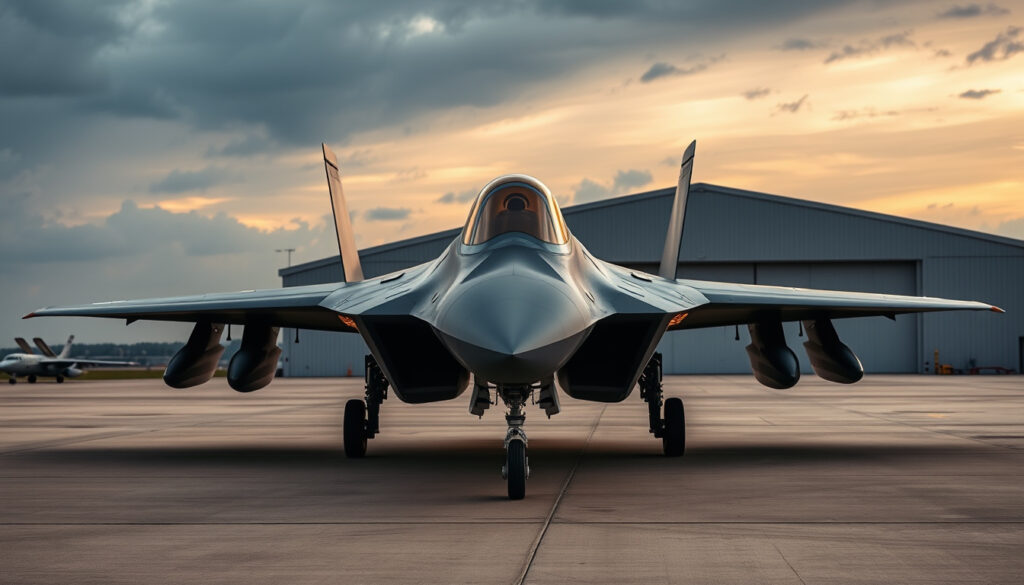
Lockheed Martin F-35 Lightning II: Specs, Cost & Range
Anyone who follows military aviation for more than a few minutes has heard strong opinions about the F-35, often described as three airplanes in one—the F-35A, F-35B, and F-35C each serve different missions, and knowing which variant you are talking about changes nearly every answer about cost, range, and combat capability. This guide lays out the facts, variant by variant, with sourced data on what each version actually delivers.
Prime contractor: Lockheed Martin · Variants: F-35A, F-35B, F-35C · Top speed: Mach 1.6 · Range (F-35A): 1,200+ nautical miles · F-35s delivered: 1,000+ as of 2024
Quick snapshot
- Three variants: F-35A (conventional), F-35B (STOVL), F-35C (carrier) (Lockheed Martin, prime contractor)
- Top speed: Mach 1.6 (Lockheed Martin) (Lockheed Martin, prime contractor)
- F-35A range: 1,200+ nautical miles on internal fuel (Lockheed Martin F-35 program site)
- 1,000+ aircraft delivered as of 2024 (Lockheed Martin) (Lockheed Martin, prime contractor)
- Exact fleet-in-service numbers shift by month and reporting source
- Unit cost varies by procurement lot and contract terms (Congressional Research Service)
- “Most feared” and “never lost” claims are subjective and unverifiable
- Exact F-35B and F-35C unit prices are not published in a single comparable format
- 2001: Lockheed Martin wins Joint Strike Fighter competition (Lockheed Martin)
- 2006: F-35A first flight (Wikipedia)
- 2024: 1,000th F-35 delivered (Lockheed Martin)
- Technology Refresh 3 upgrades and continuous production ramp
- Expanded allied operations: Japan, Poland, Finland, Singapore
- Long-term sustainment and Block 4 modernization
Six key facts define the F-35 program at a glance, from manufacturer through to fleet milestones.
| Attribute | Value |
|---|---|
| Manufacturer | Lockheed Martin |
| Role | Multirole stealth fighter |
| Crew | One pilot |
| Variants | F-35A (CTOL), F-35B (STOVL), F-35C (carrier) |
| First flight | F-35A: December 2006 |
| Top speed | Mach 1.6 |
What is the most feared fighter jet in the world?
Why do defense observers put the F-35 near the top of threat lists?
- No official body ranks fighters by “fear factor” — the label is subjective and media-driven
- Comparisons typically involve the F-35, F-22 Raptor, Su-57, and J-20
- The F-35’s reputation rests on stealth, sensor fusion, and networked combat rather than dogfighting alone
The phrase “most feared fighter” appears often in headlines, but it has no agreed definition. What sets the F-35 apart is not a single dogfight record — it is the combination of low observability, advanced radar, and the ability to share targeting data across a formation. According to the Congressional Research Service (U.S. government research agency), the F-35 is designed to detect and engage threats before a visual-range encounter begins, which shifts the entire calculation of air dominance away from classic turning fights.
How does the F-35 compare with the F-22 and Su-57?
- F-22: air-superiority specialist, supercruise capable, but no production since 2011
- Su-57: Russian fifth-generation fighter, in limited production, less operational data publicly available
- F-35: three variants, global fleet of 1,000+, designed for multirole strike, not pure air superiority
The trade-off: the F-35 trades some supersonic performance and dogfight agility for broader mission flexibility and a larger, more distributed fleet. The Lockheed Martin (prime contractor) product literature frames the F-35 as the most lethal, survivable, and connected fighter — a network-centric weapon, not merely a fast airframe.
“Most feared” is a media label, not a Pentagon category. The F-35 earns its reputation through numbers: a fleet of 1,000+ stealth aircraft sharing real-time battlefield data across allied nations. That scale of networked presence creates a different kind of deterrence than a single pure-air-superiority platform can.
In practical terms, the “fear factor” is less about one airframe and more about what a 1,000-aircraft networked fleet can do before a close-range fight starts.
Why is the F-35 so special?
What makes the F-35 a fifth-generation fighter?
- Fifth-generation means low-observable stealth, advanced sensor fusion, and networked data sharing
- Previous generations focused on speed, maneuverability, and basic radar
- The F-35 is the first production fighter to fuse sensor data into a single pilot display
The F-35’s defining feature is not just stealth — it is sensor fusion. The aircraft’s systems combine radar, infrared, electronic warfare, and off-board data into one coherent picture, reducing pilot workload. As the Director, Operational Test and Evaluation, U.S. Department of Defense (Pentagon weapons testing office) describes it, the F-35 is a single-engine strike fighter intended to replace multiple legacy platforms across the Air Force, Marine Corps, and Navy.
What can the F-35 do that older combat jets cannot?
- Share sensor data with other F-35s and allied aircraft in real time
- Operate from austere bases (F-35B) and aircraft carriers (F-35C)
- Process electronic warfare and targeting simultaneously through integrated systems
The Lockheed Martin (prime contractor) brochure emphasizes that the F-35’s fusion engine turns the aircraft into a “quarterback in the sky” — collecting, analyzing, and distributing threat data across a formation. Older fourth-generation fighters require dedicated electronic-warfare pods and lack the integrated sensor architecture to perform this role natively.
The implication: the F-35 changes how air combat is fought, not just how fast or high it flies. Its real advantage is informational — the pilot sees the battle space earlier and more completely than an adversary can.
How many F-35 Lightning 2 do we have?
How many F-35s have been delivered?
- More than 1,000 F-35s delivered as of 2024, across all variants (Lockheed Martin)
- Production rate continues at roughly 150 aircraft per year
- F-35A accounts for the majority of deliveries
The 1,000th F-35 rolled off the production line in 2024, a milestone noted by Lockheed Martin (prime contractor). Fleet totals shift monthly as new aircraft are delivered and older airframes are retired from other programs. The U.S. military operates the largest share, with allied nations growing their fleets through Foreign Military Sales and direct procurement.
How are F-35s distributed across the US military and allied forces?
- U.S. Air Force operates the F-35A (Congressional Research Service)
- U.S. Marine Corps operates the F-35B and F-35C (DOT&E, U.S. Department of Defense)
- U.S. Navy operates the F-35C (Congressional Research Service)
- International operators: UK, Italy, Japan, Israel, South Korea, Australia, Norway, Denmark, Netherlands, Belgium, Poland, Singapore, Finland (Lockheed Martin)
The original partner group comprised the U.S., UK, Italy, Netherlands, Australia, Norway, Denmark, and Canada. Foreign Military Sales customers have expanded rapidly. Lockheed Martin F-35 (program site) notes that Japan has modified some ships to operate the F-35B, marking a shift in regional naval aviation.
Why this matters: the F-35 fleet is no longer an American program with international participation — it is a global fleet where allied maintenance, training, and operations are interwoven. That scale creates logistics dependencies and shared modernization timelines that affect every partner nation.
What jet has never lost a dogfight?
Has the F-35 lost a dogfight?
- No verified public record proves any fighter has gone undefeated in close combat
- The F-35 has participated in simulated exercises and some real-world engagements without a confirmed close-range loss in public reporting
- Air combat outcomes depend on pilot skill, tactics, sensor integration, and support — not airframe alone
The claim that a particular fighter has “never lost a dogfight” is a popular line in marketing and media, but defense analysts treat it with caution. The DOT&E office (Pentagon testing authority) assesses aircraft performance across a range of scenarios, but does not publish a “clean win-loss” record for visual-range engagements. The F-35 is designed to avoid dogfights altogether — its stealth and sensors allow it to engage at beyond-visual range, where close combat becomes less relevant.
Can a modern stealth fighter avoid close-range combat?
- Stealth reduces detection range, making close encounters less likely
- Sensor fusion lets the pilot see threats before they see the F-35
- If a dogfight does occur, the F-35 relies on its high angle-of-attack capability and helmet-mounted cueing system
According to Wikipedia (encyclopedic reference), the F-35’s design philosophy emphasizes first-look, first-shot engagement over classic turning dogfight performance. The aircraft can sustain high angles of attack and carries a 25mm cannon, but the architecture prioritizes sensor-driven beyond-visual-range kills.
The F-35 is not built to win turning duels with lightweight fighters. It is built to see the Su-57 or J-20 before those aircraft see it, fire a missile while still outside their radar range, and never enter visual range at all. For a pilot trained in that doctrine, a dogfight is a failure of the stealth-and-sensors phase, not a neutral contest.
For pilots, that makes “never lost” the wrong test for the F-35’s design.
How far can an F-35 fly without refueling?
What is the F-35A’s range?
- F-35A: more than 1,200 nautical miles on internal fuel (Lockheed Martin F-35 program site)
- F-35C: comparable range at more than 1,200 nautical miles due to larger internal fuel capacity (Lockheed Martin F-35 program site)
- F-35B: approximately 900 nautical miles on internal fuel because the lift-fan system occupies internal volume
Range varies meaningfully by variant. The F-35A and F-35C both carry more internal fuel than the F-35B, which sacrifices fuel volume to accommodate the shaft-driven lift fan for vertical landing. The Lockheed Martin (prime contractor) brochure lists these ranges as baseline figures on internal fuel only — external tanks and aerial refueling extend range further, but reduce stealth.
Why does the F-35B have a shorter range?
- The lift-fan system behind the cockpit replaces internal fuel volume
- STOVL capability requires mechanical complexity that reduces space for fuel
- The trade-off: expeditionary basing flexibility at the cost of fuel and payload
The F-35B’s shorter range is a direct consequence of its vertical-lift system. According to Lockheed Martin F-35 (program site), the B variant is the first supersonic stealth aircraft with short-takeoff/vertical-landing capability — a unique mission role that inherently trades fuel for basing options. The Royal Air Force, which operates the F-35B, values the ability to operate from smaller carriers and austere runways over maximum range.
The catch: if range is the priority, the F-35A or F-35C are the choices. If expeditionary basing from ships or short strips matters more, the F-35B’s range penalty is an accepted cost of the mission profile.
How much does the Lockheed Martin F-35 Lightning II cost?
How much does an F-35A cost?
- F-35A unit cost in recent procurement lots: approximately $82.5 million (Congressional Research Service)
- Cost has declined over successive production lots as manufacturing scale improved
- F-35B and F-35C cost more due to specialized systems
The $82.5 million figure represents the average unit recurring flyaway cost for the F-35A in the Lot 15-17 procurement, as reported by the Congressional Research Service (U.S. government research agency). This is the aircraft-only cost, excluding development, sustainment, and infrastructure.
Why do the F-35B and F-35C cost more?
- F-35B: STOVL lift-fan system adds mechanical complexity and maintenance cost
- F-35C: larger wings, reinforced landing gear, and carrier-specific hardening
- Both are produced in smaller quantities than the F-35A, limiting economies of scale
The price gap between variants reflects genuine engineering differences. Lockheed Martin (prime contractor) states that the F-35B’s supersonic STOVL capability is unique and requires a shaft-driven lift fan, door mechanisms, and additional control systems. The F-35C’s carrier suitability demands stronger landing gear, a tail hook, and folding wings — all added cost.
What is included in the total F-35 program cost?
- Development (System Development and Demonstration phase)
- Procurement (aircraft production across all lots)
- Sustainment (maintenance, spare parts, training, simulators, base infrastructure)
- Modernization (Technology Refresh 3, Block 4 upgrades)
The total program cost, estimated by the Congressional Research Service (U.S. government research agency) at over $1.7 trillion across the lifecycle, includes everything from initial R&D to decades of sustainment. The unit flyaway cost is only a fraction — allied nations also invest in base modifications, pilot training, and weapons integration that are not reflected in the per-aircraft price tag.
What this means for procurement officers: the $82.5 million F-35A is competitively priced against new-build fourth-generation fighters like the F-15EX or F/A-18E/F, but the lifecycle cost is higher because sustainment, software updates, and a global supply chain run for 40+ years. Budget planners must look beyond the flyaway number to the total ownership cost.
For procurement officers, the choice comes down to launch-and-recovery environment — runway, ship, or short strip — and each one carries a different price and range trade-off.
Three variants, one pattern: the delivered cost splits into three tiers — F-35A the baseline, F-35B the premium for expeditionary basing, F-35C the premium for carrier operations. The Congressional Research Service data confirms that procurement lot size and contract structure influence the final price as much as the hardware itself.
| Attribute | F-35A (CTOL) | F-35B (STOVL) | F-35C (Carrier) |
|---|---|---|---|
| Primary operator | US Air Force, most international customers | US Marine Corps, UK, Italy | US Navy, US Marine Corps |
| Takeoff / landing | Conventional runway | Short takeoff, vertical landing | Catapult launch, arrested recovery |
| Range (internal fuel) | 1,200+ nm | 900+ nm | 1,200+ nm |
| Unique feature | Longest range, lowest cost | Shaft-driven lift fan, supersonic STOVL | Larger wings, reinforced gear, folding wingtips |
| Unit cost (approx.) | $82.5 million (Lot 15–17) | Higher than F-35A; exact lot-dependent | Higher than F-35A; exact lot-dependent |
| Internal cannon | Yes (25mm) | Yes (25mm) | Yes (25mm) |
Across the three variants, the same design pattern holds: the F-35A serves as the baseline, the F-35B trades fuel for basing flexibility, and the F-35C trades cost for carrier durability. Each variant is optimized for a different launch-and-recovery environment, and no single airframe can do all three missions equally well.
| Specification | Value |
|---|---|
| Length | 51 ft (F-35A), 51 ft (F-35B), 52 ft (F-35C) |
| Wingspan | 35 ft (A/B), 43 ft (C, folded 26 ft) |
| Height | 14 ft (all variants) |
| Empty weight | ~29,000 lb (A), ~32,000 lb (B), ~34,000 lb (C) |
| Engine | Pratt & Whitney F135 (all variants) |
| Thrust | 43,000 lbf class (afterburner) |
| Top speed | Mach 1.6 (~1,200 km/h) |
| Range (internal) | 1,200+ nm (A/C), 900+ nm (B) |
| Service ceiling | 50,000+ ft |
| Crew | 1 pilot |
| Armament | Internal bays: AIM-120 AMRAAM, GBU-32 JDAM, 25mm gun pod |
For defense planners, the takeaway is simple: one program, three airframes, and each mission profile buys a different balance of range, basing, and price.
Program timeline
- — Lockheed Martin wins the Joint Strike Fighter competition with the X-35 (Lockheed Martin)
- — F-35A first flight (Wikipedia)
- — F-35B first flight (Wikipedia)
- — F-35C first flight (Wikipedia)
- — US Marine Corps declares F-35B initial operating capability (DOT&E, Pentagon testing office)
- — US Air Force declares F-35A initial operating capability (DOT&E, Pentagon testing office)
- — US Navy declares F-35C initial operating capability (DOT&E, Pentagon testing office)
- — Lockheed Martin delivers the 1,000th F-35 (Lockheed Martin)
Read together, the timeline shows the F-35 moving from prototype competition to allied adoption and mass production.
What we know vs. what remains open
Confirmed facts
- The F-35 has three main variants: F-35A, F-35B, and F-35C (Lockheed Martin)
- Lockheed Martin is the prime contractor (Lockheed Martin)
- The F-35 is a fifth-generation stealth fighter (DOT&E, Pentagon testing office)
- Top speed is approximately Mach 1.6 (Lockheed Martin)
- More than 1,000 F-35s have been delivered (Lockheed Martin)
What’s unclear
- Exact numbers in service depend on the date and reporting source
- The “most feared fighter jet” label is subjective
- Publicly reported “never lost” claims cannot be independently confirmed
- Precise unit cost varies by procurement lot and contract
- Exact F-35B and F-35C unit prices are not published in a single comparable format
The settled facts are stable across official sources; the open items are mostly questions of timing, price reporting, and labeling.
Expert perspectives
“[The F-35 is] the most lethal, survivable and connected fighter in the world.”
“The F-35B Lightning is a multi-role combat aircraft used for day and night operations.”
“The F-35 program is managed by the Pentagon’s F-35 Joint Program Office together with the participating U.S. military services.”
Together, these perspectives frame the F-35 as a networked system, not just a single fast airframe.
For the U.S. Air Force and the majority of international customers, the F-35A remains the pragmatic choice: the lowest-cost variant with the longest range, operated from conventional runways. The F-35B serves a narrower but vital niche — expeditionary basing from short strips and amphibious ships where no runway exists. And the F-35C answers the Navy’s requirement for a carrier-based stealth fighter that can integrate with existing catapult and arresting-gear systems. The F-35 program is not one aircraft but three, and the differences between them matter more than any single spec sheet can convey. For procurement officers and defense planners, the choice is clear: pick the variant that matches the launch-and-recovery environment, and accept the trade-offs in range, payload, and cost that come with each mission profile.
Related reading: Fall of the Berlin Wall – Causes, Facts and Impact · Red Bull Ford 2026 F1: Partnership, Engine, Drivers & Car
cbo.gov, congress.gov, thedefensewatch.com, armyrecognition.com
Frequently asked questions
Who makes the F-35 Lightning II?
Lockheed Martin is the prime contractor, with Northrop Grumman and BAE Systems as principal partners. The program is managed by the Pentagon’s F-35 Joint Program Office (Lockheed Martin).
What is the F-35’s top speed?
Mach 1.6, approximately 1,200 km/h at altitude, across all three variants (Lockheed Martin).
What engine powers the F-35?
The Pratt & Whitney F135 turbofan engine powers every F-35 variant, producing approximately 43,000 lbf of thrust with afterburner (Wikipedia).
Can the F-35 hover?
Only the F-35B variant can hover, using its shaft-driven lift fan and swiveling exhaust nozzle for vertical landing. The F-35A and F-35C cannot hover (Lockheed Martin F-35 program site).
What does STOVL mean?
Short Takeoff and Vertical Landing. It allows the F-35B to operate from short runways, amphibious ships, and austere bases without a catapult or long runway (Lockheed Martin).
When did the F-35 first fly?
The F-35A first flew in December 2006, the F-35B in June 2008, and the F-35C in June 2010 (Wikipedia).
More related posts
 Ninja Slushie NZ Price: Cost, Alternatives & Where to Buy
 Best Stick Vacuums NZ: Expert Tests & Top Picks 2025
 Work and Income Palmerston North – Address, Hours, Appointments and Services
 Silver Ferns vs England 2025: Scores, Taurua News & TV
 Main Street Cafe Invercargill: Menu, Hours, Reviews Guide
 Cars for Sale Christchurch under $5,000 | Best Deals
 Run It Straight NZ: Teen Death, Rules & Safety
 English County Crossword Clue: Answers by Letter Count