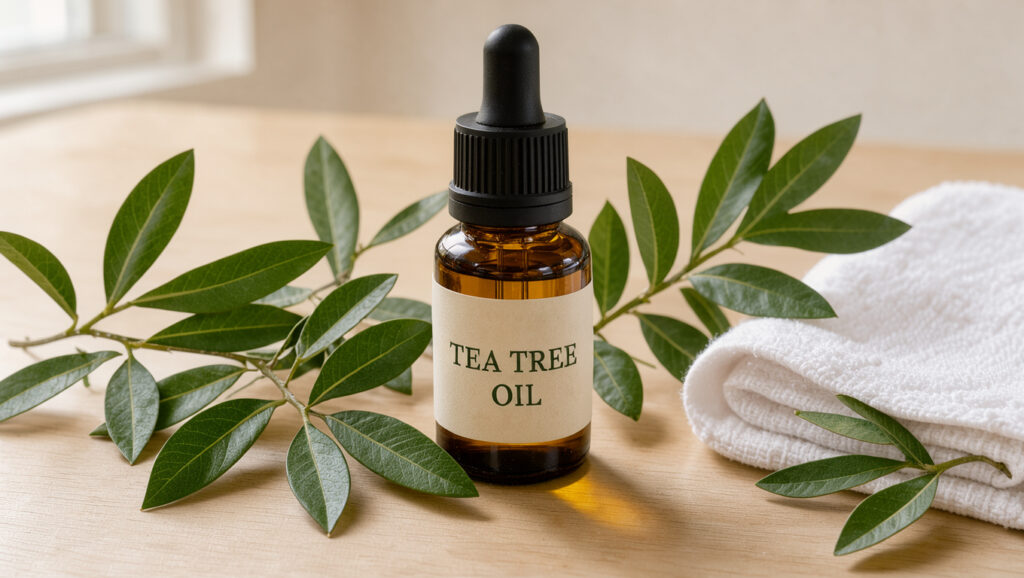
Tea Tree Oil NZ: Uses, Safety, Hair Use and Where to Buy
Most people buy tea tree oil on a whim, read the front label and move on, and that works until a reaction shows up on your skin. Medsafe NZ (medicines regulator) counted eight adverse event reports for tea tree oil in the joint Australia–New Zealand database since 2000, so the details printed on the bottle matter more than the marketing.
Botanical source: Melaleuca alternifolia (Kymata Health (supplement guide)) · Extraction method: Steam distillation of leaves (Williams Natural Foods (natural products retailer)) · Terpinen-4-ol range: 35% to 48% (Verywell Health (consumer health publisher))
Quick snapshot
- The FDA has not reviewed tea tree oil for safety and effectiveness (WebMD (health publisher))
- Tea tree oil is steam-distilled from Melaleuca alternifolia leaves, according to Williams Natural Foods (natural products retailer) (WebMD (health publisher))
- Undiluted oil should not be applied directly to the scalp, according to Verywell Health (consumer health publisher) (WebMD (health publisher))
- Long-term daily use on hair has no clinical study in the sources reviewed for this guide
- No retrieved source compares tea tree oil with coconut oil for hair
- Head lice evidence is limited, according to Verywell Health (consumer health publisher)
- The first published case of systemic hypersensitivity to topical tea tree oil dates to , according to Medsafe NZ (medicines regulator)
- Medsafe NZ published its adverse reaction review in , according to Medsafe NZ (medicines regulator)
- Buy oil that meets ISO 4730 and store it tightly closed, away from heat (Index of Herbs (herb reference))
- Patch test on the inner arm and wait 12–24 hours (Healthline (health publisher))
Six figures and dates anchor this guide, and most of them trace back to one New Zealand regulator review, which matters in a category short on hard data.
| Label | Value |
|---|---|
| Botanical name | Melaleuca alternifolia, according to Kymata Health (supplement guide) |
| Extraction method | Steam distillation of leaves, according to Williams Natural Foods (natural products retailer) |
| Terpinen-4-ol range | 35% to 48%, according to Verywell Health (consumer health publisher) |
| First systemic hypersensitivity case report | , according to Medsafe NZ (medicines regulator) |
| Medsafe review published | , according to Medsafe NZ (medicines regulator) |
| Adverse event reports in JAENS since 2000 | 8, according to Medsafe NZ (medicines regulator) |
| Shampoo dandruff trial | 5% shampoo daily for 4 weeks, with a 41% improvement reported (WebMD (health publisher)) |
| Adult skin dilution | 1–2% (Thriving Kiwi (NZ wellness publisher)) |
| 1% dilution in carrier oil | 1 drop per 1/2 teaspoon (2.5 mL) (Apollo 247 (health publisher)) |
What is an Australian tea tree?
Tea tree oil comes from one plant, Melaleuca alternifolia, which Kymata Health (supplement guide) describes as an Australian leaf.
Production is steam distillation. Williams Natural Foods (natural products retailer) says the oil is steam-distilled from the leaves, and that its main active compound is terpinen-4-ol. Most buyers never see that chemistry, but a good label should let them check it.
Where does Melaleuca alternifolia grow naturally?
- The sources reviewed describe the plant as Australian. None gives a verified growing range, so treat any regional detail as unconfirmed.
- Medsafe NZ (medicines regulator) uses the botanical name when it reviews reactions, which gives buyers a name to check on the label.
- A bottle that says only “tea tree” leaves the buyer with nothing to verify.
Eight specification lines separate a checkable bottle from a vague one, and each line can be tested against the label or the supplier’s documents.
| Specification | Detail |
|---|---|
| Botanical name | Melaleuca alternifolia, according to Kymata Health (supplement guide) |
| Origin | Australian plant leaf, according to Kymata Health (supplement guide) |
| Production | Steam distillation, according to Williams Natural Foods (natural products retailer) |
| Main active compound | Terpinen-4-ol, according to Williams Natural Foods (natural products retailer) |
| Terpinen-4-ol range | 35% to 48%, according to Verywell Health (consumer health publisher) |
| Other ISO criteria | γ-terpinene 14–28%; 1,8-cineole trace to 10%, according to Verywell Health (consumer health publisher) |
| Bottle sizes (NZ retailer) | 12 mL and 30 mL, certified organic (The Apothecary NZ (retailer)) |
| Storage | Tightly closed, dark bottle, away from heat, according to Index of Herbs (herb reference) |
The implication: a bottle that names Melaleuca alternifolia and gives a composition range has told you what is inside. A bottle that names neither has not.
A label that says only “tea tree” leaves a buyer nothing to verify. The botanical name is the one detail that ties a bottle to the species described in the regulator’s review.
What this means: a buyer who can match the botanical name and composition range to a label is checking the product, not the advertising.
What does tea tree oil help you with?
The honest answer starts with the evidence, not the shelf. WebMD (health publisher) says its benefits for skin, hair and nails are not well defined.
Acne and athlete’s foot are where the research looks most encouraging, and even there the data is thin.
- Acne: according to Kymata Health (supplement guide), a 2026 meta-analysis of 445 patients suggests a modest effect on mild to moderate acne.
- Athlete’s foot and dandruff: single trials report benefit, according to the same Kymata Health (supplement guide) review.
- The NCCIH summary, relayed by Williams Natural Foods (relays NCCIH summary), finds a small amount of evidence for acne and athlete’s foot and not enough for most other uses.
- Head lice: according to Verywell Health (consumer health publisher), evidence is limited.
Is tea tree oil used in household cleaners?
- The sources reviewed contain no tests of tea tree oil as a household cleaner.
- Cleaning Ratio (cleaning blog) gives a conservative adult skin dilution of 0.5–1%, and its guidance covers skin use rather than cleaning results.
Cleaning claims on a label are a marketing statement until the product shows its own test data.
The FDA has not reviewed tea tree oil for safety and effectiveness, according to WebMD (health publisher), so a specific-result claim on a label rests on the maker’s word.
The pattern: the evidence is strongest for small skin problems and weakest for everything else on the label.
What this means: a label that claims more than the trials test has moved past the evidence, so the claim itself deserves scrutiny.
Is tea tree oil damaging to hair?
Undiluted oil is the problem, and the hair shaft is not the first casualty. Verywell Health (consumer health publisher) advises against applying undiluted oil directly to the scalp, and Acibadem Healthpoint (clinic health blog) says concentrated oil is more likely to irritate the scalp than to damage the hair shaft.
Can I add tea tree oil to my shampoo?
- Most products recommend about three drops in one teaspoon (5 mL) of carrier, lotion or shampoo, according to WebMD (health publisher).
- In a randomised, placebo-controlled trial, a 5% tea tree oil shampoo used daily for four weeks reduced dandruff severity, itchiness and oiliness. WebMD (health publisher) reports a 41% improvement in dandruff severity and itchiness.
- A 5% shampoo works out to 1 part oil in 20 parts total, for example 1 mL of oil in 19 mL of carrier, according to Williams Natural Foods (natural products retailer).
What happens if you put tea tree oil in your hair every day?
- The sources reviewed contain no clinical study of long-term daily hair use.
- Overuse can dry the scalp and strip hair of its natural oils, according to HEALTH.com (hair-care publisher).
- Apollo 247 suggests starting with two or three applications a week and increasing only if the scalp tolerates it.
- Byrdie expert commentary suggests shampoo can be used daily with monitoring (Byrdie (beauty publisher)).
The catch: daily use is where the sources disagree, and no clinical study settles the question.
Burning, redness or swelling is the signal to stop, according to Acibadem Healthpoint (clinic health blog). On the scalp, irritation is the warning sign to watch, not hair loss.
What this means: the scalp, not the hair shaft, sets the limit, so the dilution step matters more than the brand on the bottle.
How long to leave tea tree oil in your hair?
Contact time is a label question, not a guess. WebMD (health publisher) notes that the FDA has not tested tea tree products to confirm their labelled ingredients.
Patch testing comes before any contact-time decision. Healthline (health publisher) recommends patch testing on the inner arm and waiting 12–24 hours for a reaction, and advises people allergic to Balsam of Peru, benzoin, eucalyptol or myrtle-family plants to avoid it.
How much tea tree oil should be used per wash?
- The label sets the amount per wash, and the sources reviewed give no universal figure.
- Patch tests are monitored for 24–48 hours, according to Aloderma (skincare blog).
- The common adult skin reference is 1–2% in carrier oil, per Thriving Kiwi (NZ wellness publisher).
Four usage levels, one pattern: the strength that reached the shampoo trial sits far below the neat-oil and high-solution cases where irritation was documented.
| Use | Strength | What the sources report |
|---|---|---|
| Dandruff shampoo (rinse-off) | 5% | Daily four-week trial showed improvement, according to WebMD (health publisher) |
| Adult skin use | 1–2% in carrier oil | Standard range, according to Thriving Kiwi (NZ wellness publisher) |
| High-concentration solutions | 25–50% | 3.8% developed moderate to severe dermatitis in one reviewed trial, according to Kymata Health (supplement guide) |
| Neat (undiluted) oil | 100% | Much higher sensitisation and burn risk, according to Thriving Kiwi (NZ wellness publisher) |
- Read the label first. Its dilution and contact-time directions govern use.
- Dilute the oil into a carrier or your usual shampoo, starting from the 1–2% adult skin reference, according to Thriving Kiwi (NZ wellness publisher).
- Patch test on the inner arm and wait 12–24 hours, according to Healthline (health publisher).
- Stop if burning, redness or swelling appears, according to Acibadem Healthpoint (clinic health blog).
The implication: the label sets the dose, and the patch test sets the limit for your skin.
What this means: the patch test is the step that tells a buyer whether the label’s directions fit their skin.
What are the disadvantages of tea tree oil?
The disadvantages are documented, and the most serious ones involve allergic and toxic reactions rather than cosmetic side effects.
Where should you not put tea tree oil?
- Never swallow it. Oral use can cause confusion, unsteadiness and coma, according to Williams Natural Foods (natural products retailer), and Kymata Health (supplement guide) says the EU monograph rules out oral and inhaled use.
- Keep it away from the eyes, inner ears and sensitive areas, per the doTERRA NZ product information sheet (manufacturer).
- Do not apply mixtures to broken skin, according to Verywell Health (consumer health publisher).
- Keep it away from cats. Thriving Kiwi (NZ wellness publisher) says cats lack the liver enzymes to process many essential oil compounds.
- It is not recommended for children, or for people who are pregnant or breastfeeding, given the lack of safety evidence, according to WebMD (health publisher).
- Tea tree oil cross-reacts with colophony, so people allergic to colophony should avoid it, according to Index of Herbs (herb reference), citing the EMA.
Upsides
- Lab studies show antimicrobial activity, with limited clinical evidence, according to Thriving Kiwi (NZ wellness publisher)
- A placebo-controlled 5% shampoo trial reported a 41% improvement in dandruff severity, according to WebMD (health publisher)
- A 1–2% adult dilution gives buyers a clear, checkable starting point, per Thriving Kiwi (NZ wellness publisher)
Downsides
- Undiluted oil at 25% or more caused side effects in one reviewed trial, according to Kymata Health (supplement guide)
- Oxidised oil carries greater sensitisation potential than fresh oil, according to Medsafe NZ (medicines regulator)
- Swallowing it is dangerous, and WebMD (health publisher) calls the oil poisonous if ingested
Confirmed facts
- Medsafe NZ records a first published case of systemic hypersensitivity in
- The FDA has not reviewed tea tree oil for safety and effectiveness, according to WebMD (health publisher)
- Oxidised oil increases sensitisation potential, according to Medsafe NZ (medicines regulator)
- Undiluted oil should not be applied directly to the scalp, according to Verywell Health (consumer health publisher)
What’s unclear
- Daily hair use over the long term, with no clinical study in the sources reviewed
- Whether tea tree oil beats coconut oil for hair, since no retrieved source compares them
- The head lice benefit, where evidence is limited, according to Verywell Health (consumer health publisher)
- The 2026 acne meta-analysis suggests a modest effect, but the trial is not cited directly, according to Kymata Health (supplement guide)
- Real-world antiseptic strength, since lab activity is documented and clinical evidence is limited, according to Thriving Kiwi (NZ wellness publisher)
“Tea tree oil is poisonous, so never ingest it. It’s only meant for use on the skin.”
WebMD editorial, WebMD (health publisher)
“Therapeutic grade” is a marketing term with no regulatory meaning in New Zealand.
Thriving Kiwi editorial, Thriving Kiwi (NZ wellness publisher)
For New Zealand buyers, the evidence does not pick a brand, but it does name the details to check. Buyers who read the botanical name and dilution directions before paying can verify the one part of the purchase they control.
Related reading: skincare guide for oily skin and NZ oil buying guide: where to buy and price.
Frequently asked questions
Which one is the best tea tree oil?
The sources reviewed do not rank brands. Index of Herbs (herb reference) advises buying oil that meets ISO 4730 and storing it tightly closed in a dark bottle, away from heat.
Is tea tree oil better than coconut oil for hair?
None of the retrieved sources compares the two, so the answer is unknown rather than no.
Should tea tree oil be diluted before use?
Yes. The doTERRA NZ product information sheet (manufacturer) advises diluting it with a carrier oil to minimise skin sensitivity.
Can tea tree oil be swallowed?
No. Williams Natural Foods (natural products retailer) says oral use can cause confusion, unsteadiness and coma. The DailyMed consumer label (US drug database) for a 10% hair product advises medical help if swallowed.
Is tea tree oil toxic to cats?
Thriving Kiwi (NZ wellness publisher) says cats lack the liver enzymes to process many essential oil compounds, so keep tea tree oil away from pets.
Is 100% pure tea tree oil different from a tea tree spray?
The sources reviewed do not compare pure oil with sprays. Read the ingredient list and dilution on the label, because the strength is set there, not by the word “pure.”
More related posts
 Sumi City Works Depot – Location Hours and Reservations Guide
 Grey Lynn Family Medical Centre: Guide to Services & Reviews
 Star Wars in Order: Release, Chronological & Machete Guide
 German Shepherd Puppies NZ: Prices, Breeders & Guide
 Biggest Tsunami Ever Recorded: Height, Death Toll & Facts
 Flame Bar and Grill Queenstown: Menu, Reviews, Location & Hours
 Run It Straight NZ: Teen Death, Rules & Safety