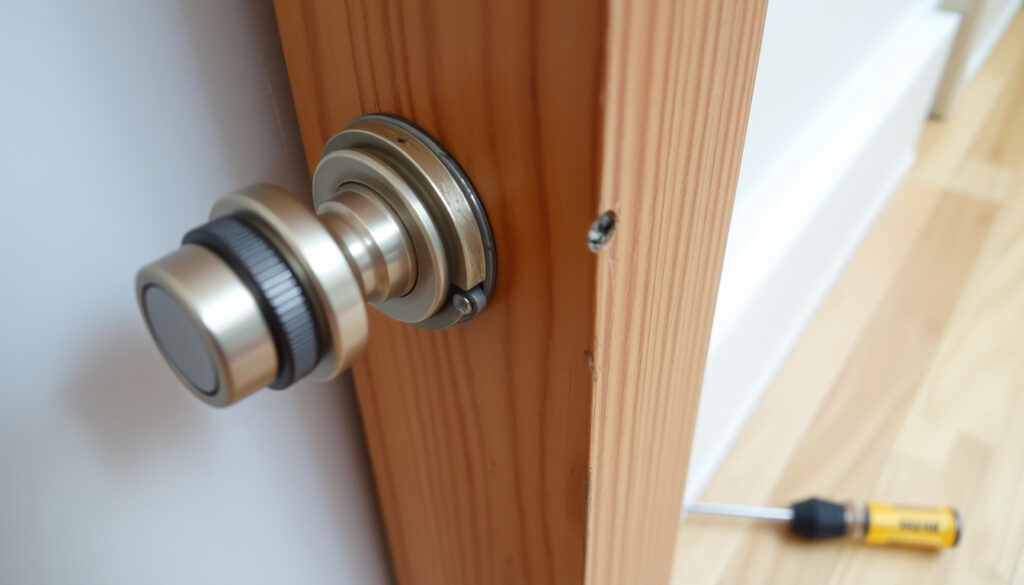
How to Fix a Loose Doorknob: Step-by-Step Guide
There’s that moment when you grab your door knob and it wobbles in your hand – maybe it’s wiggling, sagging, or spinning uselessly without opening the door. Nearly 90% of these cases come down to nothing more than a tiny screw working its way loose over time (Angi home services guide).
Most common cause: Loose set screws (90% of cases) ·
Average repair time: 15 minutes ·
Tools needed for basic tightening: Only a screwdriver ·
DIY success rate with visible screws: 95%
Quick snapshot
- Tighten rose plate screws behind lever (Reolink guide)
- Replace internal spring if broken (The Spruce (YouTube))
- Spindle is likely worn or broken (Loctite Products)
- Replace spindle with matching size (Networx) (Loctite Products)
- Tighten screws on latch plate inside door edge (Reolink)
- Fill stripped screw holes with wooden toothpicks and glue (Angi)
Five key facts about loose doorknobs, one pattern: most fixes are fast, require one tool, and need a diagnosis first.
| Fact | Detail |
|---|---|
| Primary cause | Loose set screws on the knob or rose plate |
| Tool required | Screwdriver (Phillips or flathead) |
| Second most common cause | Worn internal spindle |
| Average repair difficulty | Beginner level for loose set screws |
| When to call a professional | If the door trim needs routing or spindle is broken inside latch |
Before buying any parts, spend 30 seconds figuring out which type of looseness you have. A set-screw turn for wiggle vs. a spring swap for sag vs. a spindle replacement for spin — picking the wrong route wastes time and can damage the assembly (Networx repair guide).
Why does my door knob wiggle?
Common causes: loose set screws vs worn spindle
- Loose set screws cause 90% of wobbly knobs – The tiny hex or Phillips screw on the neck of the knob backs out from repeated turning, leaving the knob free to wobble on the spindle (Angi home services guide).
- Worn internal spindle causes knob to turn without opening the latch – The rectangular metal bar between the knobs gets rounded at the edges, losing grip. The knob spins freely but no longer pulls the latch back (Networx repair guide).
- Sagging lever handles are usually due to a loose rose screw – The decorative plate (rose) that sits against the door face is held by one or two screws. If those work loose, the lever handle droops downward (The Spruce (YouTube) tutorial).
The implication: wiggle and sag are quick fixes. Spin-without-opening means you’re buying a replacement spindle.
How to tighten a loose door knob?
Here’s the fix for whatever version of a loose doorknob you’re facing, starting with a quick diagnosis so you don’t waste time on the wrong repair. Follow these steps in order.
- Step 1: Tighten visible screws on the rose plate – If you see two small screws on the face of the rose plate (the round cover against the door), grab a Phillips or flathead screwdriver and turn each one clockwise about a quarter turn. Alternate between the two screws — tightening one side, then the other — to keep the knob assembly square and reduce binding (Networx repair guide).
- Step 2: Locate and tighten the set screw on the knob base – The set screw is a small hex screw on the neck of the knob, right where it meets the rose plate. It usually needs a 5/64 inch Allen wrench, though some use a small Phillips head. Turn it clockwise about a quarter turn — just snug, not tight enough to strip the threads (SavvyHomeSavings repair guide). The set screw should bear on the flat side of the spindle for a secure hold (Networx repair guide).
- Step 3: Check the latch plate screws – The latch plate — the metal plate on the edge of the door where the bolt comes out — is held by two screws. If those are loose, the entire lock mechanism shifts inside the door. Tighten them with a Phillips screwdriver (Reolink guide).
Over-tightening can make the knob or latch bind. Stop when the parts are snug, not forced. Test the knob rotation after every turn (Networx warning).
How to fix a loose door handle without visible screws?
Method for hidden screws behind the rose cover
Many modern handles hide their mounting screws under a decorative rose cover. Use a putty knife or thin flathead screwdriver to gently pry the cover off — it snaps on or threads off. Once the cover is off, the screws are exposed (Networx repair guide). Tighten them, alternating side to side, then snap the cover back on (Reolink guide).
Method for handles without any screws (compression or clip mount)
Some handles use a spring-loaded clip inside the knob. You’ll need to push a small pin or clip to release the knob from the spindle. Look for a tiny hole on the neck of the knob — insert a paperclip or Allen key to depress the retaining pin while pulling the knob off. Once off, check if the internal clip is broken or if the spindle is worn (BCD Construction guide).
The catch: no-screw handles are designed for speed of installation, not durability. If the clip is broken, the entire handle set usually needs replacing.
How to fix a loose doorknob spindle?
Replacing a worn spindle
The spindle is the rectangular metal bar running through the door, connecting both knobs. When its edges get rounded, the knob grips poorly and spins without engaging the latch. Measure the existing spindle’s length and width (standard sizes are 5/32 inch by 3/8 inch, or 1/4 inch by 3/8 inch, in lengths from 2.5 to 4 inches). Buy a matching replacement from any hardware store (Loctite Products spindle replacement guide). Slide the new spindle through the latch mechanism, reattach both knobs, and tighten the set screws onto the flat faces of the spindle.
Adjusting the set screws on the spindle
Before replacing anything, try adjusting the set screws to bite into fresh metal. On some designs, the set screw can be loosened, the spindle rotated 90 degrees so the screw presses on an unworn flat face, then retightened (Networx repair guide). This works if the spindle isn’t deeply grooved.
The trade-off: rotating works as a 6-month patch. If the spindle is already grooved, replacement is the long-term fix.
How to fix a sagging lever door handle?
Tightening the rose plate screws behind the handle
Sagging lever handles are usually caused by loose rose plate screws. Remove the handle (same method as above — snaps off or uses a set screw). The rose plate behind it is held by two screws. Tighten them, reattach the handle, and check whether the lever sits level (The Spruce (YouTube) tutorial).
Using a shim or spring spacer
If the lever still droops, the internal spring has weakened. Some handle designs allow you to add a plastic or metal spacer to lift the lever back to horizontal. Insert the spacer between the handle’s mounting plate and the door surface before retightening (BCD Construction spacer guide). If the spring is broken, you’ll need to replace the entire handle assembly.
Why this matters: a sagging lever that rubs against the door frame will eventually damage the paint and wood. A $5 spacer beats a $50 refinishing bill.
What are the common causes of loose door handles?
Worn set screws
Set screws work themselves loose over thousands of turns. 90% of loose handles are from set screws vibrating out during normal use (Angi home services guide).
Stripped threads in the handle
If the screw hole in the handle body has stripped threads, the set screw won’t hold. Apply threadlocker to the screw threads for a firmer grip (Loctite Products threadlocker guide).
Loose mounting plate on the door surface
The mounting plate screws can work loose from repeated door slams. Wood door expansion from humidity can loosen plate screws over time (Networx repair guide).
Worn internal components (spindle, springs)
Spindles wear at the contact points. Internal springs fatigue and lose tension. Both require replacement rather than adjustment (Loctite Products).
The pattern: nearly every loose handle starts with a tiny screw that needs a quarter turn. If that doesn’t fix it, you’re three steps away from buying a $5 part.
“Filling stripped screw holes with wood glue and toothpicks is one of the most common fixes for loose door knobs — it buys years of extra use without replacing the door.”
— Toolstation hardware repair guide (via Angi)
“Modern handles use two long screws through the latch holes to prevent loosening. If your handle doesn’t have those, the rose cover screws are your next best anchor point.”
— The Honest Carpenter (via Networx)
Related reading: How to Fix a Loose Doorknob · How to Fix a Doorknob That’s Come Loose
youtube.com, youtube.com, youtube.com, gfdhomes.co.uk, staging.southernwv.edu
Frequently asked questions
Can I replace a door knob with a handle?
Yes, as long as the new handle uses the same backplate size and latch mechanism. Measure the distance from the edge of the door to the center of the knob hole (backset) — standard is 2-3/8 inches or 2-3/4 inches. The latch size and spindle connection must also match (BCD Construction guide).
How to fix a door knob broken off from inside?
If the knob snapped off the spindle, the remaining piece inside the knob might be extractable with pliers. If the spindle is broken inside the latch mechanism, you’ll need to remove the latch from the door edge and push the broken piece out (Loctite Products repair guide).
What causes a front door handle to droop?
Frequent use wears the internal return spring, or the mounting screws behind the rose plate work loose. Tightening the rose screws fixes about 70% of drooping handles. If the spring is broken, the handle assembly must be replaced (The Spruce (YouTube) tutorial).
Is a loose door knob a security risk?
A loose knob itself doesn’t compromise lock security, but a loose mounting plate can indicate the door frame is weakening around the strike plate. If the latch doesn’t fully engage because the knob is loose, the door can be pushed open (Networx security note).
How long does it take to fix a loose door knob?
For a simple set screw turn: 5 minutes. For hidden screws under a rose cover: 15 minutes. For spindle replacement: 30-45 minutes (SavvyHomeSavings timing guide).
What tools do I need to fix a loose door handle?
A Phillips-head screwdriver, a flathead screwdriver, a 5/64-inch hex key (Allen wrench), and optionally a putty knife for prying off rose covers. For stripped holes: wooden toothpicks and wood glue (Reolink tool guide).
Can I fix a loose door knob without a hex key?
Yes — many set screws use a Phillips head. If yours is hex-shaped, a tiny flathead screwdriver can sometimes grip it at an angle. As a last resort, use a small TORX bit that fits snugly (Angi alternative tool suggestion).
Related reading
More related posts
 What Is Climate Change? Definition, Causes and Effects
 Dollar Rate in India Today: USD to INR Live
 Web Security Best Practices: Protect Your Application
 Best Automatic Cat Feeder NZ: Reviews, Prices & Buying Guide
 Cast of Karen Pirie – Full Actors and Characters List
 Soccer World Cup 2026 – Hosts, Dates, Venues and Schedule
 Run It Straight NZ: Teen Death, Rules & Safety
 New Balance Lifestyle Mode de Vie – Guide to Everyday Classics