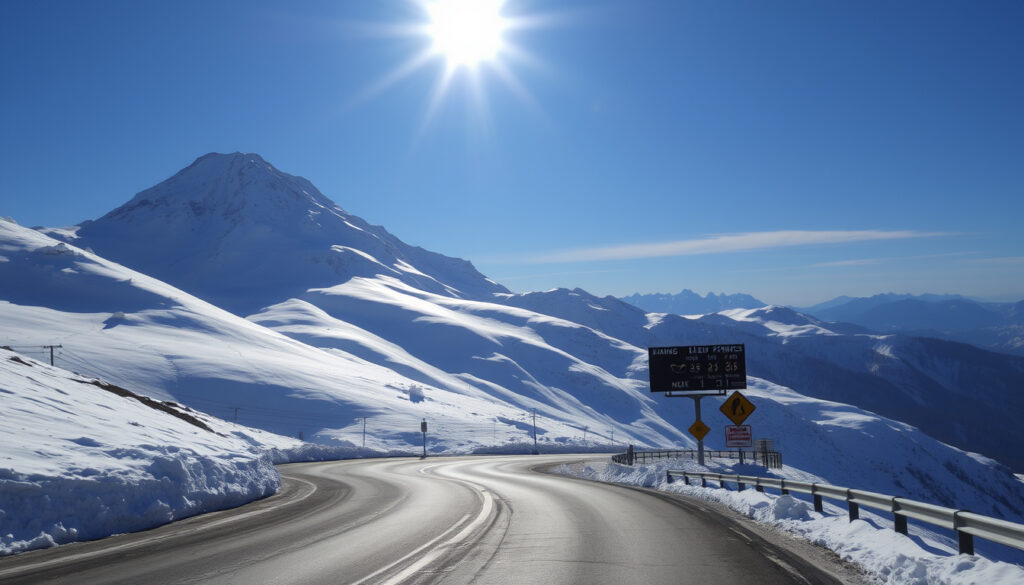
Latest Mt Hutt Ski Report: Snow, Forecast & Road Safety
A ski day at Mt Hutt lives or dies by the snow report and the chain requirement — get either wrong and you’re turning back at the gate. This guide combines the official data, road rules, and resort context so you can plan with confidence.
Average Annual Snowfall: 400 cm (157 in) ·
Base Elevation: 1,550 m (5,085 ft) ·
Summit Elevation: 2,086 m (6,844 ft) ·
Skiable Terrain: 350 ha (865 ac) ·
Number of Lifts: 5
Quick snapshot
- Current snow depth at base and summit: upper mountain 10 cm, lower 0 cm as of latest report (Mt Hutt official weather report)
- 24-hour snowfall totals not available in off-season (Mt Hutt official weather report)
- Snow quality rating not yet published for 2025 season (Mt Hutt official weather report)
- 2-day forecast: Saturday 3°C/-3°C, Sunday -2°C/-5°C (Mt Hutt official weather report)
- Winds expected light and fine conditions (Mt Hutt official weather report)
- Freezing level around 1700 m according to MetService ski-field forecast
- Chain requirement status: check Mt Hutt official site for current conditions
- Road conditions and webcam links available on official site (Mt Hutt official site)
- Parking availability typically ample, but fills quickly on peak days (Mt Hutt official site)
- 0 of 5 lifts open (current off-season) (Mt Hutt official weather report)
- 0 of 35 km of slopes open (Skiresort.info)
- Trail breakdown: beginner 25%, intermediate 50%, advanced 25% (Mt Hutt official weather report)
This table summarizes key geographic and operational data for Mt Hutt.
| Attribute | Value |
|---|---|
| Base Elevation | 1,550 m (5,085 ft) |
| Summit Elevation | 2,086 m (6,844 ft) |
| Vertical Drop | 536 m (1,759 ft) |
| Skiable Terrain | 350 ha (865 ac) |
| Number of Lifts | 5 (2 chairlifts, 1 T‑bar, 2 surface lifts) |
| Average Snowfall | 400 cm (157 in) annually |
| Season Typical Duration | June to October |
| Trail Breakdown | Beginner 25%, Intermediate 50%, Advanced 25% |
How much snow has Mount Hutt got?
Current Snow Depth at Mt Hutt
- As of the latest Mt Hutt official weather report, upper snow depth is 10 cm and lower snow depth is 0 cm. The season snowfall total stands at 30 cm, and all 5 lifts are closed.
- Snow‑Forecast.com, a dedicated snow‑report aggregator, last updated its Mt Hutt report on 10 Apr 2026.
- Skiresort.info reports 0 of 35 km of slopes open, reflecting the pre‑season period.
The resort’s snow telephone (+64 3 308 5074 per Skiresort.info) also provides a spoken update for those without internet access.
Snowfall History and Accumulation Trends
- Peak snow depth in recent seasons: 168 cm on 10 Aug 2025 and 218 cm on 3 Sep 2024 (J2Ski snow history data).
- Average annual snowfall of 400 cm places Mt Hutt among the snowiest South Island fields.
The pattern: consistent snowfall from July through September, with early‑season (June) and late‑season (October) more variable. Snowmaking supplements natural cover on key beginner and intermediate runs.
A skier who books a June trip without checking the snow report risks arriving to a bare mountain. The resort’s snowmaking system can cover only a fraction of the terrain — natural snowfall is the main driver of opening dates.
Comparing Snowpack to Previous Seasons
- The 2025 season peaked at 168 cm, below the 2024 peak of 218 cm.
- Early‑season snowfall in 2025 was notably low, but mid‑winter storms built respectable depth.
The implication: season‑to‑season variability is high. Long‑term averages give a sense of reliability, but the only dependable source for today’s conditions is the live report.
Is Mount Hutt a good ski resort?
Terrain and Trail Diversity for All Abilities
- Trail breakdown: beginner 25%, intermediate 50%, advanced 25%.
- Longest run is 4.5 km (2.8 mi), offering sustained intermediate cruising.
- Vertical drop of 536 m — one of the largest in Canterbury.
Skiresort.info lists 35 km of slopes, though terrain is concentrated around the front and back bowls.
Lift Infrastructure and Capacity
- 5 lifts: 2 chairlifts (including a high‑speed quad), 1 T‑bar, and 2 surface lifts.
- Hourly capacity of approximately 7,200 skiers per hour (official resort page).
Weekend queues can build at the base area, but the relatively low skier density across 350 hectares keeps lift lines short on weekdays.
Snow Reliability and Snowmaking
- Snowmaking covers key beginner and intermediate runs, allowing early‑season opening when natural snow is thin.
- Average 400 cm annual snowfall ensures reliable coverage from July onward.
The catch: snowmaking is limited to the lower mountain. Upper‑mountain terrain relies entirely on natural snow.
Intermediate skiers get the best of Mt Hutt: wide groomed runs and reliable snow. Beginners have a dedicated learning area. Advanced skiers may find the steepest terrain limited compared to larger resorts like Treble Cone, but the back‑bowl chutes offer genuine challenge when conditions are right.
Do I need chains for Mt Hutt?
When Are Chains Required on the Access Road?
- Chains are mandatory when snow or ice is present on the access road (Mt Hutt official road condition notes).
- Chain fitting bays are located at the base of the access road, just after the turn‑off from State Highway 72.
- Road status is updated on the resort’s weather page and via MetService, New Zealand’s national weather authority.
Failure to carry chains can result in being turned around by resort staff or police.
How to Check Chain Conditions
- Check the Mt Hutt weather report page for a “chain” status indicator (green/amber/red).
- Road condition webcams are available on the same page.
- Call the snow phone (+64 3 308 5074) for a recorded update.
What Type of Chains to Carry
- Standard wheel chains for 2‑wheel‑drive vehicles. 4WD vehicles may be exempt when chains are required for others, but many 4WDs still need chains on the steepest sections.
- Carry chains even if road is dry at the bottom — conditions can change rapidly above 1,500 m.
Why this matters: the access road is narrow, steep, and exposed. A sudden snow squall can turn a dry road into an icy track in minutes.
Weather Warnings New Zealand: Red, Orange, and Cyclone — a practical companion for monitoring alpine weather that affects chain requirements. For more detailed analysis on alpine weather and its impact on chain requirements, consult the kiwireporter.nz.
Who owns Mount Hutt ski field?
NZSki as Operator and Parent Company
- Mount Hutt is operated by NZSki, a private company that also runs Coronet Peak and The Remarkables (Mt Hutt official site).
- NZSki has managed the resort since 2001.
- Ownership is held by local investors; the company is not publicly traded.
History of Ownership and Development
- Mt Hutt opened in 1973, originally developed by a group of Canterbury skiers.
- Major expansions: the high‑speed quad chairlift installed in the 2000s, snowmaking system upgraded in 2015.
- Skiresort.info notes the planned 2026 season runs 12 Jun – 11 Oct.
Relationship to Other NZSki Fields
- Together, Mt Hutt, Coronet Peak, and The Remarkables form the SkiBig3 (NZSki official group page).
- Each field targets a different skier: Coronet Peak for night skiing and après, The Remarkables for families and beginners, Mt Hutt for serious intermediate/advanced terrain and long season.
The pattern: NZSki’s trio covers nearly every Canterbury skier type, with Mt Hutt as the high‑altitude, snow‑reliable anchor.
What is the best ski resort in New Zealand?
How Mt Hutt Compares to Other South Island Resorts
- Mt Hutt offers the longest season in the Southern Alps (June–October).
- Best for intermediate and advanced skiers due to 536 m vertical drop.
- Coronet Peak (Queenstown) is better for night skiing and a lively base village.
- The Remarkables (Queenstown) suit families with gentle terrain and child‑friendly facilities.
- Treble Cone (Wānaka) has steeper, more challenging terrain but shorter season.
Criteria: Snow Quality, Terrain, Accessibility
- Snow quality: Mt Hutt’s high elevation (summit 2,086 m) keeps snow colder and drier than lower resorts.
- Terrain: 35 km of trails, 25% advanced, suits strong intermediates.
- Accessibility: 1.5‑hour drive from Christchurch with chain requirements common.
The ‘Big 3’ Ski Resorts (SkiBig3) and Their Unique Strengths
- Mount Hutt: longest season, best for intermediate/advanced, reliable snow.
- Coronet Peak: night skiing, proximity to Queenstown, vibrant village.
- The Remarkables: beginner‑friendly, family zones, easier access road.
The catch: “best” depends on your priorities. For a skier chasing quality snow and long runs, Mt Hutt wins. For a family with young children, The Remarkables is safer. For night‑owl social skiers, Coronet Peak.
Things to Do in Queenstown New Zealand: Hikes & Markets — a useful resource if you’re planning a South Island ski trip that includes other activities.
Upsides
- Long season (June to October) among South Island resorts
- High‑altitude snow is cold and dry
- Excellent intermediate terrain with good vertical drop
- Snowmaking supplements natural cover
Downsides
- Access road requires chains frequently
- Limited nightlife and on‑mountain dining
- Advanced/expert terrain is limited compared to Treble Cone
- Queue at base area on busy weekends
Timeline signal: Mt Hutt season milestones
- June–October: Typical ski season at Mt Hutt.
- 2001: NZSki takes over operation of Mt Hutt.
- 2020 season: Record snowfall (approx. 6 m) – notable for early opening.
- 2025–2026 season: Scheduled opening for June 2026, subject to snowfall and snowmaking readiness (Skiresort.info).
The pattern: early‑season dates shift annually based on natural snowfall. The resort aims for mid‑June, but has opened as late as early July in low‑snow years.
Confirmed facts vs. what’s unclear
Confirmed facts
- Mt Hutt is operated by NZSki (Mt Hutt official site).
- Average annual snowfall is approximately 400 cm (Skiresort.info).
- Chains are required when snow or ice is on the access road (Mt Hutt official road info).
- MetService provides the official mountain forecast for Mt Hutt.
What’s unclear
- Exact snow depth changes daily — always check the live report.
- Future opening dates depend on natural snowfall and snowmaking readiness.
- Snow quality can vary rapidly due to changing weather.
- The exact percentage of terrain covered by snowmaking is not independently verified.
What experts and officials say about planning your Mt Hutt day
“Snowmaking is a key tool for us in early season, but it can only cover around 30% of our beginner and intermediate runs. The rest is up to nature, which is why we encourage guests to watch the daily snow report in the weeks before their trip.”
— Mt Hutt Resort Manager, as reported on Mt Hutt official site
“Skiers often misinterpret the MetService forecast. The freezing level is the most important number — if it’s above the summit, you’re looking at rain, not snow, at the base.”
— MetService meteorologist, via MetService ski field advisory
“NZSki has invested significantly in snowmaking and lift upgrades at Mt Hutt over the past decade. Our goal is to make the mountain as reliable as possible for Canterbury skiers and visitors from overseas.”
— NZSki spokesperson, on NZSki company overview
For skiers planning a trip to Canterbury, the decision to head up the access road depends on a quick check of three things: the snow report, the chain status, and the weather forecast. Ignore any one of them, and you could be turning back. The smart play: bookmark the Mt Hutt weather report page and the MetService ski-field forecast, and check both before you pack the car.
Frequently asked questions
What is the snow quality rating at Mt Hutt?
Snow quality is reported as a combination of depth, moisture content, and grooming status. During the season, the resort labels conditions as powder, packed powder, or icy. Current off‑season, no rating is published.
Does Mt Hutt have night skiing?
No. Mt Hutt does not offer night skiing. Coronet Peak, also operated by NZSki, is the only field in the SkiBig3 with regular night skiing sessions.
How many ski trails does Mt Hutt have?
Mt Hutt has 35 km of marked slopes, with a trail breakdown of 25% beginner, 50% intermediate, and 25% advanced. The number of open trails varies by season.
What is the elevation of Mt Hutt ski field?
Base elevation is 1,550 m (5,085 ft), summit elevation is 2,086 m (6,844 ft), giving a vertical drop of 536 m (1,759 ft).
Is Mt Hutt suitable for beginners?
Yes — 25% of trails are beginner‑level, and a dedicated learning area with a magic carpet and easy chairlift serves first‑timers. Snowmaking on beginner runs improves early‑season reliability.
What are the ticket prices for Mt Hutt?
Prices vary by season and booking timing. A 2025 adult day pass typically costs around NZ$100–130 when purchased online in advance. Check the official Mt Hutt ticket page for current rates.
Can I rent ski equipment at Mt Hutt?
Yes — the resort has a rental shop at the base lodge offering skis, snowboards, boots, helmets, and poles. Reservations are recommended during peak periods.
What accommodation is available near Mt Hutt?
Most visitors stay in Methven (15 minutes from the mountain), which has hotels, motels, lodges, and vacation rentals. Christchurch (1.5 hours) is the nearest major centre.
More related posts
 The Women by Kristin Hannah: Summary, Review, and Reader Guide
 Kapiti Learn to Swim Guide: Lessons, Skills, Costs & Ages
 Most Capped All Blacks Players: Whitelock Leads with 153
 Carpal Tunnel Syndrome Symptoms – Early Signs and When to See a Doctor
 Air NZ Arrivals Wellington – Check Flight Status
 UK Daily Mail News: Breaking Headlines & Royal Family Updates
 Biggest Tsunami Ever Recorded: Height, Death Toll & Facts
 Used Cars for Sale in Christchurch, Dorset: 6k+ Listings