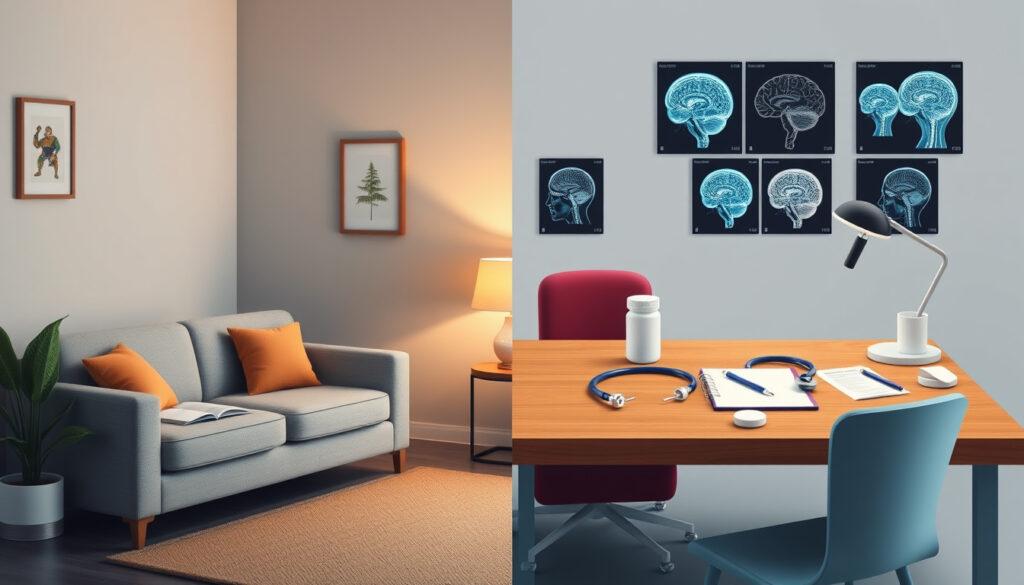
Psychologist vs Psychiatrist: Key Differences and How to Choose
Anyone who has searched “should I see a psychologist or a psychiatrist” knows the advice splits into two camps: psychiatrists are medical doctors who can prescribe medication (American Psychiatric Association (medical specialty body)), while psychologists are doctoral-level clinicians who focus on therapy and psychological assessment. That training difference drives nearly every practical choice that follows — from who writes prescriptions to who should treat severe depression.
Psychiatrist: medical doctor (MD or DO) plus 4-year residency (New York County Psychiatric Society (regional psychiatric association)) ·
Psychologist: doctoral degree (PhD or PsyD), 5–7 years of study ·
Prescribing: psychiatrists yes, psychologists limited ·
Both diagnose: yes
Quick snapshot
- Psychiatrists are licensed medical doctors who can diagnose mental health conditions and prescribe medication (American Psychiatric Association (medical specialty body))
- Psychologists hold doctoral degrees in psychology (PhD or PsyD) and are not medical doctors (NHS Health Careers (U.K. health service careers body))
- Psychiatrists can prescribe medication; psychologists generally cannot (American Medical Association (physicians’ professional association))
- Which provider fits best depends on the condition, severity, and personal preference (Cleveland Clinic Health Essentials (clinical health publisher))
- Diagnosis usually takes more than one session; the range stretches from a short clinical interview to a full battery of tests (Cleveland Clinic Health Essentials (clinical health publisher))
- Combined treatment versus a single provider is not settled for every condition (Cleveland Clinic Health Essentials (clinical health publisher))
- Psychiatrist pathway: four years of medical school plus four years of psychiatry residency (National Institute of Mental Health (U.S. federal research agency))
- Psychologist pathway: five to seven years of doctoral study plus supervised clinical hours (National Institute of Mental Health (U.S. federal research agency))
- When depression symptoms persist, the guidance is to seek care rather than wait (National Institute of Mental Health (U.S. federal research agency))
- If depression is severe, long-lasting, recurrent, or linked to self-harm thoughts, a psychiatrist is the appropriate next step (Healthdirect Australia (government health service))
- A primary care doctor can also prescribe depression medication and refer you onward if symptoms do not improve (Healthdirect Australia (government health service))
Key facts at a glance
Six rows, one pattern: the psychiatrist’s license covers the medical toolkit, while the psychologist’s license covers the behavioral toolkit.
| Label | Value |
|---|---|
| Training — psychiatrist | Medical school (MD or DO) plus a 4-year psychiatry residency (New York County Psychiatric Society (regional psychiatric association)) |
| Training — psychologist | Doctoral degree (PhD or PsyD), typically 5–7 years plus supervised clinical hours (Psychology.org (psychology education and careers resource)) |
| Prescribing | Psychiatrists: yes, in all 50 U.S. states (NAMI (mental health advocacy nonprofit)) · Psychologists: only in 5 states with extra training (American Psychological Association (professional body for psychologists)) |
| Diagnosis | Both professionals can diagnose mental illness (Cleveland Clinic Health Essentials (clinical health publisher)) |
| Depression treatment | Psychotherapy, medication, or both are standard options (National Institute of Mental Health (U.S. federal research agency)) |
| Time to diagnose | Psychologists often deliver a preliminary diagnosis after 1–3 sessions; psychiatrists may diagnose at the first visit |
The implication: the training gap is not a quality gap. It is a supply gap — psychiatrists are medical specialists, and that is exactly why they are rarer and harder to see than the psychologist down the street.
What is the main difference between a psychiatrist and a psychologist?
The main difference sits in the word “medical.” One profession trains as a physician; the other trains as a behavioral scientist.
Training and education pathways
- Psychiatrist: a physician (MD or DO) who finishes medical school plus a four-year psychiatry residency (New York County Psychiatric Society (regional psychiatric association))
- Psychologist: a doctoral-level clinician (PhD or PsyD) who studies human behavior, emotion, and cognition rather than medicine (NHS Health Careers (U.K. health service careers body))
- Psychiatry is defined as the study of mental health problems and their diagnosis, management, and prevention (NHS Health Careers (U.K. health service careers body))
Because psychiatrists study medicine first, they are trained to connect mental symptoms to physical conditions — hormonal shifts, infections, neurological disease — before they ever specialize in mental health.
If you are looking for coping skills without medication, a psychologist is a strong first stop. If you already expect drug treatment, a psychiatrist — or a primary care doctor — can get you there faster.
Licensing and scope of practice
- A psychiatrist is a licensed physician: they can prescribe medication, order medical tests, and admit patients to hospital
- A psychologist is licensed to provide psychotherapy, psychological assessment, and behavior-change treatment — but not medical care
- In most states, psychologists cannot prescribe medication; five states — New Mexico, Louisiana, Illinois, Iowa, and Idaho — allow it with additional training (American Psychological Association (professional body for psychologists))
The scope gap is the most practical difference of all: it decides who can write an antidepressant prescription and who has to refer you to someone who can.
Is it better to see a psychologist or a psychiatrist?
“Better” depends on what you are treating. For depression, the choice is rarely either/or — the two roles solve different problems.
When to choose a psychologist for therapy and counseling
- You are dealing with depression, anxiety, a stressful life event, or want assessment and support to cope (Healthdirect Australia (government health service))
- You want structured talk therapy such as CBT, DBT, or psychodynamic therapy, which is the psychologist’s core expertise
- Your symptoms are mild to moderate and you would prefer to try non-drug treatment first
When to choose a psychiatrist for medication management and complex cases
- Depression is severe, long-lasting, recurrent, or not improving with other treatment (Healthdirect Australia (government health service))
- The condition may have a strong biological component, such as bipolar disorder or schizophrenia
- You want a provider who can rule out physical causes and oversee medication over time
Factors to consider: severity, preferences, access
- Severity and duration of symptoms matter most — the more severe, the stronger the case for a medical provider
- Psychiatrists are fewer and often have longer wait times, so cost and access can steer the decision
- Many people use both: a psychologist for therapy and a psychiatrist for medication
A practical path is to start with a psychologist or primary care doctor, then add a psychiatrist if symptoms do not improve or if medication becomes part of the picture.
Outside the few states with prescribing psychologists, a psychologist cannot write prescriptions. If medication becomes necessary, a physician has to be involved — so a long therapy waitlist should not delay the medical step.
The pattern: therapy-first for mild cases, medicine-first for severe ones, and combined care for most people in between.
Can a psychologist diagnose mental illness?
Yes. The more useful question is what happens after the diagnosis.
Diagnostic tools used by psychologists
- Clinical interviews and DSM-5 criteria are the standard diagnostic framework
- Psychologists use structured psychological testing and assessments that go beyond a symptom checklist (Psychology.org (psychology education and careers resource))
- Conditions commonly diagnosed by psychologists include anxiety, depression, and personality disorders
Psychologists are trained to evaluate the full psychological picture — symptoms, history, behavior patterns, and test results — before confirming a diagnosis.
Limitations compared to psychiatrists
- Psychiatrists can rule out medical conditions that mimic mental illness, such as thyroid disorders, vitamin deficiencies, or neurological problems (American Medical Association (physicians’ professional association))
- Psychologists are not medical doctors, so they cannot order blood work or brain imaging; a psychologist who suspects a physical cause will refer you to a physician
- When a diagnosis is complex, the psychologist’s assessment is often the deeper one, but the psychiatrist’s medical screen is the safer one
A thyroid condition or vitamin deficiency can present as depression. The provider who can order the right medical test is the one who can close that loophole.
The trade-off: a psychologist may spend far longer measuring your symptoms, but only a medical doctor can prove nothing physical is driving them.
What not to say during therapy?
What you do not say matters as much as what you do. Hidden symptoms can turn a correctable diagnosis into a stalled treatment plan.
Communication pitfalls with psychologists and psychiatrists
- Don’t hide symptoms or downplay their severity — honest reporting is what allows an accurate diagnosis and a treatment plan that actually fits
- Don’t dismiss the clinician’s expertise or push back on every recommendation; if you disagree, say so and ask for reasoning instead of shutting down
- Don’t demand a specific medication by name — psychiatrists weigh side effects, interactions, and alternatives, so start with the symptoms, not the drug
- Don’t turn sessions into social conversation; therapy works when the hard material is on the table
What to avoid to build trust and make progress
- Avoid lying, minimizing, or exaggerating symptoms to seem “better” or “worse” than you are
- Don’t ask the clinician to keep secrets from your care team if medication and therapy are being coordinated
- Don’t compare yourself to other clients or make the session about the therapist’s personal life
There is also a practical difference in how the two settings work. A psychiatrist appointment is often shorter, focused on symptoms and side effects; a therapy session with a psychologist is usually longer, conversational, and built for exploration. A written symptom list helps in both rooms.
The implication: the same honesty that makes therapy useful is what makes a psychiatric visit productive. Withhold details and both professionals are working blind.
How many sessions for a psychologist to diagnose?
There is no universal clock, but there is a typical shape to the diagnostic process.
Initial assessment and intake sessions
- Most psychologists can offer a preliminary diagnosis after 1–3 sessions, based on a clinical interview and history (American Psychological Association (professional body for psychologists))
- Psychiatrists often diagnose during the first session, combining medical history, symptom review, and a mental status exam
The first one or two visits are usually intake: background, current symptoms, sleep, appetite, and how the problem is affecting daily life. A provisional diagnosis can emerge quickly, but it is not the end of the assessment.
When a full evaluation is needed
- A comprehensive diagnostic evaluation can take 4–6 sessions when psychological testing is involved
- Complex or co-occurring conditions may require multiple assessment tools and several weeks of observation
- Severe or urgent symptoms — including self-harm thoughts — should not wait for a full assessment; seek care sooner
The catch: a diagnosis is a working map, not a verdict. Early provisional labels often shift as new information emerges in later sessions.
Psychiatrist vs psychologist: side-by-side comparison
Three practical differences, one pattern: medical authority sits with the psychiatrist, behavioral depth with the psychologist.
| Dimension | Psychiatrist | Psychologist |
|---|---|---|
| Core training (NHS Health Careers (U.K. health service careers body)) | Medical doctor (MD or DO) — 4 years of medical school plus residency | Doctoral degree (PhD or PsyD) — 5–7 years of graduate study |
| Prescribing power (NAMI (mental health advocacy nonprofit)) | Yes — can prescribe and monitor medication | Only in a few states with additional training |
| Primary focus (Cleveland Clinic Health Essentials (clinical health publisher)) | Medical and biological treatment of mental illness | Psychotherapy, assessment, and behavior change |
What this means: the right provider is not the one with the better reputation — it is the one whose license matches what your symptoms require.
Psychiatrist vs psychologist: upsides and downsides
The honest version of this comparison is a trade-off, not a ranking.
Upsides
- A psychiatrist can prescribe antidepressants and manage the medical side of depression (American Medical Association (physicians’ professional association))
- A psychologist provides deeper talk therapy for the behavioral patterns that keep depression going
- Standard depression care includes psychotherapy, medication, or both, so the two roles can be combined (National Institute of Mental Health (U.S. federal research agency))
Downsides
- Psychiatrist visits are often short and medication-focused, leaving less room for extended psychotherapy
- A psychologist alone cannot provide medication in most states, so a second provider may be needed
- Coordinating two providers means more appointments, more paperwork, and more out-of-pocket cost
The trade-off: one provider can do everything only if you accept the limits of their license. If you need both talk therapy and medication, the system works best when you plan for two.
What’s confirmed and what’s still unclear
Distinguishing settled facts from open questions keeps this comparison honest.
Confirmed facts
- Psychiatrists are medical doctors; psychologists are not (American Medical Association (physicians’ professional association))
- Talk therapy is a core element of depression treatment and the psychologist’s main tool (Mayo Clinic (nonprofit medical center))
- Both professionals can diagnose mental illness (NAMI (mental health advocacy nonprofit))
What’s unclear
- Whether “better” means medication access or talk-therapy depth depends on the condition and the patient
- The exact number of sessions needed for a diagnosis varies widely
- Combined treatment versus a single provider is not settled for every condition
- How much therapy a psychiatrist offers varies by practice, setting, and patient load
The pattern: the facts are clear about training and licenses; the open questions are about fit, timing, and individual outcomes.
What psychiatrists and psychologists say
“Psychiatrists are medical doctors who can diagnose mental health conditions and prescribe medications for depression.”
“Psychiatrists are medical doctors who have qualified in psychiatry.”
NHS Health Careers (U.K. health service careers body)
The through-line in both: the border between these professions is defined by medical authority, not by caring or competence.
The takeaway
Choosing between a psychologist and a psychiatrist does not have to be a permanent decision. Start where your symptoms point: a psychologist for the work of therapy and behavior change, a psychiatrist when medication or medical clearance is part of the picture, and a primary care doctor if you need a fast on-ramp. For anyone dealing with depression, the implication is clear: raise the question of medical evaluation early — because delaying it when symptoms are severe or persistent can mean months of avoidable suffering.
Frequently asked questions
Can a psychologist prescribe medication?
In most states, no. Psychologists are not medical doctors, so they generally cannot prescribe psychiatric medication. A handful of states allow licensed psychologists to prescribe after completing additional specialized training (Psychology.org (psychology education and careers resource)).
Are psychiatrists also therapists?
Yes. Psychiatrists can provide psychotherapy as part of their practice — they are licensed physicians who can diagnose, prescribe and monitor medication, and offer therapy (NAMI (mental health advocacy nonprofit)). In practice, many focus more on medication management and shorter visits.
Do I need a referral to see a psychiatrist?
Usually not for the appointment itself, but your insurance may require one. If you already have a primary care doctor, that provider can prescribe depression medication and refer you to a psychiatrist when symptoms are severe or persistent (Mayo Clinic (nonprofit medical center)).
How do I choose between a psychologist and a psychiatrist for depression?
For mild-to-moderate depression, a psychologist is a strong first step for talk therapy. For severe, long-lasting, recurrent depression, or if you are having self-harm or suicide thoughts, a psychiatrist is more appropriate. National guidance also supports combining both — psychotherapy, medication, or both are standard options (National Institute of Mental Health (U.S. federal research agency)).
What is the cost difference between seeing a psychologist and a psychiatrist?
Psychiatrists generally bill at higher rates because they are medical doctors and their visits are framed as medical care. Actual session costs depend heavily on insurance, location, and whether the appointment is for therapy or medication management.
Do psychologists and psychiatrists work together?
Yes. Combined treatment is common: a psychologist handles therapy while a psychiatrist manages medication. The National Institute of Mental Health notes that depression treatment commonly includes psychotherapy, medication, or both (National Institute of Mental Health (U.S. federal research agency)).
More related posts
 Cool Toys for 12 Year Olds Girl: Smyths Ireland Picks
 Cake in a Cup NZ – Quick Microwave Desserts Using Kiwi Staples
 The Farmers Son Menu – Prices and Seasonal Dishes Hudson NY
 Sam Ruthe Next Race 2026: Schedule, Age & Key Facts
 David Reid Homes Coromandel Collapse: Key Facts and Impact
 How Is Plastic Made? Step-by-Step Guide to Plastic Manufacturing
 UK Daily Mail News: Breaking Headlines & Royal Family Updates
 iPhone 16 Case NZ: Best Options from Top Retailers