When does spring start in NZ? Both dates explained
Ask two New Zealanders when spring starts and you’ll get two answers: 1 September or the equinox around 22–23 September. This guide explains both systems—meteorological and astronomical—and what they mean for planning your trip or your garden, backed by data from NIWA (New Zealand’s national climate institute), which uses 1 September as the meteorological start.
Meteorological spring start date: 1 September ·
Astronomical spring start date (2025 average): 22 or 23 September ·
Average spring temperature range (major cities): 8°C–18°C (46°F–64°F) ·
Overall season duration (meteorological): September–November
Quick snapshot
- Meteorological spring begins 1 September each year (WeatherWatch)
- Spring equinox occurs 22–23 September in the Southern Hemisphere (NIWA)
- Which convention—meteorological or astronomical—is more widely accepted by the public; survey data is limited
- 1 September: Meteorological spring starts
- 22–23 September: Spring equinox (astronomical start)
- 30 November: Meteorological spring ends; summer begins
- 21–22 December: Summer solstice; astronomical spring ends
Five key facts, one pattern: the two systems overlap but use different logic. Here is the summary.
| Label | Value |
|---|---|
| Meteorological spring in NZ | 1 September – 30 November |
| Latest spring equinox date | 23 September (e.g., 2024) |
| Average North Island spring temperature | 15–18°C (high) / 8–11°C (low) |
| Average South Island spring temperature | 12–16°C (high) / 5–8°C (low) |
| Coldest month in New Zealand | July |
What are the dates of the four seasons in New Zealand?
New Zealand’s four seasons follow a clear pattern: spring from September to November, summer December to February, autumn March to May, and winter June to August. 100% Pure New Zealand (official tourism site) uses this September–November definition for spring.
Meteorological season calendar
- Summer: December–February
- Autumn: March–May
- Winter: June–August
- Spring: September–November
Astronomical season dates
- Spring begins at the equinox (22–23 September) and ends at the summer solstice (21–22 December)
- Summer: solstice to autumnal equinox
- Autumn: equinox to winter solstice
- Winter: solstice to spring equinox
The pattern: astronomical dates shift by a day or two each year because Earth’s orbit is not perfectly circular. For most daily planning, meteorological dates are simpler and more consistent.
What is the official first day of spring?
There is no single legislated official date. New Zealanders use two conventions side by side.
Meteorological definition (1 September)
WeatherWatch (NZ weather service) explains that meteorological seasons divide the year into tidy three-month blocks for record-keeping. NIWA, the national climate institute, also uses 1 September as the standard start (NIWA).
Astronomical definition (spring equinox)
The spring equinox—when the sun crosses directly over the equator—marks the astronomical start. In 2015 it occurred on 23 September at 8:20 pm NZT (NIWA). In 2016 it was 2:21 am on an early Friday (Scoop).
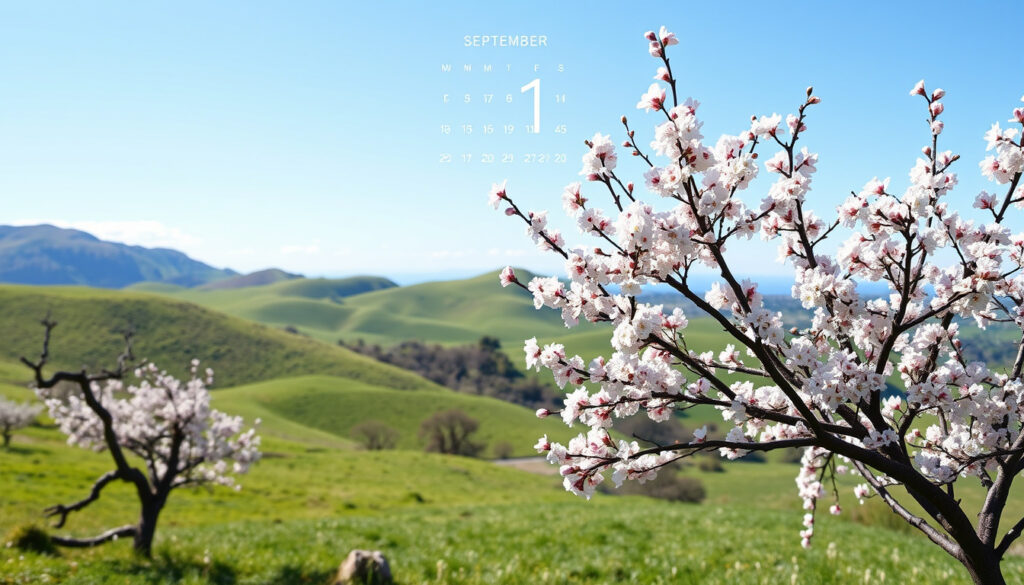
The trade-off: meteorological wins for simplicity; astronomical wins for celestial accuracy. Most New Zealanders treat 1 September as the unofficial start, aligned with the blooming of cherry blossoms and daylight saving preparations.
How cold is spring in New Zealand?
Spring is a transition season, so temperatures climb steadily but with plenty of variability. New Zealand Trails (adventure travel operator) notes daytime ranges from about 10°C to 21°C depending on island and timing.
Temperature ranges by region
Five regions, one pattern: the North Island stays warmer; the South Island cools faster.
| City | September | October | November |
|---|---|---|---|
| Auckland | 10–16°C | 11–18°C | 13–20°C |
| Wellington | 8–14°C | 9–15°C | 10–17°C |
| Christchurch | 4–15°C | 6–17°C | 8–19°C |
| Queenstown | 2–13°C | 4–15°C | 6–18°C |
Source: MoaTrek (NZ travel specialist)
What is New Zealand’s coldest month?
July is the coldest month nationwide. NIWA data shows average temperatures range from about 4°C to 12°C across the country.
Coldest month for North Island
July averages 8–12°C in Auckland, 6–11°C in Wellington. Frosts are rare in urban areas but common inland.
Coldest month for South Island
Queenstown July averages 0–9°C; Christchurch 3–11°C. Inland valleys can dip below freezing. Official tourism advice warns that snow can fall even in spring at higher elevations.
The implication: spring travellers who assume “spring = warm” may be caught off guard in September. July being coldest means spring is a recovery month, not a true warm season.
When does spring start in New Zealand in 2026?
Meteorological spring 2026
Always 1 September 2026, consistent with the fixed calendar.
Astronomical spring 2026
The spring equinox will occur on 22 or 23 September 2026. Exact timing is determined by Earth’s orbit and published by NIWA closer to the date.
Why this matters: if you are booking a spring event for 2026—like a garden festival or a wedding—the meteorological date is safe; the astronomical date gives you the precise celestial alignment.
Timeline: key spring dates in New Zealand
- 1 September – Meteorological spring begins
- 22–23 September – Spring equinox (astronomical spring start)
- 30 November – Meteorological spring ends
- 21–22 December – Summer solstice; astronomical spring ends
Confirmed facts vs what remains unclear
Confirmed facts
- Meteorological spring begins 1 September each year (NIWA)
- Spring equinox occurs 22–23 September in the Southern Hemisphere (NIWA)
- Spring months are September–November according to tourism and weather services (100% Pure New Zealand)
What remains unclear
- Which convention (meteorological or astronomical) has greater public adoption; no large-scale survey exists
What experts and official sources say
“The meteorological start of spring occurs on the first day of September.”
— NIWA (National Institute of Water and Atmospheric Research)
“Spring is a transition season with rising temperatures, increased daylight, and frequent weather changes.”
“New Zealand’s four seasons – spring September to November, summer December to February, autumn March to May, winter June to August.”
— 100% Pure New Zealand (tourism authority)
The consequence: New Zealand’s spring is not a single moment but a month-long transition governed by two different calendars. For the traveller, the clear choice is to treat September–November as spring, pack for variability, and use the astronomical equinox as a cultural—not practical—reference. For the local gardener or event planner, the meteorological system is the reliable workhorse, the equinox the celestial marker. Either way, spring in New Zealand starts on 1 September for most practical purposes, with the equinox adding a touch of precision.
Related reading: New Zealand spring travel guide
365.wiki, nzvoice.nz, niwa.co.nz, niwa.co.nz, sunrisesunsettime.org
Frequently asked questions
Does spring start on the same date every year in New Zealand?
Meteorological spring starts on 1 September every year. Astronomical spring varies between 22–23 September depending on the equinox.
Why do meteorologists use 1 September for spring?
Meteorologists prefer fixed three-month blocks for consistent record-keeping and forecasting. WeatherWatch explains this as a “tidy three-month recording system.”
What is the difference between the spring equinox and the first day of spring?
The spring equinox is the astronomical event when the sun passes over the equator. The “first day of spring” is usually the meteorological 1 September, though some use the equinox as the start.
Is it cold in New Zealand during spring?
Yes, especially in September and in the South Island. Daytime temperatures range from about 10°C to 18°C in most regions, with nights cooler. NZ Pocket Guide lists Auckland at 11–19°C, Queenstown at 5–16°C.
When are the spring school holidays in New Zealand?
Spring school holidays typically run from late September to early October (two weeks). Exact dates vary by region and year.
What months are spring in New Zealand for travel planning?
Most travel resources, including 100% Pure New Zealand, list spring as September, October, and November.
Related reading: New Zealand spring travel guide (MoaTrek) · Seasons in New Zealand (tourism)
More related posts
 McAfee Anti-Virus – 2025 Guide Pricing Tests Download
 Cheap Washing Machine NZ: 2025 Best Budget & Reviews
 Air NZ Arrivals Wellington – Check Flight Status
 ASICS Running Shoes NZ – Men’s, Women’s & Buyers Guide
 Weather Warnings New Zealand: Red, Orange, and Cyclone
 David Reid Homes Coromandel Collapse: Key Facts and Impact
 Jake Paul vs Gervonta Davis Canceled: New Opponent Anthony Joshua
 How Tall is Jenna Ortega? Exact Height, Comparisons & Facts